Building topical authority that AI engines trust and cite
Module 27: GEO: Generative Engine Optimisation for Wix | Lesson 326 of 683 | 35 min read
By Michael Andrews, Wix SEO Expert UK
AI engines do not cite random web pages. They overwhelmingly cite sources they consider authoritative on the topic being discussed. Topical authority, being recognised as a comprehensive, trusted expert on a subject, is the single most powerful GEO signal. This lesson shows you how to build the kind of depth, breadth and credibility on your Wix site that makes AI engines choose you as their go-to citation.
How AI Engines Assess Topical Authority
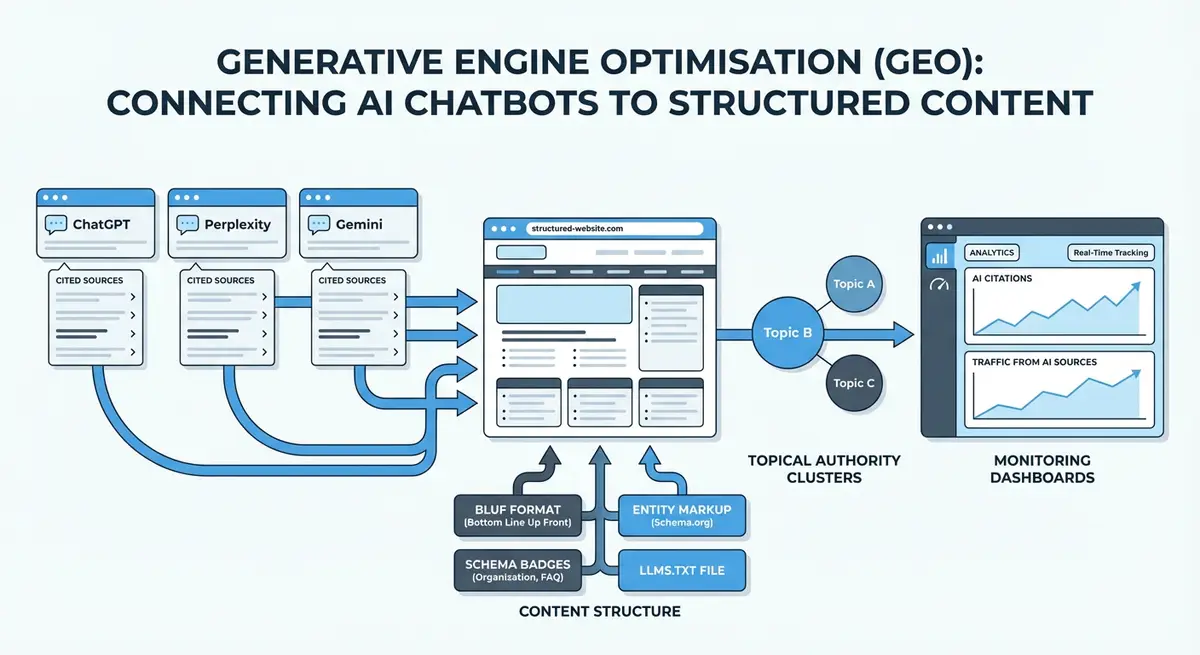
When an AI engine needs to answer a question about Wix SEO, it evaluates potential sources by looking at how comprehensively the source covers the topic. A site with one blog post about Wix SEO will rarely be cited. A site with 30 interconnected pages covering every aspect of Wix SEO, from technical audits to schema markup to local SEO, will be cited repeatedly. AI engines recognise topical clusters and reward depth.
- Coverage breadth: how many aspects of the topic does your site address?
- Coverage depth: how thoroughly does each page cover its specific subtopic?
- Internal linking: do your pages reference and link to each other, demonstrating a connected body of knowledge?
- Original contribution: do you add unique data, experience or perspective that other sources do not?
- Author consistency: does the same credentialled author publish across the topic?
Building Topic Clusters on Wix for GEO
A topic cluster is a group of interconnected pages that comprehensively cover a subject. The structure is a pillar page (broad topic overview) supported by cluster pages (specific subtopics) all interlinked. For GEO, this structure is ideal because AI engines can discover your full body of knowledge on a subject by following internal links from any entry point.
Creating a GEO-optimised topic cluster on Wix
- Choose a core topic your business is an authority on
- Create a pillar page that covers the topic comprehensively (2,000-4,000 words)
- Identify 8-15 subtopics and create a dedicated page for each
- Write each cluster page with BLUF formatting and extractable answers
- Interlink every cluster page to the pillar and to related cluster pages
- Add Article schema to every page with the same author and organization
- Update cluster pages quarterly to maintain freshness signals
Creating Original Data AI Engines Will Cite
AI engines heavily favour content that contains original data, statistics, survey results and proprietary findings. When you publish data that no one else has, AI engines have no choice but to cite you when that data is relevant. This is one of the most powerful GEO strategies available to any business.
- Run a survey of your customers or industry peers and publish the findings
- Analyse your own client data (anonymised) to reveal industry trends
- Create benchmarks: average costs, timelines, success rates in your niche
- Document case study results with specific numbers: "traffic increased 340% in 6 months"
- Compile industry statistics from multiple sources into a single, comprehensive reference page
Expert Commentary and First-Person Experience
The Experience component of E-E-A-T is increasingly important for GEO. AI engines distinguish between content that summarises existing information and content that adds original expert commentary based on real experience. Adding first-person insights, professional opinions and experiential observations to your Wix content makes it more valuable as a citation source.
Cross-Platform Authority
Your authority is not built on your Wix site alone. AI engines assess your authority by looking at your presence across the web: guest articles on industry sites, mentions in press coverage, active profiles on professional networks, contributions to forums and communities, and citations in other people's content. Every authoritative mention of your brand reinforces the entity signals that make AI engines trust you.
Essential Resources
- Google Business Profile Help: Manage your local business listing for AI and traditional search
- Perplexity AI: Test your local business visibility in AI search answers
- Schema.org LocalBusiness: LocalBusiness schema for local entity recognition
- Bing Webmaster Tools: Monitor local visibility for Bing and AI engines
Complete How-To Guide: Building Topical Authority That AI Engines Trust and Cite
This guide covers planning and building topic clusters, creating original data, and establishing the depth of coverage that makes AI engines choose your Wix site as a primary citation source.
How to build topical authority for AI citation on your Wix site
- Step 1: Choose your primary authority topic. This should be the subject where you have the deepest expertise and the strongest business incentive to be cited. For most Wix businesses, this is your core service area.
- Step 2: Map every subtopic within your authority area. List 15-25 specific questions or aspects that someone learning about this topic would want answered. Each becomes a potential cluster page.
- Step 3: Create a pillar page on your Wix site covering the broad topic comprehensively (2,000-4,000 words). Structure it with clear H2 sections addressing each major aspect, with BLUF answers under each heading.
- Step 4: Create 8-15 cluster pages, each addressing a specific subtopic in depth (1,000-2,500 words). Every cluster page should provide a definitive answer to its specific question with data, examples and expert commentary.
- Step 5: Interlink every cluster page to the pillar page and to 2-3 related cluster pages. Use descriptive anchor text that tells both readers and AI engines what the linked page covers.
- Step 6: Add Article schema to every cluster page with the same author Person entity. Consistent authorship across a topic cluster signals to AI engines that one expert comprehensively covers this subject.
- Step 7: Create original data within your topic cluster. Run a survey of your clients, analyse anonymised results data, or compile unique benchmarks. Publish the findings as a dedicated data page within your cluster.
- Step 8: Add first-person expert commentary to every page. Include paragraphs starting with phrases like "In my experience working with 100+ clients..." or "The data from our 2025 client audits shows...". This demonstrates genuine experience.
- Step 9: Reference and link to primary sources within your content. Cite industry reports, academic studies, and authoritative publications. AI engines trust content that demonstrates research rigour.
- Step 10: Update your cluster quarterly. Add new data, update outdated statistics, refresh examples, and add new subtopic pages as the field evolves. Each update strengthens freshness signals.
- Step 11: Build external authority for your topic. Write guest articles about subtopics for industry publications. Get quoted in press as an expert on the topic. Each external mention reinforces your topical authority.
- Step 12: Test and measure. Search your cluster topic and subtopics in ChatGPT and Perplexity monthly. Track how many queries result in citations to your content. Aim to be cited for at least 50% of your target queries within 6 months.
Essential Resources
- Google Search Console: Monitor topical authority signals through keyword impression clusters
- Ahrefs Content Explorer: Research competitor content depth and find topical gaps to fill
- Google Trends: Identify emerging subtopics to expand your topical authority clusters
Was this lesson useful?
It takes 1 minute to tell me. The course is free and I want to keep it that way, and your feedback shows me what is working and helps other people find it.
This lesson on Building topical authority that AI engines trust and cite is part of Module 27: GEO: Generative Engine Optimisation for Wix in The Most Comprehensive Complete Wix SEO Course in the World (2026 Edition). Created by Michael Andrews, a Wix Marketplace Legend Partner with 14 years of hands-on experience, 800 completed Wix SEO projects and 456 verified five-star reviews.