Rankings suddenly dropped: how to diagnose and recover from ranking losses
Module 50: Wix SEO Troubleshooting, Diagnostics & Common Fixes | Lesson 551 of 683 | 62 min read
By Michael Andrews, Wix SEO Expert UK
You check your Google Search Console or rank tracking tool and your heart sinks: your rankings have plummeted overnight. Pages that were ranking on page one are now buried on page three or have disappeared entirely. Traffic is down 30%, 50% or more. A sudden ranking drop is one of the most alarming experiences for any Wix website owner, but panic is your worst enemy. In most cases, ranking drops are diagnosable and recoverable if you follow a systematic approach. This lesson provides a comprehensive diagnostic framework for identifying the exact cause of your ranking loss, specific recovery strategies for every type of ranking drop, realistic timelines for recovery, and a complete playbook you can follow step by step to get your Wix site back on track.

The Six Categories of Ranking Drops
Not all ranking drops are created equal. The cause determines the recovery strategy, the timeline and the effort required. Before you start making changes to your Wix site, you need to identify which category your ranking drop falls into. Making the wrong changes can actually make things worse.
- Google Algorithm Update: A core algorithm update or specific system update (like Helpful Content, Spam Update, Link Spam Update or Reviews Update) has changed how Google evaluates and ranks pages
- Technical Issue: Something broke on your Wix site that is preventing Google from crawling, indexing or rendering your pages correctly
- Content Quality Degradation: Your content has been deemed lower quality, either because it declined or because Google raised its quality standards
- Backlink Profile Changes: You lost important backlinks, gained toxic backlinks or Google devalued links that were previously helping your rankings
- Manual Action: A Google human reviewer has penalised your site for violating webmaster guidelines
- Competitor Improvement: Your competitors improved their sites, content or authority, pushing your pages down in relative rankings
The Ranking Drop Diagnostic Framework
This framework walks you through a systematic investigation to pinpoint the exact cause of your ranking drop. Work through each step in order. Each step is designed to either confirm or eliminate a potential cause.
Phase 1: Establish the Timeline and Scope
Document the drop characteristics
- In Google Search Console, go to Performance and set the date range to the last 6 months. Look for the exact date the drop began. Note whether it was sudden (overnight) or gradual (over days or weeks)
- Check which metrics dropped: clicks, impressions, CTR, average position. A drop in impressions suggests a ranking loss. A drop in clicks with stable impressions suggests a CTR problem
- Filter by page to identify which specific pages lost rankings. Is it a site-wide drop affecting all pages, or is it concentrated on specific pages or sections?
- Filter by query to see which search queries lost performance. Are branded queries affected? Are all queries down or only specific keyword groups?
- Compare desktop versus mobile performance. If the drop is mobile-only, it may be related to a mobile usability issue or mobile-first indexing change
- Check if the drop correlates with any changes you made to your Wix site around the same time (content changes, design changes, domain changes, plugin additions)
Phase 2: Check for Google Algorithm Updates
Google rolls out algorithm updates regularly, and major updates can cause significant ranking fluctuations. If your ranking drop coincides with a known Google algorithm update, that is almost certainly the cause. Knowing which specific update affected you is critical because each update targets different aspects of search quality and requires different recovery strategies.
How to check if a Google algorithm update caused your drop
- Note the exact date your rankings dropped from your GSC Performance report
- Visit the Google Search Status Dashboard (status.search.google.com/summary) and check for any ranking updates around that date
- Check Google SearchLiaison on X (twitter.com/searchliaison) for official announcements about algorithm updates
- Visit SEO news sites like Search Engine Journal, Search Engine Land and Moz Blog to check for reported algorithm updates around your drop date
- Use the Semrush Sensor or Moz Algorithm History tools to see if widespread ranking volatility was detected on the dates matching your drop
- If your drop date matches a confirmed algorithm update, research the specific update to understand what it targets
- Core Updates target overall content quality and E-E-A-T. Helpful Content Updates target unhelpful, AI-generated or thin content. Spam Updates target manipulative practices. Link Updates target unnatural link building
Phase 3: Check for Manual Actions
A manual action is a penalty applied by a human reviewer at Google. Manual actions cause immediate and severe ranking drops or complete deindexing. Fortunately, they are clearly communicated in Google Search Console.
Checking for manual actions
- Log into Google Search Console and select your property
- Navigate to Security & Manual Actions > Manual Actions in the left sidebar
- If you see a green checkmark with "No issues detected", manual actions are not your problem. Move to Phase 4
- If a manual action is listed, read the description carefully. Common types include: Unnatural links to your site, Unnatural links from your site, Thin content with no added value, Pure spam, Cloaked images, Hidden text or keyword stuffing, User-generated spam
- Each manual action type requires a specific remediation approach. Address the violation completely before submitting a reconsideration request
- Manual action recovery typically takes 1-4 weeks after submitting a reconsideration request, assuming you have fully addressed the issue
Phase 4: Technical Audit After a Ranking Drop
Technical issues on your Wix site can cause ranking drops if they prevent Google from properly crawling, indexing or rendering your pages. Even a small technical change can have cascading effects on rankings if it affects how Googlebot interacts with your site.
Technical audit checklist for ranking drops
- In GSC, check the Pages report for any sudden increase in errors or excluded pages around the date of the drop
- Check the Core Web Vitals report for any degradation in page speed metrics (LCP, FID/INP, CLS). A significant performance drop can affect rankings
- Verify your robots.txt at yourdomain.com/robots.txt has not been accidentally modified to block important pages
- Check your sitemap at yourdomain.com/sitemap.xml for any errors or missing pages
- Use the URL Inspection tool on your most affected pages. Check for crawl errors, rendering issues, canonical problems or noindex tags
- Check for redirect issues. If you recently changed URLs on your Wix site, verify that 301 redirects are in place from old URLs to new URLs
- Test your site speed using Google PageSpeed Insights. Compare to previous scores if available. A significant slowdown can impact rankings
- Check for mobile usability issues in GSC under Experience > Mobile Usability. Google uses mobile-first indexing
- Review any recent changes to your Wix site: did you change templates, add new apps, modify custom code, update navigation structure or change URL slugs?
- If you recently migrated to Wix from another platform, verify that all redirects are working and that no pages are returning 404 errors
Content Quality Assessment After a Ranking Drop
Google's quality standards have increased dramatically with the Helpful Content system and successive core updates. Content that ranked well previously may no longer meet the threshold. If your ranking drop coincides with a core update or Helpful Content Update, your content quality is the most likely culprit.
How to assess your Wix site content quality
- Identify the pages that lost the most rankings and traffic in GSC
- For each affected page, ask: Does this page provide substantial, original value? Would an expert in this field consider it comprehensive and accurate?
- Check for signs of thin content: pages under 500 words, pages that only summarise information available elsewhere, pages with excessive filler text
- Evaluate your E-E-A-T signals: Does the content demonstrate first-hand experience? Is the author identified and credible? Does the page cite authoritative sources?
- Check for AI-generated content that was published without significant human editing, enhancement or expert review
- Look for keyword stuffing: excessive repetition of target keywords that makes the content unnatural to read
- Compare your top affected pages against the pages that now outrank you. What do they offer that you do not?
- Use Google's own Search Quality Evaluator Guidelines questions: Is this content created primarily for search engines or for people? Does this content provide substantial value compared to other pages in search results?
Backlink Profile Analysis for Ranking Recovery
Backlinks remain one of Google's strongest ranking signals, so changes to your backlink profile can directly cause ranking drops. You may have lost important links, gained toxic or spammy links, or had previously valuable links devalued by a Google update.
Analysing your backlink profile after a ranking drop
- In Google Search Console, go to Links in the left sidebar. Review your top linking sites and most linked pages
- Compare current link data to previous periods. Have you lost any significant linking domains?
- Use a dedicated backlink tool like Ahrefs, Semrush or Moz to get a more detailed view of your backlink profile
- Check for recently lost backlinks using the Lost Backlinks report in your backlink tool. High-authority links that disappeared could explain ranking drops
- Check for new toxic backlinks. Look for links from spam sites, link farms, PBNs or irrelevant foreign-language sites
- If you find toxic backlinks, use Google's Disavow Tool to disavow them. Create a disavow file listing the domains or URLs to disavow
- If you lost important editorial backlinks, reach out to the linking sites to find out why they removed the link and whether it can be restored
- Evaluate your anchor text distribution. If your anchor text profile looks unnatural (over-optimised with exact-match keywords), it may have triggered a link spam filter
Competitor Surge Analysis
Sometimes your rankings drop not because anything changed on your site, but because competitors improved theirs. Google rankings are relative. If a competitor publishes better content, earns more backlinks or improves their site technically, they can push your pages down even if your site has not changed at all.
How to check if competitors caused your ranking drop
- Search Google for the queries where you lost rankings. Note which pages now rank above you
- Are these the same competitors as before, or have new competitors entered the top results?
- Analyse the pages that replaced yours: Are they more comprehensive? Do they have better content, more media, or more recent updates?
- Check competitor backlink profiles using Ahrefs or Semrush. Have they recently gained significant new backlinks?
- Look at competitor publication dates. Did they recently update or refresh their content while yours remained static?
- Check if competitors have implemented structured data or other rich result features that you lack
- Review whether competitors have better E-E-A-T signals: author bios, credentials, cited sources, original research
Wix-Specific Ranking Drop Causes
Beyond general SEO issues, there are several Wix-specific factors that can cause ranking drops. These are unique to the Wix platform and are often overlooked in standard SEO troubleshooting guides.
- Wix platform updates: Wix regularly updates its infrastructure, which can temporarily affect site performance, rendering or URL handling. Check the Wix Status page and community forums for known issues
- Template or design changes: Switching Wix templates or making major design changes can alter page structure, internal linking, heading hierarchy and content layout in ways that affect rankings
- Wix app additions or removals: Adding heavy apps (especially third-party ones) can slow your site and hurt Core Web Vitals. Removing apps can delete content that was contributing to rankings
- Accidental noindex: Changes to Wix SEO Patterns or individual page SEO settings can accidentally add noindex tags to important pages
- URL slug changes: Editing page URL slugs in Wix without setting up 301 redirects from the old URLs causes 404 errors and lost link equity
- Wix Blog updates: Changes to blog settings, categories or tag structures can alter the URL patterns and internal linking of your blog content
- Domain configuration changes: Switching between www and non-www, changing domain registrars, or modifying DNS settings can cause temporary crawl issues
- Wix Editor to Wix Studio migration: Moving between Wix platforms can change URL structures, page layouts and technical SEO elements
Recovery Strategies by Cause
Recovering from a Google Algorithm Update
Algorithm update recoveries take the longest because they require fundamental improvements to your site rather than quick technical fixes. The key is to understand what the specific update targets and improve accordingly.
- For Core Updates: Focus on improving E-E-A-T across your entire site. Add author bios, credentials, cited sources. Improve content depth and originality. Remove or improve thin, unhelpful pages
- For Helpful Content Updates: Remove or significantly improve content created primarily for search engines. Ensure every page serves genuine user needs. Eliminate AI-generated content without human value-add
- For Spam Updates: Audit for any manipulative practices including hidden text, cloaking, doorway pages, or scraped content. Remove or fix them completely
- For Link Spam Updates: Audit your backlink profile. Disavow toxic links. Stop any active link building that involves paid links, link exchanges or PBNs
- Recovery timeline: Typically you will not recover until the next update of the same type rolls out, which can be 3-6 months. Use this time to make substantial improvements
Recovering from Technical Issues
Technical recoveries are usually the fastest because once the issue is fixed, Google will re-crawl and restore rankings relatively quickly.
- Fix the specific technical issue identified in your audit
- Use the URL Inspection tool to request re-crawling of affected pages
- Submit your sitemap again to GSC to signal a fresh crawl
- Monitor the Pages report for improvements over the next 1-2 weeks
- Recovery timeline: 1-4 weeks for most technical fixes, depending on crawl frequency
Recovering from Content Quality Issues
Content quality recovery requires genuine improvements to your content. Quick fixes and superficial changes will not work.
- Audit and improve or remove every thin or unhelpful page on your site
- Consolidate similar pages into comprehensive, authoritative resources
- Add original research, expert insights, case studies and first-hand experience
- Update outdated information and add fresh data points
- Ensure every page clearly communicates who wrote it and why they are qualified
- Recovery timeline: 2-6 months as Google needs to re-crawl, re-evaluate and build trust in your improved content
Timeline for Ranking Recovery: Setting Realistic Expectations
One of the hardest aspects of ranking recovery is managing expectations. Recovery is rarely instant, and the timeline depends heavily on the cause and the extent of the drop. Here are realistic timelines based on common causes.
- Technical fixes (noindex removal, robots.txt fix, redirect implementation): 1-4 weeks
- Manual action resolution: 2-6 weeks after submitting a reconsideration request
- Lost backlink recovery: 2-8 weeks if links are restored or replaced with equivalent quality links
- Content quality improvements: 2-6 months, often requiring the next core update to see significant movement
- Algorithm update recovery: 3-12 months, typically requiring the next update of the same type
- Complete site overhaul (content + technical + links): 6-12 months for full recovery
- Domain reputation damage: 6-18 months or longer. In severe cases, starting with a new domain may be faster
When to Panic vs When to Wait
Not every ranking fluctuation requires immediate action. Google's rankings fluctuate naturally, and small movements are normal. Here is a guide to help you determine when to act and when to wait.
- Normal fluctuation (no action needed): Positions move 1-3 spots up or down. Traffic varies by 5-15% day to day. Happens consistently across the web
- Monitor closely (wait 1-2 weeks): Positions drop 3-8 spots for some queries. Traffic drops 15-30%. May coincide with a known algorithm update rollout
- Investigate immediately (start diagnostic process): Positions drop 10+ spots. Traffic drops 30-50%. Multiple important pages affected. Drop happens suddenly
- Emergency response (act now): Site completely disappears from Google. Traffic drops 80%+. Manual action notification received. Security issues detected in GSC
Complete How-To Guide: The Full Ranking Recovery Playbook
Follow this complete recovery playbook from start to finish
- Document the drop: Screenshot your GSC Performance report. Note the exact date, affected pages, affected queries, and the magnitude of the drop. Export all data for baseline comparison
- Check for algorithm updates: Visit Google Search Status Dashboard, Google SearchLiaison on X, and SEO news sites to determine if a Google update coincides with your drop date
- Check for manual actions: In GSC, navigate to Security & Manual Actions > Manual Actions. Clear this cause before proceeding to other diagnostics
- Check for security issues: In GSC, navigate to Security & Manual Actions > Security Issues. Address any malware or hacking alerts immediately
- Run a technical audit: Check the Pages report for new errors, verify robots.txt and sitemap, inspect affected pages with URL Inspection, test site speed, and review mobile usability
- Check for Wix-specific issues: Review any recent changes to your Wix site (template changes, app additions, URL slug edits, SEO setting changes). Revert problematic changes if identified
- Audit your backlink profile: Use GSC Links report and a dedicated backlink tool. Check for lost high-quality links and new toxic links. Disavow toxic links if found
- Assess content quality: Review your most affected pages against current top-ranking competitors. Identify gaps in content depth, originality, E-E-A-T signals and user value
- Analyse competitors: Search for your lost queries and study the pages that now outrank you. Identify what they offer that you do not. Note any patterns across multiple competitors
- Implement fixes based on diagnosis: Apply the appropriate recovery strategy for the identified cause. If multiple causes are found, address technical issues first, then content, then links
- Request re-crawling: After implementing fixes, use the URL Inspection tool to request re-indexing of your most important affected pages. Resubmit your sitemap
- Monitor recovery weekly: Check GSC Performance report every week. Track changes in impressions, clicks and average position for your target queries. Document progress in your recovery log
- Adjust strategy if recovery stalls: If you see no improvement after 4-6 weeks (for technical fixes) or 3-4 months (for content and algorithm recovery), reassess your diagnosis and consider hiring a specialist
- Build long-term resilience: After recovery, implement ongoing monitoring, regular content updates, proactive technical audits and continuous authority building to prevent future drops
Essential Ranking Recovery Tools
- Google Search Console: Monitor ranking performance, check for manual actions, diagnose technical issues and track recovery progress
- Google Search Status Dashboard: Check for confirmed Google algorithm updates that may coincide with your ranking drop
- Semrush Sensor: Monitor Google search volatility to determine if ranking fluctuations are widespread or unique to your site
- Ahrefs Site Explorer: Analyse backlink profile changes, lost links, new toxic links and competitor link growth
- Google PageSpeed Insights: Test Core Web Vitals and page performance to identify speed-related ranking issues
- Moz Algorithm History: Historical record of confirmed and suspected Google algorithm updates with descriptions
- Google Disavow Tool: Disavow toxic or spammy backlinks that may be causing ranking penalties
- Wayback Machine: Compare how your pages looked before and after ranking drops to identify content changes that may have triggered the loss
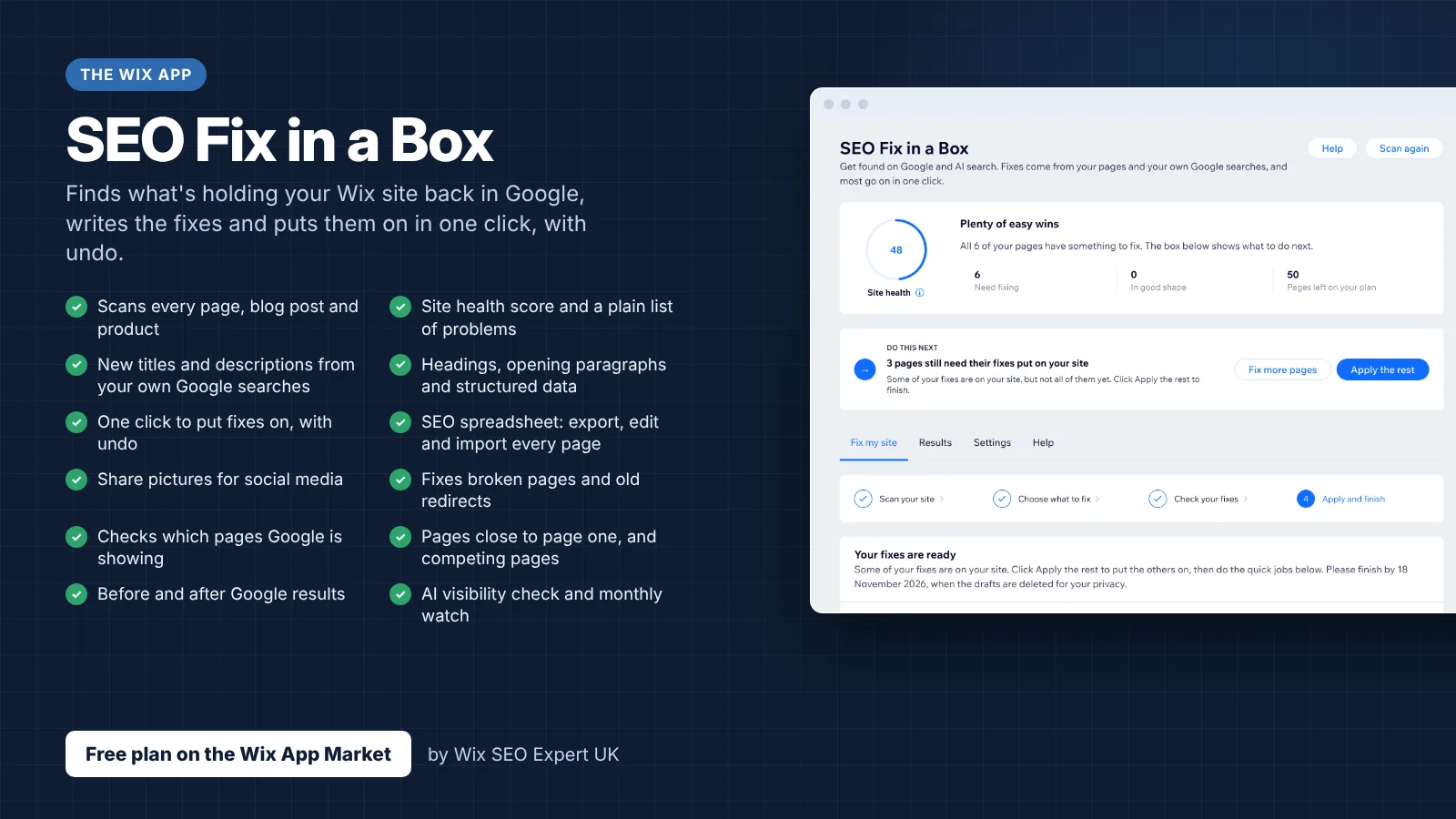
- SEO Fix in a Box: My Wix app. Free to install, it scans your site and shows what needs fixing, and paid plans write the fixes from your own Google searches
Was this lesson useful?
It takes 1 minute to tell me. The course is free and I want to keep it that way, and your feedback shows me what is working and helps other people find it.
This lesson on Rankings suddenly dropped: how to diagnose and recover from ranking losses is part of Module 50: Wix SEO Troubleshooting, Diagnostics & Common Fixes in The Most Comprehensive Complete Wix SEO Course in the World (2026 Edition). Created by Michael Andrews, a Wix Marketplace Legend Partner with 14 years of hands-on experience, 800 completed Wix SEO projects and 456 verified five-star reviews.