Pages not being indexed: identifying and fixing indexing failures on Wix
Module 50: Wix SEO Troubleshooting, Diagnostics & Common Fixes | Lesson 550 of 683 | 55 min read
By Michael Andrews, Wix SEO Expert UK
Your Wix site is in Google, some pages are indexed, but many important pages are stubbornly refusing to appear in search results. You check Google Search Console and see a growing list of pages under "Not indexed" with cryptic status messages like "Discovered - currently not indexed" or "Crawled - currently not indexed". This is one of the most frustrating SEO problems because partial indexing means Google knows about your pages but has actively chosen not to include them. This lesson provides a deep dive into every indexing failure reason in Google Search Console, explains exactly what each status means for Wix sites, and gives you targeted fixes for each specific issue so you can get your important pages indexed and ranking.

Understanding the Google Search Console Pages Report
The Pages report (previously called the Coverage report) in Google Search Console is your primary diagnostic tool for understanding why specific pages are not being indexed. It categorises every URL Google knows about into clear status groups. To access it, log into GSC, select your property, and click Pages in the left sidebar. You will see a chart showing indexed pages over time and a breakdown of why non-indexed pages were excluded.
Every "Page Is Not Indexed" Reason Explained and Fixed
Discovered - Currently Not Indexed
This status means Google has found the URL (usually through your sitemap or internal links) but has not yet crawled it. Google is aware the page exists but has not visited it to read its content. This is common for new pages on sites that Google does not crawl very frequently. It can also indicate that Google considers the page low priority based on signals from the rest of your site.
How to fix "Discovered - currently not indexed" on Wix
- Use the URL Inspection tool in GSC to request indexing of the specific page. This prompts Google to crawl it sooner
- Improve internal linking to the page. Add links from your homepage, navigation menu, sidebar or footer to signal that the page is important
- Ensure the page is included in your XML sitemap (check yourdomain.com/sitemap.xml)
- Add the page URL to your social media profiles and share it on social platforms to create external discovery signals
- Improve the overall crawl frequency of your site by publishing fresh content regularly, which encourages more frequent Googlebot visits
- Check that the page has unique, substantial content that differentiates it from other pages on your site
- Be patient. For newer sites, it can take 2-4 weeks for discovered pages to be crawled. Continue building site authority
Crawled - Currently Not Indexed
This is one of the most frustrating and common statuses. It means Google has visited and read your page but deliberately chose not to include it in the search index. Google crawled the content, evaluated its quality, and decided it did not meet the threshold for inclusion. This is a quality signal, and it usually means the page needs significant improvement before Google will index it.
How to fix "Crawled - currently not indexed" on Wix
- Evaluate the content quality honestly. Is the page thin (fewer than 300 words)? Does it provide unique value? Is it substantially different from other pages on your site and on the web?
- Expand the content significantly. Pages with fewer than 500 words of unique, valuable content rarely get indexed in competitive niches. Aim for 1000+ words of genuinely useful content
- Add unique media: original images, videos, infographics or data tables that add value beyond what text alone provides
- Improve the page title and meta description to clearly communicate the unique value proposition of the page
- Add internal links from high-authority pages on your site (homepage, popular blog posts) to signal that this page matters
- Build external backlinks to the specific page. Even one or two quality links can push Google to reconsider indexing
- Check for duplicate or very similar content on other pages of your site. Consolidate thin pages into comprehensive ones
- After improvements, use the URL Inspection tool to request re-crawling and indexing
Excluded by Noindex Tag
This status means Google found a noindex meta tag on the page and is respecting it by excluding the page from the index. This is working as intended if you deliberately set noindex on the page. If you did not intend to noindex the page, you need to remove the tag.
How to fix accidental noindex on Wix pages
- In the Wix Editor, select the affected page from the Pages panel on the left
- Click the three-dot menu next to the page name and select SEO Settings (or SEO Basics)
- Look for the Advanced SEO section and check the Robots Meta Tag setting
- If it shows noindex, change it to index, follow
- Also check your Wix SEO Patterns if the affected pages are dynamic pages (blog posts, product pages, etc.). Go to Marketing & SEO > SEO Tools > SEO Patterns and verify the pattern does not include noindex
- Publish the changes and then use the URL Inspection tool in GSC to request re-indexing
Blocked by Robots.txt
Google wants to crawl this page but your robots.txt file is preventing it. This is different from noindex: robots.txt blocks crawling entirely, so Google cannot even see the page content. If a page is blocked by robots.txt but Google finds links to it, it may still appear in search results as a URL-only listing with no snippet, which is usually worse than not appearing at all.
Fixing robots.txt blocking on Wix
- Check your robots.txt file at yourdomain.com/robots.txt
- Identify which Disallow rule is blocking the affected URL
- In Wix, go to Marketing & SEO > SEO Tools > Robots.txt Editor
- Remove or modify the Disallow rule that is blocking the page
- If you need to block some pages but not others, use more specific Disallow paths instead of broad rules
- Save and publish the changes. Google will detect the new robots.txt within 24-48 hours
Alternate Page with Proper Canonical Tag
This status means Google considers this page a duplicate of another page, and the canonical tag on this page (or Google's own analysis) points to a different URL as the primary version. Google is indexing the canonical version instead. This is typically correct behaviour for pages like print versions, AMP versions, or parameter-based duplicates. However, if your important pages are being marked as alternates of the wrong canonical, you have a problem.
Diagnosing and fixing canonical issues on Wix
- Use the URL Inspection tool on the affected page. Under Coverage, look at the "Google-selected canonical" field
- Compare the Google-selected canonical to the "User-declared canonical" (the canonical tag you set)
- If they match and both point to the correct preferred URL, this is working correctly. The alternate page does not need to be indexed separately
- If the Google-selected canonical is wrong (pointing to a different page that is not a true duplicate), you need to fix the canonical tag
- In Wix, go to the page's SEO Settings and check the Canonical URL field. Ensure it points to the correct URL or is left blank (which defaults to the page's own URL)
- If Google is incorrectly identifying two different pages as duplicates, differentiate their content significantly to prove they are unique
Duplicate Without User-Selected Canonical
Google has found multiple pages with very similar or identical content and none of them have canonical tags specifying which is the preferred version. Google will pick one version to index and exclude the others. This commonly happens on Wix sites with similar service pages, blog posts covering the same topic, or product pages with minimal differences.
- Identify the groups of duplicate pages. GSC will show which pages are affected
- Decide which page in each group should be the canonical (primary) version
- Add explicit canonical tags to the non-preferred versions pointing to the preferred version
- Alternatively, differentiate the content so the pages are no longer considered duplicates
- For Wix blog tag and category pages that generate duplicates, consider noindexing the less valuable archive pages
- Consolidate truly duplicate pages by redirecting the inferior version to the superior one using Wix URL Redirects
Soft 404
A soft 404 means Google visited the page, found it returned a 200 (OK) HTTP status code, but the content appeared to be an error page or extremely thin page that should have been a 404. This happens on Wix when dynamic pages have empty content, when database-driven pages have no data to display, or when pages have so little content that Google considers them effectively empty.
Fixing soft 404 errors on Wix
- Visit the affected URLs yourself and check what content is actually displayed
- If the pages are genuinely empty or have placeholder content, either add substantial content or delete the pages
- For Wix dynamic pages (like blog categories with no posts), add content to the pages or set them to noindex until they have sufficient content
- If the pages are product pages with no products, consider hiding them until products are added
- For pages that should be proper 404s, delete them in Wix so they return a true 404 status code
- After fixing, use the URL Inspection tool to request re-crawling of the affected pages
Thin Content: The Hidden Indexing Killer on Wix
Thin content is one of the most common reasons Wix pages fail to get indexed, and it is also one of the hardest for site owners to recognise because they believe their pages have enough content. From Google's perspective, a page needs to provide substantial, unique value to justify inclusion in the search index. With billions of pages competing for index space, Google is increasingly selective about what it indexes.
- Pages with fewer than 300 words of body text are at high risk of being considered thin
- Pages that primarily consist of images with no descriptive text or alt text lack indexable content
- Pages that repeat the same information found on other pages of your site are treated as duplicates
- Wix blog posts that are just a few sentences with a single image rarely get indexed in competitive niches
- Service pages that only list services without detailed descriptions, pricing, FAQs or case studies are often too thin
- Wix Stores product pages with only a title, price and one-line description need much more content to compete
Canonical Tag Issues Specific to Wix
Canonical tags tell Google which version of a page is the authoritative one when multiple URLs serve similar or identical content. Wix handles canonical tags automatically for most pages, but issues can arise with dynamic pages, URL parameters, and custom configurations. Understanding how Wix manages canonicals is essential for diagnosing indexing failures.
- Wix automatically adds self-referencing canonical tags to all pages by default, which is the correct behaviour
- Dynamic pages (Wix blog posts, Wix Stores products) receive canonical tags based on their URL pattern
- If you manually set a canonical URL in the page SEO settings that points to a different page, that page will not be indexed
- URL parameters added by tracking codes or filters can create duplicate URLs. Wix usually handles these correctly with canonicals
- The www versus non-www version of your site should resolve to the same canonical. Check your Wix domain settings
- If you migrated from another platform and changed URL structures, old URLs without proper redirects may create canonical conflicts
Wix Blog Tag and Category Page Indexing Issues
Wix blogs automatically generate tag pages and category pages for every tag and category you create. While these pages can be useful for site navigation, they often create indexing problems because they tend to have thin content (just a list of post titles with excerpts), they duplicate content that already exists on the main blog page, and when you have many tags they can massively inflate the number of low-quality pages Google discovers on your site.
Managing Wix blog archive page indexing
- Audit your Wix blog tags. If you have dozens of tags with only 1-2 posts each, consolidate them into fewer, broader tags
- Consider noindexing tag pages that have fewer than 5 posts. These pages add little search value
- Keep category pages indexed only if they have unique introductory text and enough posts to provide value
- Add unique descriptive content at the top of category pages using the Wix Blog category description feature
- In Wix SEO Patterns, you can set default noindex for blog tag pages while keeping blog post pages indexed
- Monitor the ratio of indexed pages to total pages in GSC. If you have more tag/category pages indexed than actual content pages, you have a problem
Forcing Re-Indexing with the URL Inspection Tool
The URL Inspection tool in Google Search Console is your most direct way to communicate with Google about specific pages. It allows you to see exactly how Google views a page, check its indexing status, and request that Google re-crawl and re-index it. While it does not guarantee indexing, it is the fastest way to get Google to reconsider a page you have improved.
How to use URL Inspection effectively
- In GSC, click the URL Inspection search bar at the top and paste the full URL of the page you want inspected
- Wait for the results to load. Review the indexing status, crawl date, canonical URL, and any detected issues
- If the page has been crawled before, click Test Live URL to force a fresh crawl and see the current state
- Compare the rendered screenshot to your actual page to check for rendering differences
- If everything looks correct and you want Google to re-process the page, click Request Indexing
- You can submit up to approximately 10-12 individual URL indexing requests per day per property. Use them strategically on your most important pages
- After requesting indexing, it typically takes 1-7 days for Google to process the request. Do not resubmit during this period
Bulk Indexing Strategies for Wix Sites
When you have many pages that need to be indexed or re-indexed, submitting them one by one through URL Inspection is impractical. Instead, use these bulk strategies to accelerate indexing across your entire Wix site.
- Ensure all target pages are in your XML sitemap and that the sitemap is submitted in GSC. When you update pages, Wix automatically updates the lastmod date in the sitemap, signalling Google to re-crawl
- Build a comprehensive internal linking structure. Create hub pages that link to all related content pages, making it easy for Googlebot to discover and follow links to every page
- Use the Google Indexing API for eligible content types (job postings, live streaming, product pages with merchant centre). This provides near-instant indexing
- Share batches of page URLs on social media platforms to generate crawl signals from external sources
- Create a blog post or news page that links to all the pages you want indexed. Google often crawls linked pages when it crawls the linking page
- Submit your sitemap to Bing Webmaster Tools as well. Bing's crawling can indirectly encourage Google to revisit pages through shared crawl data partnerships
- Use Google's ping mechanism by accessing the URL: google.com/ping?sitemap=https://yourdomain.com/sitemap.xml after sitemap updates
When to Use Noindex Intentionally on Wix
Not every page on your Wix site should be indexed. In fact, strategically noindexing low-value pages can improve the indexing of your high-value pages by focusing Google's crawl budget on content that matters. Here are the pages you should typically noindex on a Wix site.
- Thank-you pages and form confirmation pages that provide no search value
- Login and member-area pages that require authentication to be useful
- Blog tag pages with fewer than 5 posts of substantial content
- Duplicate archive pages that rehash content already available on the main blog feed
- Utility pages like terms of service and privacy policy (unless they target specific keywords)
- Internal search result pages generated by Wix site search
- Test pages, draft pages and staging content that should not appear in search results
- Parameter-heavy filter pages on Wix Stores that create thin duplicate content
Complete How-To Guide: Fixing All Indexing Failures on Your Wix Site
Follow this systematic process to identify and fix every indexing failure
- Log into Google Search Console and navigate to the Pages report. Click on Not Indexed to see the full breakdown of why pages are excluded from Google's index
- Export the complete list of not-indexed pages by clicking the Export button. Open in a spreadsheet and sort by reason. This gives you a prioritised list of issues to fix
- For each reason category, count the affected URLs and prioritise: focus first on reasons affecting your most important pages (service pages, product pages, key blog posts)
- For "Discovered - currently not indexed" pages: request indexing via URL Inspection, improve internal linking, and ensure the pages are in your sitemap. These pages just need a crawl nudge
- For "Crawled - currently not indexed" pages: this is a quality issue. Open each affected page and honestly assess whether it provides unique, substantial value. Expand thin content to 1000+ words, add unique media, improve titles and descriptions, and build internal links from authoritative pages
- For "Excluded by noindex tag" pages: determine whether the noindex is intentional. If not, remove it through Wix page SEO settings or SEO Patterns. If intentional, no action needed
- For "Blocked by robots.txt" pages: edit your robots.txt in Wix SEO Tools to remove the blocking directive for pages you want indexed
- For "Alternate page with proper canonical" pages: verify the canonical is correct using URL Inspection. If the wrong page is being treated as the canonical, fix the canonical tag in Wix SEO settings
- For "Duplicate without user-selected canonical" pages: add explicit canonical tags to your preferred versions and differentiate duplicate content or consolidate with 301 redirects
- For "Soft 404" pages: add substantial content to empty or near-empty pages, or delete pages that serve no purpose and should return actual 404 errors
- After fixing each batch of issues, use the Validate Fix button in GSC for each reason category. This tells Google to re-check the affected pages over the coming weeks
- Create a monitoring schedule: check the Pages report weekly for the first month after fixes, then monthly. Track the ratio of indexed to not-indexed pages over time
- For ongoing maintenance, audit all new pages before publishing to ensure they have sufficient content, correct canonical tags and no accidental noindex settings
- Review your blog tag and category page strategy quarterly. Remove unused tags, consolidate thin ones and ensure archive pages add genuine value
Essential Indexing Tools
- Google Search Console Pages Report: The primary tool for diagnosing page-level indexing failures and tracking indexing progress over time
- Google URL Inspection Tool: Inspect individual URLs to see how Google views them, check canonical tags and request re-indexing
- Screaming Frog SEO Spider: Crawl your Wix site to identify thin content, duplicate pages, missing canonical tags and noindex issues
- Sitebulb: Visual website crawler that identifies indexing issues, internal linking gaps and content quality problems
- Google Indexing API: For eligible content types, submit URLs directly to Google for near-instant indexing
- Bing Webmaster Tools: Submit your sitemap to Bing for additional search engine coverage and indirect crawl signals
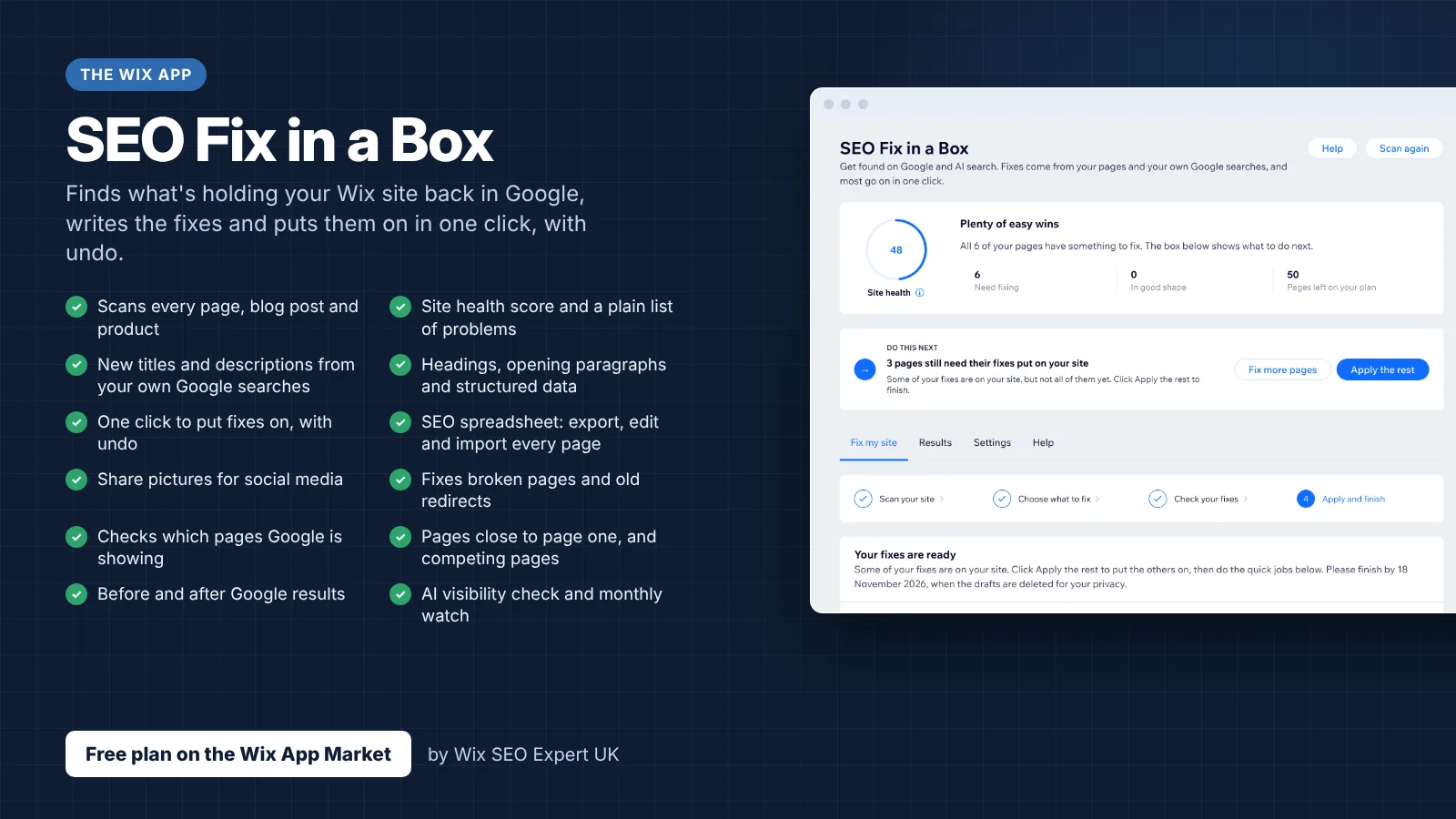
- SEO Fix in a Box: My Wix app. Free to install, it scans your site and shows what needs fixing, and paid plans write the fixes from your own Google searches
Was this lesson useful?
It takes 1 minute to tell me. The course is free and I want to keep it that way, and your feedback shows me what is working and helps other people find it.
This lesson on Pages not being indexed: identifying and fixing indexing failures on Wix is part of Module 50: Wix SEO Troubleshooting, Diagnostics & Common Fixes in The Most Comprehensive Complete Wix SEO Course in the World (2026 Edition). Created by Michael Andrews, a Wix Marketplace Legend Partner with 14 years of hands-on experience, 800 completed Wix SEO projects and 456 verified five-star reviews.