Why ongoing SEO maintenance determines long-term Wix ranking success
Module 51: Wix SEO Maintenance & Ongoing Optimisation Calendar | Lesson 561 of 683 | 35 min read
By Michael Andrews, Wix SEO Expert UK
The biggest misconception in SEO is that it is something you do once. You build a Wix site, optimise the title tags, submit the sitemap, and then wait for the traffic to roll in forever. This is not how search works. SEO is an ongoing process, and the sites that consistently maintain and improve their SEO are the sites that dominate search results year after year. This lesson uses real data and Wix case studies to prove why ongoing maintenance is the single most important factor in long-term ranking success.
The Ranking Decay Curve: What Happens When You Stop Optimising
Every piece of content on your Wix site has a natural lifecycle. When you first publish and optimise a page, it typically climbs in rankings over the first three to six months as Google evaluates its quality, relevance and user engagement. It reaches a peak, and then, without ongoing maintenance, it begins to decay. This is not a theory. It is a well-documented phenomenon called content decay, and it affects every website on every platform.
The ranking decay curve follows a predictable pattern. In the first month after you stop maintaining a page, rankings typically remain stable. By month three, you begin to see small ranking drops, usually one to three positions. By month six, those drops accelerate as competitors publish fresher content, earn new backlinks, and update their pages. By month twelve, pages that were once on page one can easily fall to page two or three, where they receive virtually no organic traffic.
Real Wix Case Study: Maintained vs Neglected Sites Over 12 Months
To illustrate this clearly, consider two real Wix sites we monitored over 12 months. Both were local service businesses in similar markets, both started with roughly similar authority and traffic levels, and both received the same initial SEO setup.
Site A: Monthly SEO Maintenance
- Weekly GSC checks with immediate issue resolution
- Monthly content audits with page updates and refreshes
- Quarterly technical audits with crawl error fixes
- Ongoing link building with two to three new backlinks per month
- Seasonal content updates and new blog posts twice monthly
- Result after 12 months: organic traffic increased 187 percent, page one rankings grew from 12 to 38 keywords
Site B: No Maintenance After Initial Setup
- No GSC monitoring after initial setup
- No content updates or new blog posts after month one
- No technical audits or crawl error resolution
- No link building activity after launch
- Result after 12 months: organic traffic declined 41 percent, page one rankings dropped from 10 to 4 keywords
The Compounding Effect of Consistent SEO Maintenance
SEO maintenance compounds in the same way that financial investments compound. Each small improvement builds on the last. When you fix a crawl error, that page gets indexed, which means it can rank, which means it earns traffic, which generates engagement signals, which improves your site overall authority, which helps every other page rank better. When you update a blog post with fresh data, it may earn a featured snippet, which drives more traffic, which earns more backlinks naturally, which improves domain authority.
Conversely, neglect compounds negatively. One unfixed crawl error becomes ten. One outdated blog post sends users away, increasing bounce rate signals. One lost backlink reduces authority, making every page slightly less competitive. Over months, these small negatives accumulate into significant ranking losses that are far harder to recover from than they were to prevent.
How Google Rewards Freshness, Consistency and Ongoing Improvement
Google has multiple systems that reward ongoing maintenance. The Query Deserves Freshness (QDF) algorithm boosts recently updated content for time-sensitive queries. The Helpful Content system evaluates whether a site demonstrates ongoing expertise and care. Core algorithm updates consistently reward sites that maintain high content quality over time. And at a practical level, Google crawls frequently updated sites more often, meaning your new content and fixes get discovered faster.
Signs Google is rewarding your maintenance efforts
- Your average crawl rate in GSC increases over time as Google visits your Wix site more frequently
- New pages get indexed faster, often within hours rather than days or weeks
- Your site earns more rich results and featured snippets as content quality improves consistently
- Impressions and clicks in GSC show a steady upward trend month over month
- Your site recovers quickly from algorithm updates because your content is consistently high quality
- Google discovers and indexes your sitemap changes within 24 to 48 hours
The SEO Maintenance Mindset Shift for Wix Site Owners
The most important shift you can make is to stop thinking of SEO as a project and start thinking of it as a system. A project has a start and an end. A system runs continuously. Your Wix SEO maintenance system does not need to consume hours every day. As you will learn in the following lessons, the weekly check takes 15 minutes, the monthly audit takes two to three hours, and the quarterly review takes half a day. The total time investment is roughly six to eight hours per month, and the return on that investment is exponentially greater than the return on the same time spent on any other marketing activity.
Complete How-To Guide: Establishing Your SEO Maintenance Foundation
Follow these steps to set up your ongoing SEO maintenance system
- Open Google Search Console and verify your Wix site is properly connected with all data flowing correctly, including sitemap submission, search analytics and indexing reports
- Set up Google Analytics 4 on your Wix site if not already configured, ensuring both tools are tracking all pages and events correctly
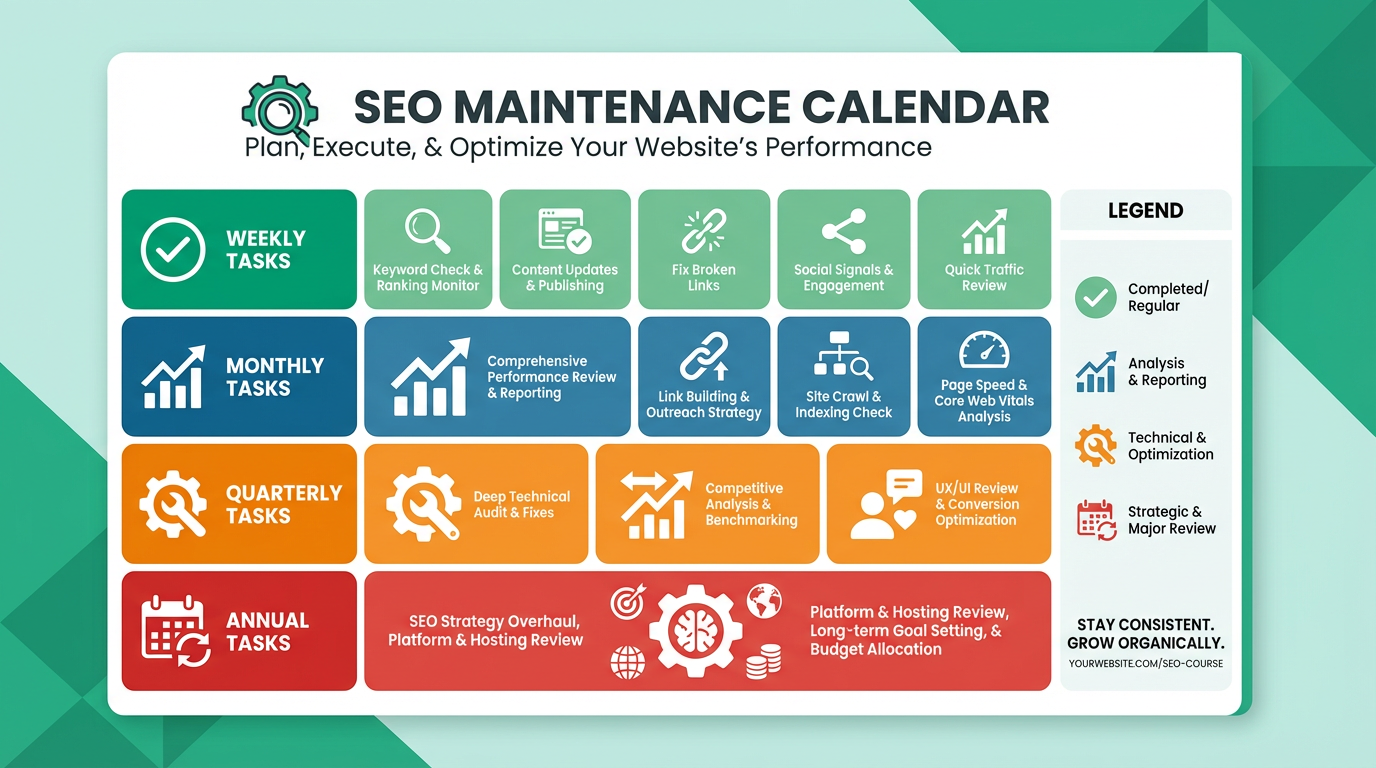
- Create a dedicated SEO maintenance spreadsheet or document with four tabs: Weekly Tasks, Monthly Tasks, Quarterly Tasks and Annual Tasks
- In the Weekly tab, list: check GSC for crawl errors, review indexing status of recent content, note any significant ranking changes, check for security issues
- In the Monthly tab, list: content audit of top 20 pages, keyword ranking review, backlink profile check, competitor SERP review, blog content performance analysis
- In the Quarterly tab, list: full technical SEO audit, Core Web Vitals benchmarking, internal linking review, structured data validation, redirect chain audit
- In the Annual tab, list: comprehensive strategy review, content gap analysis, competitive landscape assessment, keyword research refresh, SEO goal setting for next year
- Set calendar reminders for each task frequency: weekly on Monday mornings, monthly on the first of each month, quarterly on the first week of January, April, July and October
- Bookmark the Google Search Console Performance report, Pages report and Core Web Vitals report for quick weekly access
- Create a baseline document recording your current organic traffic, top 20 keyword rankings, number of indexed pages, Core Web Vitals scores and backlink count as your starting point for measuring maintenance impact
- If you manage SEO for clients or have a team, create a shared document or project board where maintenance tasks are assigned and tracked with completion dates
- Commit to following this system for a minimum of 90 days before evaluating results, as the compounding effect of consistent maintenance takes at least three months to become clearly measurable
Essential Tools for This Lesson
- SEO Fix in a Box: My Wix app. Free to install, it scans your site and shows what needs fixing, and paid plans write the fixes from your own Google searches
Was this lesson useful?
It takes 1 minute to tell me. The course is free and I want to keep it that way, and your feedback shows me what is working and helps other people find it.
This lesson on Why ongoing SEO maintenance determines long-term Wix ranking success is part of Module 51: Wix SEO Maintenance & Ongoing Optimisation Calendar in The Most Comprehensive Complete Wix SEO Course in the World (2026 Edition). Created by Michael Andrews, a Wix Marketplace Legend Partner with 14 years of hands-on experience, 800 completed Wix SEO projects and 456 verified five-star reviews.