SERP feature analysis: stealing featured snippets, People Also Ask and Knowledge Panels
Module 23: Competitor Analysis & Competitive SEO Strategy for Wix | Lesson 285 of 683 | 60 min read
By Michael Andrews, Wix SEO Expert UK
SERP features, the special result types that appear alongside traditional blue links in Google search results, now occupy more than 65% of all Google searches. Featured snippets, People Also Ask boxes, Knowledge Panels, local packs, image packs, video carousels, and sitelinks represent massive opportunities for Wix site owners to dominate search results beyond standard organic rankings. This lesson teaches you how to systematically analyse which SERP features appear for your target keywords, identify which competitors currently own those features, reverse-engineer the exact content formats that win them, and implement proven strategies to steal SERP features from competitors using your Wix site.

Understanding Every SERP Feature Type
Before you can steal SERP features from competitors, you need to understand every type of special result that Google displays. Each SERP feature has different triggering criteria, different content format requirements, and different levels of value for your Wix site. Here is a comprehensive breakdown of every major SERP feature you should be targeting.
- Featured Snippets (Position 0): Extracted answers displayed in a prominent box above the first organic result. Types include paragraph snippets (40-60 words answering a question), list snippets (ordered or unordered lists), table snippets (data comparisons), and video snippets (YouTube clips with timestamp markers).
- People Also Ask (PAA): Expandable question-and-answer boxes that appear for most informational queries. Clicking one question loads more questions, creating an infinite expansion of related queries.
- Knowledge Panels: Information boxes appearing on the right side of desktop results (or top of mobile) for entities Google has mapped in its Knowledge Graph, including businesses, people, organisations, places, and concepts.
- Local Pack (Map Pack): The three-listing map result that appears for queries with local intent, showing Google Business Profile listings with ratings, addresses, and phone numbers.
- Image Pack: A horizontal row of images that appears within organic results for queries where visual content is relevant.
- Video Carousel: A horizontal scrollable row of video results, primarily from YouTube, appearing for queries where video content is relevant.
- Sitelinks: Additional sub-page links displayed beneath a main organic result, typically for branded queries, showing the site's most important pages.
- Top Stories: A carousel of recent news articles from Google News-indexed publications.
- Shopping Results: Product listing ads and free shopping listings displaying prices, images, and merchant information.
- FAQ Rich Results (discontinued May 2026): Previously showed expandable FAQ dropdowns within organic listings. Google no longer shows FAQ rich results, and says no special schema is needed to appear in AI Overviews.
Featured Snippet Types: Paragraph, List, Table and Video
Featured snippets are the most valuable SERP feature for informational queries. They appear above all organic results in what is often called "Position 0" and can capture 8-12% of all clicks for a given query. Understanding the four types of featured snippets and when Google chooses each type is essential for targeting them effectively.
Paragraph Featured Snippets
Paragraph snippets are the most common type, accounting for approximately 70% of all featured snippets. Google extracts a block of text, typically 40-60 words, that directly answers a specific question. These are triggered by queries beginning with "what is", "why does", "how does", and similar question formats. The key to winning paragraph snippets is to provide a concise, authoritative, direct answer to the question within your content, ideally immediately after an H2 or H3 heading that matches the question.
List Featured Snippets
List snippets appear as either ordered (numbered) or unordered (bulleted) lists. Ordered lists are triggered by queries involving processes, rankings, or sequential steps such as "how to", "steps to", "best ways to". Unordered lists appear for non-sequential collections like "types of", "examples of", "features of". Google either extracts an existing HTML list from your page or assembles a list from your H2/H3 headings. To win list snippets, format your content with clear HTML list markup or use descriptive H2/H3 headings that Google can compile into a list.
Table Featured Snippets
Table snippets display structured data in rows and columns, typically triggered by comparison queries, pricing queries, or data-focused questions. Google extracts HTML table elements from your page and may even reformat them. To win table snippets, include well-structured HTML tables on your Wix pages with clear column headers and relevant data. Comparison tables, pricing tables, and specification tables are the most common winners.
Video Featured Snippets
Video snippets embed a YouTube video directly in the featured snippet position, often with a specific timestamp highlighting the relevant section. These are triggered by "how to" queries where video content is particularly useful. To win video snippets, create YouTube videos optimised for your target keywords with clear chapter markers and timestamps in the description.
How to Identify Which Competitors Own Featured Snippets
Before you can steal a featured snippet, you need to know which competitor currently owns it and what content format they used to win it. This analysis should be performed systematically across all your target keywords.
Mapping featured snippet ownership
- Open your target keyword list in a spreadsheet and add columns for: Featured Snippet Present (Yes/No), Snippet Type (Paragraph/List/Table/Video), Current Snippet Owner (URL), Snippet Content (exact text extracted).
- Search each keyword in Google (use incognito mode to avoid personalisation bias) and check whether a featured snippet appears.
- For each featured snippet, record the owning URL, snippet type, and copy the exact snippet content into your spreadsheet.
- Use Ahrefs Site Explorer to scale this analysis: enter your domain, go to Organic Keywords, and filter by "SERP Features > Featured Snippet". This shows all keywords where you rank and a featured snippet exists.
- In Semrush, use the Position Tracking tool to monitor featured snippet ownership across your keyword set over time.
- Identify patterns: Are featured snippets in your niche predominantly paragraph, list, or table format? Do certain competitors win snippets more frequently than others?
- Prioritise keywords where you already rank in positions 1-5 and a competitor owns the featured snippet. These are your highest-probability stealing opportunities.
- Note keywords where no featured snippet currently exists but the query format suggests one could appear (question-based queries). These are opportunity gaps.
Reverse-Engineering Featured Snippet Content Format
Once you have identified the featured snippets you want to target, the next step is reverse-engineering the exact content format that Google is pulling from the current snippet owner. This analysis reveals the precise structure, word count, and formatting that Google rewards.
Reverse-engineering a featured snippet
- Copy the exact featured snippet text displayed in Google.
- Visit the owning URL and find the exact location of the snippet text on the page. Use Ctrl+F to search for the first sentence.
- Analyse the HTML structure around the snippet text: Is it in a <p> tag immediately after an H2? Is it in an <ol> or <ul> list? Is it in a <table>?
- For paragraph snippets: Count the exact word count of the extracted text. Note the heading that precedes it. Check if the heading is phrased as a question matching the search query.
- For list snippets: Count the number of list items. Note whether the list is ordered or unordered. Check if items are H2/H3 headings compiled by Google or actual HTML list items.
- For table snippets: Note the number of columns and rows. Check column header text. Note what data type is in each cell.
- Determine the "snippet trigger": the specific heading, question format, or content structure that caused Google to select this text.
- Create a template for your own content that matches the winning format: same HTML structure, similar word count, more comprehensive and authoritative answer.
People Also Ask Optimisation Strategy
People Also Ask (PAA) boxes appear in approximately 65% of all Google searches and represent an enormous traffic opportunity. Each PAA question expands to show a short answer extracted from a webpage, with a link to the source page. Winning PAA placements drives incremental traffic on top of your organic ranking position and dramatically increases your brand visibility for related queries.
Optimising for People Also Ask
- Search your primary keyword and record all PAA questions that appear. Click each question to expand it and trigger more questions. Record up to 20-30 questions.
- Use AlsoAsked.com to systematically map the complete PAA question tree for your keyword. This tool visualises how PAA questions branch and expand.
- For each PAA question, note the current source URL that Google is pulling the answer from.
- Create an FAQ section on your Wix page that directly answers the top 10-15 PAA questions. Use each PAA question as an H3 heading followed by a concise 40-60 word answer paragraph.
- Implement FAQPage schema markup for your FAQ section. This serves double duty: it helps you win PAA placements and feeds AI systems like Google AI Overviews with structured Q&A pairs for citation.
- Ensure your answer is more concise, accurate, and authoritative than the current PAA source. Google will replace the current source with a better answer.
- Include the question in your heading verbatim. Google matches PAA answers to content with headings that closely match the question.
- Place your FAQ section after your main content but before your conclusion. This gives it enough page authority context while keeping it accessible.
FAQ Schema for PAA Dominance
FAQPage schema markup is one of the most powerful tools for winning PAA placements and improving AI citation visibility. When properly implemented on your Wix site, FAQ schema tells Google exactly which questions your page answers and provides the answer text in a structured format that AI systems can easily extract and cite.
Implementing FAQ schema on Wix for PAA targeting
- Write your FAQ section with 5-15 questions and answers directly on your Wix page. Use the H3 tag for each question and a paragraph for each answer.
- Create JSON-LD FAQPage schema markup that mirrors your on-page FAQ content exactly. Each question-answer pair becomes a "mainEntity" item.
- In Wix, navigate to your page's SEO settings. Under "Advanced SEO", you can add custom structured data in JSON-LD format.
- Paste your FAQPage schema markup into the structured data field.
- Validate your schema at search.google.com/test/rich-results to ensure there are no errors.
- Ensure the question text in your schema exactly matches the question text visible on your page. Mismatches can result in a manual action.
- Monitor PAA appearances for your target keywords, and check any FAQ schema in the Schema Markup Validator. You should see improvements in AI citation visibility within 1-4 weeks of proper implementation.
- Expand your FAQ section over time by adding new PAA questions as they emerge for your target keywords.
{
  "@context": "https://schema.org",
  "@type": "FAQPage",
  "mainEntity": [
    {
      "@type": "Question",
      "name": "What is competitor analysis in SEO?",
      "acceptedAnswer": {
        "@type": "Answer",
        "text": "Competitor analysis in SEO is the process of evaluating competing websites to understand their search engine optimisation strategies, identify their strengths and weaknesses, and discover opportunities to outperform them in search results."
      }
    },
    {
      "@type": "Question",
      "name": "How do I find my SEO competitors?",
      "acceptedAnswer": {
        "@type": "Answer",
        "text": "Find your SEO competitors by searching your primary keywords in Google and identifying which domains repeatedly appear in the top 10 results. Use tools like Ahrefs or Semrush to identify domains competing for the same keyword set."
      }
    }
  ]
}
Knowledge Panel Acquisition Strategy
Knowledge Panels are the information boxes that appear on the right side of Google search results for recognised entities, including businesses, people, organisations, and brands. Having a Knowledge Panel is a powerful trust signal and significantly increases brand visibility in search results. While Google automatically generates Knowledge Panels based on its understanding of entities, you can influence and accelerate the process.
Working towards a Knowledge Panel for your brand
- Establish your entity in Google's Knowledge Graph by ensuring consistent NAP (Name, Address, Phone) information across your Wix site, Google Business Profile, social media profiles, and all directory listings.
- Claim and fully optimise your Google Business Profile with complete business information, photos, posts, and reviews.
- Create a comprehensive About page on your Wix site with detailed information about your business, founder, history, and credentials.
- Implement Organization or LocalBusiness schema markup on your Wix site that matches your Google Business Profile data exactly.
- Build a Wikipedia page for your business if you meet notability criteria. Wikipedia is one of Google's primary Knowledge Graph sources.
- Create and optimise a Wikidata entry for your business at wikidata.org. This is easier to achieve than Wikipedia and feeds directly into Google's Knowledge Graph.
- Ensure your brand appears on authoritative third-party sources: industry publications, news articles, professional directories, and government databases.
- Use the "sameAs" property in your Organization schema to link your Wix site to all official social profiles and authoritative mentions.
- Once a Knowledge Panel appears, claim it via the Google Knowledge Panel verification process to suggest edits and corrections.
Local Pack Optimisation vs Competitors
For businesses with a physical location or service area, the local pack (map pack) is often the most valuable SERP feature, appearing above organic results for local-intent queries. Analysing how competitors perform in the local pack and implementing targeted optimisations on your Wix site and Google Business Profile can help you claim a top-three local pack position.
- Analyse which competitors appear in the local pack for your target local keywords. Note their review count, average rating, and listing completeness.
- Compare Google Business Profile optimisation: categories, attributes, business description keyword usage, photo count, post frequency, and Q&A section completeness.
- Check competitor review velocity: How many new reviews are they earning per month? Set a target to match or exceed this pace.
- Evaluate NAP consistency: Use a tool like BrightLocal or Moz Local to check your NAP consistency versus competitors across directories.
- Compare proximity, relevance, and prominence signals. While you cannot change your location (proximity), you can strengthen relevance through keyword optimisation and prominence through reviews and citations.
- Ensure your Wix site includes location-specific content, embedded Google Maps, local schema markup, and a dedicated location page that reinforces your Google Business Profile signals.
- Implement LocalBusiness schema on your Wix site that exactly matches your GBP information.
Image Pack Targeting Strategy
Image packs appear in approximately 22% of Google searches and are triggered by queries where visual content is relevant. For many industries including design, real estate, fashion, food, travel, and home improvement, image pack rankings drive significant traffic through Google Images.
- Identify which of your target keywords trigger image packs by searching each keyword and checking for the image results block.
- Analyse competitor images appearing in the pack: Are they original photos, infographics, screenshots, or stock images?
- Note the image dimensions and aspect ratios of images appearing in the pack. Google tends to prefer landscape-oriented images for image packs.
- Check the alt text and surrounding context of competitor images that appear in image packs.
- Create high-quality original images for your Wix site that target image pack keywords. Infographics, branded diagrams, and original photography perform best.
- Optimise image alt text to include target keywords naturally. In Wix, click any image and use the settings panel to add alt text.
- Use descriptive file names for images before uploading to Wix. Name files like "competitor-analysis-process-diagram.jpg" rather than "image1.jpg".
- Surround images with relevant contextual content including keyword-rich captions and descriptive paragraphs.
Video Carousel Opportunities
Video carousels appear for approximately 20% of all Google searches and are almost exclusively sourced from YouTube. For Wix site owners, creating YouTube content that targets video carousel keywords is a powerful way to gain additional SERP visibility alongside your organic listing.
Targeting video carousel placements
- Identify which of your target keywords trigger video carousels by searching each keyword and looking for the video results section.
- Record the titles, channel names, and video durations of videos appearing in the carousel for each keyword.
- Analyse patterns: Are carousel videos tutorials, reviews, interviews, or explainers? What is the average video duration?
- Create YouTube videos targeting these keywords. Optimise video titles to include the target keyword, write keyword-rich descriptions of 200+ words, and add relevant tags.
- Add timestamps and chapters to your YouTube videos. Google uses these to create "Key Moments" in video carousel results and video featured snippets.
- Embed your YouTube videos on relevant Wix pages using the Video element. This creates a connection between your YouTube content and your Wix site.
- Add VideoObject schema markup to your Wix pages where you embed videos. This helps Google understand the video content and may trigger video rich results for your organic listing.
- Build YouTube channel authority by publishing consistently. Channels with higher authority are more likely to appear in video carousels.
Sitelinks Optimisation for Brand Queries
Sitelinks are the additional sub-page links that appear beneath your main organic listing for branded queries. They are generated automatically by Google based on your site's structure and cannot be directly controlled, but you can influence which pages appear through site architecture and optimisation.
- Check your current sitelinks by searching your exact brand name in Google. Note which pages appear as sitelinks.
- Compare against competitor sitelinks: How many sitelinks do competitors have? Which pages do they feature?
- To influence sitelinks, ensure your Wix site has a clear, logical navigation structure with the most important pages in your main menu.
- Use descriptive page names and title tags for pages you want to appear as sitelinks.
- Build strong internal linking to the pages you want featured as sitelinks. Pages with more internal links are more likely to be selected.
- Add breadcrumb navigation to your Wix site and implement BreadcrumbList schema markup. This helps Google understand your page hierarchy.
- Remove or noindex pages you definitely do not want appearing as sitelinks (e.g., thank-you pages, terms and conditions).
- Google Search Console previously allowed sitelink demotion, but this feature has been retired. The only way to influence sitelinks now is through site architecture and on-page signals.
How to Systematically Steal SERP Features from Competitors on Wix
Stealing SERP features is not a one-time task but an ongoing process of analysis, optimisation, and iteration. Here is the systematic framework for consistently winning SERP features away from competitors using your Wix site.
- Audit all target keywords for SERP feature presence. Identify which features appear, which competitors own them, and what content format they use.
- Prioritise keywords where you already rank in positions 1-5 and a SERP feature exists. These have the highest probability of being won.
- For featured snippets: Create snippet bait sections matching the format of the current winning snippet but with a superior answer.
- For PAA: Add comprehensive FAQ sections with schema markup targeting all relevant PAA questions.
- For Knowledge Panels: Build entity signals through consistent branding, schema markup, and authoritative third-party mentions.
- For local packs: Optimise your Google Business Profile and Wix local SEO signals to outperform local competitors.
- For image packs: Create superior original images with optimised alt text and contextual surrounding content.
- For video carousels: Produce YouTube content targeting video-triggering keywords with proper schema on your Wix embeds.
- For sitelinks: Optimise site architecture and internal linking to influence which pages Google features.
- Track SERP feature ownership weekly using rank tracking tools that monitor SERP features specifically.
Tracking SERP Feature Ownership Over Time
SERP features are dynamic. Google frequently rotates featured snippet owners, adds and removes PAA questions, and updates Knowledge Panel information. Tracking your SERP feature ownership over time is essential for measuring the effectiveness of your optimisation efforts and responding quickly when features are lost.
Setting up SERP feature tracking
- Use a rank tracking tool that monitors SERP features, such as Ahrefs Rank Tracker, Semrush Position Tracking, or AccuRanker. These tools report not just your ranking position but also which SERP features appear and whether you own them.
- Set up tracking for all target keywords and enable SERP feature monitoring in your tool's settings.
- Create a weekly report that shows: keywords with featured snippets you own, keywords with featured snippets owned by competitors, PAA placements won, and other SERP features gained or lost.
- When you lose a featured snippet, immediately analyse the new owner's content to understand what change caused the switch. Update your content accordingly.
- Track SERP feature trends over time: Are featured snippets becoming more or less common in your niche? Are new SERP feature types appearing?
- Set up alerts for significant changes in SERP feature ownership so you can respond within 24-48 hours.
- Create a monthly SERP feature scorecard comparing your ownership percentage versus each competitor. Your goal is to increase your share of SERP features month over month.
The future of SEO is not just about ranking number one. It is about owning as much SERP real estate as possible through featured snippets, PAA placements, Knowledge Panels, rich results, and other SERP features. The site that dominates SERP features wins the majority of clicks regardless of traditional ranking position.
Complete How-To Guide: SERP Feature Analysis and Acquisition
Step-by-step SERP feature analysis and stealing strategy for Wix
- Step 1: Compile your full target keyword list and search each keyword in Google incognito mode. For every keyword, record which SERP features are present: featured snippet, PAA, Knowledge Panel, local pack, image pack, video carousel, sitelinks, AI Overviews.
- Step 2: For each SERP feature present, identify the current owner (URL and domain) and the exact content format that won the feature.
- Step 3: Map featured snippet ownership across your keyword set. Identify the snippet type (paragraph, list, table, video) for each.
- Step 4: Reverse-engineer featured snippet content by visiting the owning page, locating the extracted content, analysing the HTML structure, and noting the heading format, word count, and surrounding context.
- Step 5: Create "snippet bait" sections on your Wix pages. Use H2 headings that match the target query, followed by concise 40-60 word direct answers for paragraph snippets, properly formatted HTML lists for list snippets, or structured tables for table snippets.
- Step 6: Extract all PAA questions for your target keywords using AlsoAsked.com. Build comprehensive FAQ sections on your Wix pages addressing the top 10-15 PAA questions for each keyword.
- Step 7: Implement FAQPage schema markup for all FAQ sections on your Wix site via the SEO panel structured data field. Validate with Google Rich Results Test to ensure schema is error-free.
- Step 8: Audit your entity signals for Knowledge Panel readiness: consistent NAP, complete Google Business Profile, Organization schema, social profile sameAs links, and third-party authority mentions.
- Step 9: For local keywords, compare your Google Business Profile optimisation against local pack competitors. Target review count parity, complete attribute coverage, and consistent posting schedule.
- Step 10: Create original, optimised images targeting image pack keywords. Ensure proper alt text, descriptive file names, and contextual surrounding content on your Wix pages.
- Step 11: Produce YouTube videos for keywords triggering video carousels. Embed videos on relevant Wix pages with VideoObject schema markup.
- Step 12: Optimise Wix site architecture for sitelinks by ensuring clear navigation, strong internal linking to key pages, and BreadcrumbList schema markup.
- Step 13: Set up SERP feature tracking in your rank tracking tool for all target keywords. Enable alerts for ownership changes.
- Step 14: Create a monthly SERP feature scorecard tracking features owned, features gained, features lost, and overall SERP feature market share versus competitors.
- Step 15: Review and iterate monthly. Update content targeting lost features within 48 hours of detection. Expand content targeting new feature opportunities as they emerge.
SERP Feature Analysis and Acquisition Tools
- Ahrefs SERP Overview: See which SERP features appear for any keyword and identify featured snippet ownership directly in keyword research.
- Semrush Position Tracking: Track your ranking positions alongside SERP feature ownership over time. Alerts when featured snippets change hands.
- AlsoAsked.com: Map the complete People Also Ask question tree for any keyword. Essential for PAA optimisation and FAQ content planning.
- Google Rich Results Test: Validate FAQPage, HowTo, and other schema markup for proper structure and error-free implementation.
- Schema Markup Validator: Check structured data for errors and warnings. Use alongside Rich Results Test for comprehensive schema validation.
- AccuRanker: Enterprise-grade rank tracker with advanced SERP feature tracking, share of voice reporting, and daily ranking updates.
- Wikidata: Create an entity entry for your brand in Wikidata to feed Google's Knowledge Graph and accelerate Knowledge Panel acquisition.
- Google Business Profile: Optimise your GBP listing for local pack dominance including reviews, posts, photos, Q&A, and complete business attributes.
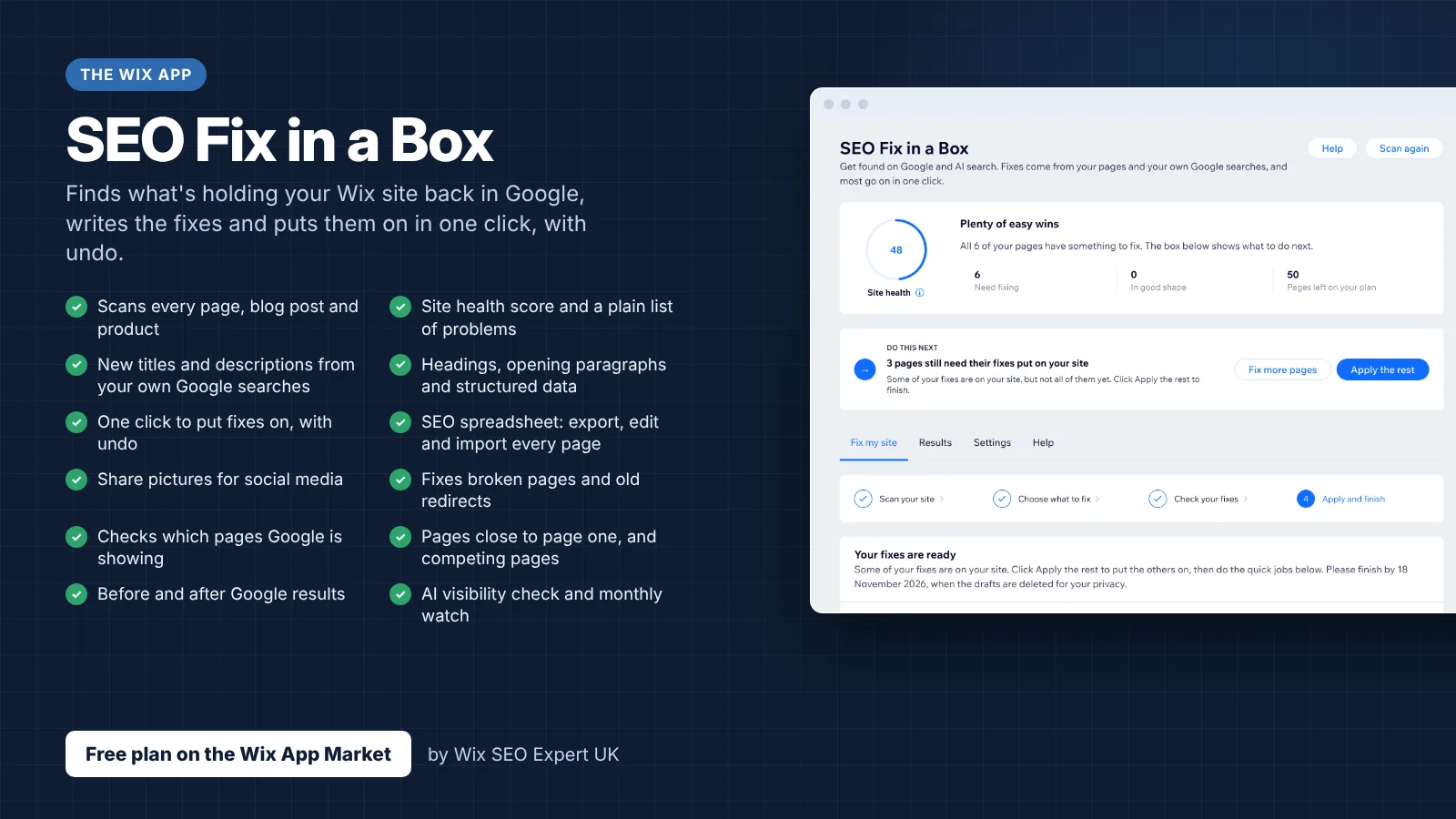
- SEO Fix in a Box: My Wix app. Free to install, it scans your site and shows what needs fixing, and paid plans write the fixes from your own Google searches
Was this lesson useful?
It takes 1 minute to tell me. The course is free and I want to keep it that way, and your feedback shows me what is working and helps other people find it.
This lesson on SERP feature analysis: stealing featured snippets, People Also Ask and Knowledge Panels is part of Module 23: Competitor Analysis & Competitive SEO Strategy for Wix in The Most Comprehensive Complete Wix SEO Course in the World (2026 Edition). Created by Michael Andrews, a Wix Marketplace Legend Partner with 14 years of hands-on experience, 800 completed Wix SEO projects and 456 verified five-star reviews.