SERP analysis: deconstructing the first page of Google for any keyword
Module 23: Competitor Analysis & Competitive SEO Strategy for Wix | Lesson 280 of 683 | 60 min read
By Michael Andrews, Wix SEO Expert UK
SERP analysis is the process of systematically deconstructing the first page of Google for any given keyword to understand what Google considers the best answer, what content format it prefers, what SERP features are present, and whether the keyword is realistically winnable for your Wix website. Every successful SEO campaign begins with SERP analysis because it eliminates guesswork. Instead of assuming what content to create, you observe what Google already rewards and reverse-engineer a strategy that matches or exceeds the current standard. This lesson teaches you how to read a Google SERP like a professional SEO strategist, evaluate keyword difficulty in context, and identify the specific opportunities that Wix sites can exploit.

What Is SERP Analysis and Why Every Wix Owner Needs to Do It
SERP analysis answers the most fundamental question in SEO: what does Google want to see for this keyword? Before writing a single word of content or building a single backlink, you need to know what is already ranking, why it is ranking, and what gaps exist that your Wix site could fill. Without SERP analysis, you are essentially creating content blindfolded, hoping it matches what Google rewards.
A thorough SERP analysis tells you the dominant search intent (informational, commercial, transactional or navigational), the preferred content format (blog post, product page, video, listicle, how-to guide), the expected content depth (word count, subtopic coverage, media usage), the authority threshold required to rank (domain authority of current rankers), and which SERP features present opportunities for additional visibility beyond the standard organic results.
The Anatomy of a Modern Google SERP
A 2026 Google SERP is far more complex than the ten blue links of the past. Google now displays a rich, dynamic results page that can include over a dozen different element types, each competing for attention and clicks. Understanding every element is essential for identifying where your Wix site can appear.
Paid Ads (Google Ads)
Paid advertisements appear at the top and sometimes the bottom of the SERP, marked with a small "Sponsored" label. The number of ads varies by keyword: commercial keywords may show 4 ads above organic results, while informational keywords may show none. A SERP saturated with ads indicates high commercial value but also means organic results are pushed further down the page, reducing their click-through rates. Count the number of ads as part of your analysis: if 4 ads dominate the top of the page, you need to assess whether organic positions 1-3 still receive meaningful click volume.
AI Overview (SGE)
Google's AI Overview, formerly known as Search Generative Experience, now appears for many informational queries. This AI-generated summary occupies a large portion of the top of the SERP and can include citations to specific web pages. Being cited in an AI Overview can drive significant traffic, but it also means that users may get their answer without clicking through to any website. Note whether an AI Overview appears for your target keywords and which sources it cites.
Featured Snippets (Position Zero)
Featured snippets appear in a prominent box above the standard organic results, earning the coveted "Position Zero". They come in several formats: paragraph snippets (a short text answer), list snippets (numbered or bulleted lists), table snippets (data in table format), and video snippets (a YouTube video with a timestamp). Winning a featured snippet can dramatically increase your visibility and click-through rate. Wix sites can absolutely earn featured snippets with properly structured content.
People Also Ask (PAA)
The People Also Ask box displays expandable questions related to the search query. Each question reveals a snippet-style answer sourced from a web page. PAA boxes are valuable because they expand dynamically: when a user clicks one question, Google loads additional related questions, creating infinite visibility potential. PAA appearances are often easier to win than standard organic positions because they focus on specific questions rather than broad topics.
Local Pack (Map Results)
For queries with local intent, Google displays a map with three business listings below it. The local pack is controlled primarily by Google Business Profile optimisation, not your Wix website. However, the two are interconnected: a strong website with relevant content supports your GBP ranking. If your target keyword triggers a local pack, you need a dual strategy covering both GBP optimisation and organic website SEO.
Knowledge Panel
Knowledge Panels appear on the right side of the SERP for branded queries and entities. They pull information from Wikipedia, your Google Business Profile, social media profiles and other authoritative sources. A Knowledge Panel for your brand indicates strong entity recognition in Google's Knowledge Graph. While you cannot directly control Knowledge Panels, you can influence them through consistent brand information across your Wix site, GBP, social profiles and Wikipedia (if eligible).
Image Pack
Image packs display a horizontal row of images within the SERP. They appear when Google determines visual content is relevant to the query. If an image pack appears for your target keyword, it represents an additional ranking opportunity through Google Image Search optimisation. Ensure your Wix site images have descriptive filenames, comprehensive alt text and relevant surrounding content.
Video Results and Video Carousel
Video results appear as either individual organic listings with a video thumbnail or as a horizontal carousel of videos, usually from YouTube. If Google shows video results for your keyword, it indicates that users want visual content for that query. Consider creating YouTube videos targeting those keywords and embedding them on your Wix pages for a combined SEO benefit.
Shopping Results
For product-related queries, Google may display a shopping carousel with product images, prices and merchant names. If shopping results dominate your target keyword, it signals strong transactional intent. Wix ecommerce sites can appear in Google Shopping through the Google Merchant Center integration available in the Wix dashboard.
Sitelinks
Sitelinks are additional links that appear beneath a domain's main listing, typically for branded searches. They show that Google has a strong understanding of your site structure. You cannot directly choose sitelinks, but a clear Wix site architecture with descriptive page titles and logical navigation increases the likelihood of earning them.
How to Evaluate SERP Difficulty: Is This Keyword Winnable?
Keyword difficulty scores from tools like Ahrefs and SEMrush provide a starting estimate, but the real difficulty assessment comes from analysing the actual SERP. A keyword with a Difficulty score of 30 might be nearly impossible if the top results are from domains like Wikipedia, Amazon and the BBC. Conversely, a keyword with a Difficulty score of 50 might be very achievable if the top results are thin content from low-authority sites.
How to manually assess SERP difficulty
- Search for the keyword in an Incognito window and examine all page one results
- Check the Domain Authority or Domain Rating of the top 5 results using the MozBar, Ahrefs SEO Toolbar or SEOquake Chrome extension
- Note the average DA/DR: if most results have DA 60+ and your site is DA 15, the keyword is likely too competitive for now
- Look for weak results on page one: pages with low word count, outdated information, poor formatting, few backlinks or irrelevant content
- Check if any results are forums, Reddit threads, or user-generated content, as these are often easy to outrank with quality content
- Examine whether small or niche websites rank alongside major brands: if they do, it signals the keyword is accessible
- Count the number of exact-match title tags in the top 10: fewer exact matches means less optimised competition
- Check the age of the ranking content: if top results are 3+ years old with no updates, fresh content may be favoured
- Assess the backlink profiles of the top 3 results: if they have hundreds of referring domains, you need a substantial link-building effort
- Consider SERP features: if a featured snippet, PAA or image pack dominates, you may be able to win these features without ranking in the traditional top 3
Reading the Intent Behind the SERP Layout
Google constructs the SERP layout to match the dominant intent behind a query. By reading the layout, you can determine exactly what type of content to create. The SERP is essentially Google telling you: this is what users want when they search for this keyword.
Informational Intent SERPs
These SERPs are dominated by blog posts, how-to guides, educational articles and Wikipedia entries. Featured snippets and People Also Ask boxes are prominent. Few or no ads appear. Video results may be present for tutorial-style queries. If your target keyword triggers an informational SERP, you need to create comprehensive educational content that thoroughly answers the query.
Commercial Investigation Intent SERPs
These SERPs show comparison articles, "best of" lists, review roundups and buyer's guides. Results often include titles like "Best X in 2026", "X vs Y: Which Is Better?" and "Top 10 X for [use case]". Some ads may appear but the organic results are primarily research-oriented. Create comparison content, detailed reviews and comprehensive guides that help users make purchase decisions.
Transactional Intent SERPs
Transactional SERPs are dominated by product pages, category pages and ecommerce listings. Shopping carousels, ads and product rich snippets are prominent. Homepage or category-level pages from major retailers often dominate. If your Wix site is ecommerce, you need optimised product and category pages. If you are a service business, you need service pages with clear pricing, booking and conversion-focused content.
Navigational Intent SERPs
Navigational SERPs show a single dominant domain with sitelinks, typically for branded queries. The user is looking for a specific website. You generally cannot compete for another brand's navigational keywords, but you should ensure your own branded terms trigger navigational SERPs with sitelinks for your Wix site.
Mixed Intent SERPs
Many SERPs display mixed intent, showing a combination of informational and transactional results. Google does this when the query is ambiguous or when user intent is split. A search for "running shoes" might show product pages, review articles, buyer's guides and informational content about choosing the right shoe. Mixed intent SERPs present opportunities to rank with different content types for the same keyword.
SERP Volatility and What It Means for Your Strategy
SERP volatility refers to how frequently the rankings change for a given keyword. High volatility means Google is still testing which results best satisfy user intent, and rankings shift frequently. Low volatility means Google has settled on a stable set of results. Understanding volatility helps you set realistic expectations and choose your battles wisely.
- High Volatility Keywords: Rankings change significantly week-to-week. Google may be running experiments, the topic may be trending, or there may be no clearly dominant content. These keywords represent opportunities because no one has locked in their position.
- Low Volatility Keywords: Rankings are stable with the same domains holding positions for months or years. These keywords are harder to break into but offer more stable traffic once you do rank.
- Seasonal Volatility: Some keywords see ranking fluctuations tied to seasons, holidays or events. Plan content publication timing to coincide with periods of maximum search demand.
- Algorithm Update Volatility: Major Google algorithm updates can shuffle rankings for weeks. Track whether your target keywords were affected by recent updates using tools like SEMrush Sensor or Mozcast.
Analysing Content Type, Format and Length of Ranking Pages
One of the most valuable outputs of SERP analysis is understanding what content characteristics Google rewards for your target keyword. This eliminates guesswork from your content creation process.
How to analyse ranking content characteristics
- Open the top 5 ranking pages for your keyword in separate browser tabs
- Record the content type: blog post, service page, product page, category page, video, tool, infographic, or other
- Note the content format: how-to guide, listicle, ultimate guide, comparison, case study, tutorial, FAQ or other
- Estimate the word count using the Word Counter Plus Chrome extension or by pasting the content into a Google Doc
- Record the average word count of the top 5 results as your minimum content length target
- Note the heading structure (H2s and H3s) of each result: how many subtopics do they cover?
- Check for multimedia usage: images, videos, infographics, charts, tables, downloadable resources
- Assess the reading level and writing style: technical, casual, professional, educational
- Look for interactive elements: calculators, quizzes, comparison tables, filters
- Note the date of last update: is fresh content being rewarded, or are older evergreen pages ranking?
- Check internal and external linking patterns: how many links does each page include?
- Review the comments section (if present): what additional questions are users asking?
SERP Features and How Wix Sites Can Target Them
SERP features represent additional opportunities to appear on page one beyond the standard organic listings. Wix sites can target several of these features through structured content and schema markup.
Winning Featured Snippets with Wix
- Paragraph Snippets: Answer the target question directly in 40-60 words immediately after an H2 heading that contains the question. Use clear, concise language.
- List Snippets: Use properly formatted H2 and H3 headings in your Wix editor to create numbered or bulleted lists. Google extracts these heading structures into list snippets.
- Table Snippets: Use the Wix Table element to present data in rows and columns. Google can extract tables into SERP table snippets.
- Video Snippets: Embed a YouTube video on your Wix page and include timestamps in the video description. Google may feature the video with a direct timestamp link.
Targeting People Also Ask
Structure your content with FAQ-style H2 and H3 headings that match PAA questions exactly. Provide concise, direct answers in the paragraph immediately following each heading. Use FAQ schema markup on your Wix site to explicitly mark these question-answer pairs for Google. Check the PAA questions for your target keywords and ensure your content addresses every relevant question.
Local Pack Optimisation
If a local pack appears for your target keyword, optimise your Google Business Profile: complete every field, add photos regularly, respond to all reviews, post weekly updates, and ensure your Wix site content matches your GBP categories and service areas. Use local schema markup on your Wix site to reinforce local relevance.
Wix-Specific SERP Opportunities
Wix sites have specific advantages and considerations when it comes to SERP competition that are worth understanding as part of your analysis.
- Wix Blog: The Wix blog platform supports proper heading hierarchy, structured content and meta tag customisation, making it competitive for informational keywords
- Wix Stores: Wix ecommerce pages support product schema markup, which enables rich product snippets with price, availability and review stars in SERPs
- Wix Bookings: Service pages can be structured to target "near me" and service-specific keywords with local schema support
- Wix SEO Patterns: Wix allows you to set SEO patterns across product pages, blog posts and dynamic pages, ensuring consistent optimisation at scale
- Wix Multilingual: For multi-market Wix sites, the multilingual feature implements hreflang tags automatically, helping you compete in SERPs across different languages and regions
- Wix Speed: Wix's improved Core Web Vitals scores as of 2026 mean your pages are no longer disadvantaged by platform speed issues in Google's page experience ranking factor
Complete How-To Guide: Running a Full SERP Analysis for Any Keyword
This consolidated guide walks you through the complete SERP analysis process from start to finish. Use this workflow for every target keyword before creating content or optimising pages on your Wix site.
Follow these steps for a complete SERP analysis
- Open a Google Incognito window and search for your target keyword to view an unbiased SERP
- Screenshot the entire SERP (use the GoFullPage Chrome extension) and save it as a reference document
- Map every SERP element: count paid ads, note any AI Overview, identify featured snippets, PAA boxes, local pack, image pack, video results, knowledge panels, shopping results and sitelinks
- Record all 10 organic results in a spreadsheet with columns for Position, Domain, Page URL, Title Tag, Meta Description, Content Type, Content Format and Estimated Word Count
- Install MozBar, Ahrefs SEO Toolbar or SEOquake and record the Domain Authority and Page Authority of each result
- Open each of the top 5 results in new tabs and analyse content depth: word count, number of headings, images, videos, internal links and external links
- Identify the dominant search intent based on the content types ranking: informational, commercial, transactional, navigational or mixed
- Assess keyword difficulty by evaluating the average DA of top results, the quality of content and the presence of weak spots
- Note any SERP features you could target: featured snippets, PAA, image pack or video results
- Compare the top 5 results against each other: identify what they all cover (baseline requirements) and what only some cover (differentiation opportunities)
- Create a Content Brief based on your analysis: specify the target word count, heading structure, subtopics to cover, media to include, SERP features to target and intent to satisfy
- Determine if the keyword is winnable for your Wix site within 3-6 months, or if it should be a long-term target
- If the keyword is too competitive, identify related long-tail variations by examining PAA questions, "Related Searches" at the bottom of the SERP, and Google Autocomplete suggestions
- Save your SERP analysis document and reference it when creating or optimising the target page on your Wix site
- After publishing your content, check back in 4-8 weeks to see where your page has entered the SERP and compare its position to your analysis predictions
SERP Analysis Tools
- Ahrefs SERP Checker: Analyse SERP difficulty, SERP features and ranking history for any keyword
- SEMrush Keyword Overview: Comprehensive SERP analysis with intent classification, SERP features and difficulty scoring
- MozBar Chrome Extension: Free Chrome extension showing DA/PA metrics for every SERP result
- SEOquake Chrome Extension: Free Chrome extension displaying SEO metrics directly in Google SERPs
- GoFullPage Chrome Extension: Screenshot entire SERPs for documentation and analysis
- Keyword Surfer: Free Chrome extension showing search volume and word count of ranking pages
- Google Search Console: Free tool showing your current SERP positions, impressions and click-through rates
- Mozcast: Track Google algorithm volatility and SERP fluctuations
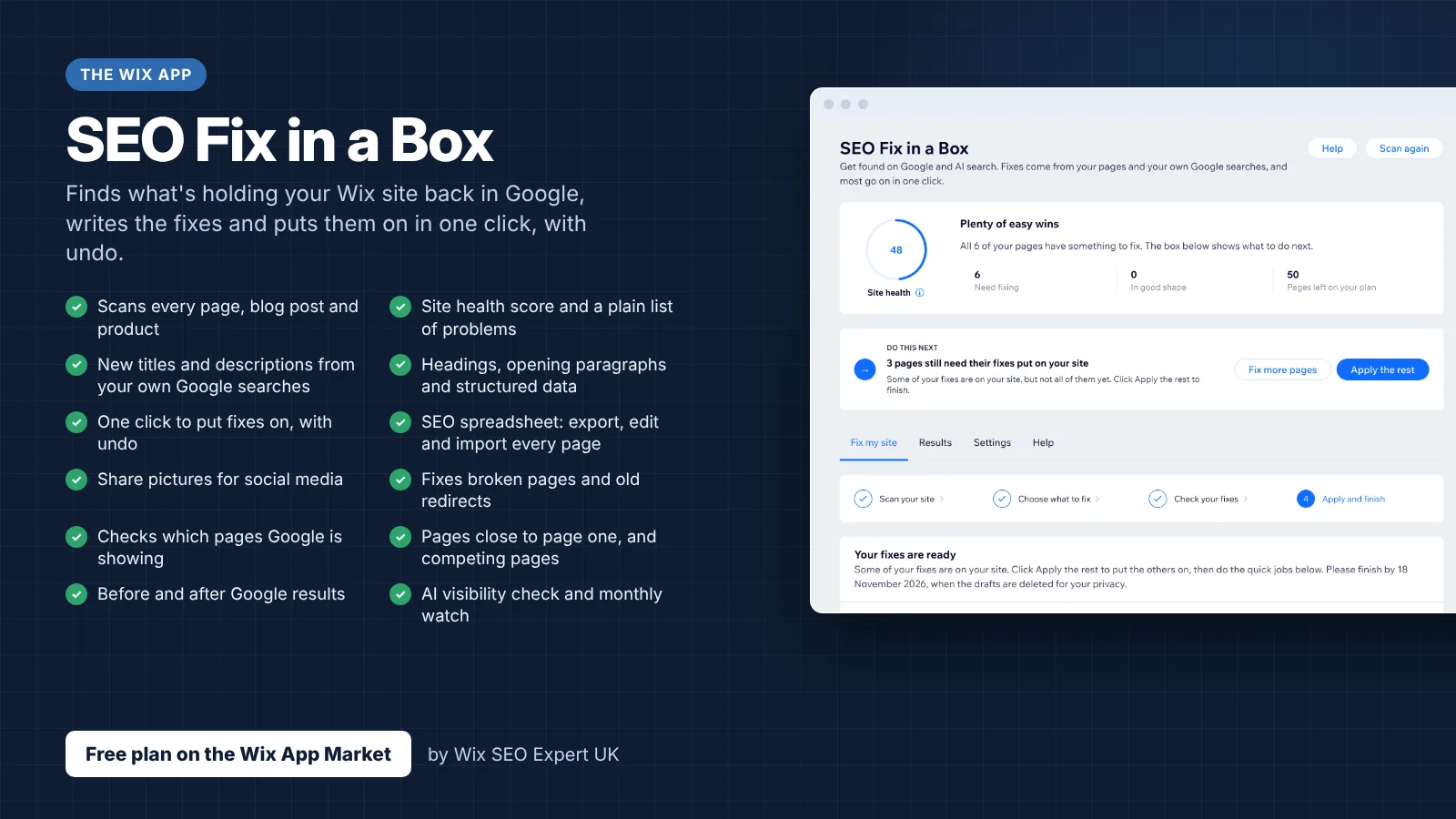
- SEO Fix in a Box: My Wix app. Free to install, it scans your site and shows what needs fixing, and paid plans write the fixes from your own Google searches
Was this lesson useful?
It takes 1 minute to tell me. The course is free and I want to keep it that way, and your feedback shows me what is working and helps other people find it.
This lesson on SERP analysis: deconstructing the first page of Google for any keyword is part of Module 23: Competitor Analysis & Competitive SEO Strategy for Wix in The Most Comprehensive Complete Wix SEO Course in the World (2026 Edition). Created by Michael Andrews, a Wix Marketplace Legend Partner with 14 years of hands-on experience, 800 completed Wix SEO projects and 456 verified five-star reviews.