Ongoing competitive monitoring: tools, alerts and dashboards for tracking rival performance
Module 23: Competitor Analysis & Competitive SEO Strategy for Wix | Lesson 287 of 683 | 50 min read
By Michael Andrews, Wix SEO Expert UK
Competitive SEO is not a one-time activity. The search landscape shifts constantly as competitors publish new content, acquire backlinks, make technical changes, and adjust their strategies. A competitor who ranked below you last month can overtake you next month if they are executing while you are standing still. Ongoing competitive monitoring is the system that ensures you always know what your competitors are doing, when they make changes, and how those changes affect your relative position in search results. This lesson teaches you how to build a complete competitive monitoring system using paid tools, free tools, automated alerts, custom dashboards and regular reporting cadences. By the end, you will have a set-and-forget monitoring infrastructure that keeps you informed of every meaningful competitive change without requiring hours of manual checking.

Why Ongoing Competitive Monitoring Is Essential
Without monitoring, you are flying blind. You will not know when a competitor publishes a superior piece of content targeting your best keyword. You will not notice when a competitor earns a high-authority backlink that boosts their rankings. You will not detect when a competitor launches a new section of their site that targets keywords in your niche. You will not see when a competitor steals your featured snippet. And you will not recognise when a new competitor enters your market and begins building visibility. Each of these events erodes your competitive position, and by the time you notice the impact in your own traffic numbers, the damage is done. Proactive monitoring gives you early warning signals so you can respond within days rather than months.
The Cost of Not Monitoring
Consider this scenario: your top competitor publishes 10 new articles targeting keywords you rank for. Without monitoring, you do not notice until your rankings drop, which might take 4-8 weeks. By then, the competitor has gained link equity, user engagement signals and topical authority from those pages. Recovering lost positions is significantly harder than defending them. Monitoring costs a fraction of what recovery costs in both time and money.
Setting Up Ahrefs Alerts for Competitor Backlinks and Keywords
Ahrefs Alerts is one of the most powerful competitive monitoring tools available. It automatically notifies you when competitors gain new backlinks, lose backlinks, or when new pages start ranking for your tracked keywords. Setting up comprehensive Ahrefs alerts takes 15 minutes but saves hours of manual checking every week.
Configure Ahrefs alerts for competitive monitoring
- Log into Ahrefs and navigate to More > Alerts from the top navigation menu
- Click "New Alert" and select "Backlinks" to set up backlink monitoring for each competitor
- Enter your first competitor domain (e.g., competitor1.com) and set the alert to notify you of new backlinks daily or weekly depending on how actively you want to monitor
- Set the filter to "One link per domain" to avoid notification overload from sites that add multiple links
- Set a minimum Domain Rating filter of 30 to only be notified about meaningful backlinks, not low-quality spam links
- Repeat for each competitor domain (up to 5 competitors for a standard Ahrefs subscription)
- Create a "New Keywords" alert by going to Alerts > New Keywords and entering competitor domains to be notified when competitors start ranking for new keywords in your niche
- Set up keyword alerts for your own brand name and competitor brand names to monitor brand mentions that could become link opportunities
- Configure alert delivery to a dedicated email folder so competitive alerts do not get lost in your inbox
- Review alerts weekly and add any significant competitor link acquisitions or new keyword rankings to your competitive opportunity matrix for action
SEMrush Position Tracking for Competitive Monitoring
SEMrush Position Tracking allows you to track your ranking positions for specific keywords alongside up to five competitors, updated daily. This is the most granular way to monitor competitive ranking changes and identify when competitors are gaining or losing ground on specific keywords.
Set up SEMrush Position Tracking for competitive analysis
- Log into SEMrush and navigate to Position Tracking under the SEO toolkit
- Create a new project for your Wix site domain if you have not already
- Add your target keywords. Start with your 50-100 most important keywords including brand terms, primary commercial keywords, top content keywords, and keywords where you compete directly with specific competitors.
- Add up to 5 competitor domains to track alongside your own. Choose the competitors most directly competing for your target keywords.
- Set your tracking location to match your target market (country, city or postcode level for local businesses)
- Set tracking to desktop and mobile separately, as rankings often differ between devices
- Enable daily tracking updates for the most accurate competitive intelligence
- Navigate to the Competitors Discovery tab to see which domains compete with you most frequently across all tracked keywords
- Use the Rankings Distribution chart to visualise how your rankings compare to competitors across positions 1-3, 4-10, 11-20 and 20+
- Set up automated email reports to receive weekly ranking summaries showing your position changes versus competitors
Reading Position Tracking Data for Competitive Insights
The raw position tracking data becomes valuable when you analyse patterns. Look for these competitive signals in your weekly data.
- Competitor upward trends: If a competitor is consistently gaining positions across multiple keywords, they are likely executing a content or link building strategy. Investigate what they are doing.
- Competitor downward trends: If a competitor is losing positions, they may have been hit by an algorithm update, lost backlinks, or neglected content updates. This is an opportunity to capture their declining positions.
- SERP volatility spikes: Large position changes across multiple competitors for the same keyword group may indicate a Google algorithm update rather than individual competitor actions.
- New competitor entries: If a domain you are not tracking suddenly appears in the SERP for your keywords, add it to your tracking immediately.
- Feature snippet flips: When a featured snippet changes owner, the traffic impact is dramatic. Monitor these closely for your most important keywords.
Free Tools for Competitive Monitoring
You do not need a large budget to monitor competitors effectively. Several free tools provide valuable competitive intelligence when combined strategically. The following tools complement paid tools like Ahrefs and SEMrush or serve as alternatives for Wix site owners on tight budgets.
Google Alerts for Brand and Keyword Monitoring
Set up Google Alerts for competitive monitoring
- Go to google.com/alerts and sign in with your Google account
- Create an alert for each competitor brand name (e.g., "Competitor Name") to monitor mentions across the web
- Create an alert for your own brand name to track mentions and potential link opportunities
- Create alerts for your primary industry keywords combined with terms like "guide", "tips", "best", "review" to detect new competing content
- Set the frequency to "As-it-happens" for brand mentions and "Once a day" for keyword alerts
- Set the source to "Automatic" or filter to specific sources (News, Blogs, Web) depending on your needs
- Set the language and region to match your target market
- Create a dedicated email filter or label for Google Alerts so they are easy to review in batches
Visualping for Competitor Website Change Detection
Visualping monitors competitor web pages for visual or textual changes and notifies you when something changes. This is invaluable for detecting when competitors update key pages, change their pricing, launch new features, or modify their SEO elements.
Set up Visualping for competitor page monitoring
- Go to visualping.io and create a free account (free tier monitors up to 5 pages with daily checks)
- Add your top competitors homepage URLs to monitor for design changes, new content sections and navigation updates
- Add competitor pricing pages to detect pricing changes or new service offerings
- Add competitor blog index pages to detect when new content is published
- Add competitor service or product pages that directly compete with your key offerings
- Set monitoring frequency to daily for the most important pages and weekly for secondary pages
- Choose between visual comparison (screenshots) and text comparison (content changes) depending on what you want to detect
- Review change notifications weekly and assess whether any competitor changes require a response from your side
SimilarWeb Free for Traffic Benchmarking
SimilarWeb provides estimated traffic data, traffic source breakdowns, and engagement metrics for any website. The free version is limited but still useful for high-level competitive benchmarking. Visit similarweb.com, enter a competitor domain, and you can see their estimated monthly visits, average visit duration, pages per visit, bounce rate, traffic sources (direct, search, social, referral, paid) and top referring sites. Compare these metrics monthly against your own data to track relative competitive performance.
Setting Up Google Search Console Comparison Benchmarks
Google Search Console does not show competitor data directly, but it provides the most accurate data about your own search performance. By establishing benchmarks and tracking trends, you create the baseline against which competitive movements are measured.
Establish GSC benchmarks for competitive tracking
- Open Google Search Console and navigate to the Performance report
- Set the date range to the last 3 months to establish your current baseline
- Export the full query report to a spreadsheet. This is your keyword baseline.
- Note your current total clicks, total impressions, average CTR and average position
- Identify your top 50 keywords by clicks and record their current average position. These are the rankings you need to protect from competitor incursion.
- Set up a monthly export routine: on the first of every month, export the previous months query and page data to track trends
- Use the date comparison feature (Compare button) to overlay the current period against the previous period. Sudden drops in impressions or positions for specific queries may indicate competitor gains.
- Cross-reference any GSC position drops with your Ahrefs or SEMrush competitive tracking to determine whether a specific competitor is responsible
Building a Competitive Monitoring Dashboard in Google Looker Studio
A centralised competitive monitoring dashboard eliminates the need to log into multiple tools every week. Google Looker Studio (formerly Google Data Studio) is free and connects directly to Google Search Console, Google Analytics and Google Sheets, allowing you to build a comprehensive competitive dashboard that updates automatically.
Dashboard Design for Competitive SEO Monitoring
Build your competitive monitoring dashboard in Looker Studio
- Go to lookerstudio.google.com and click "Create" then "Report"
- Add your first data source: Google Search Console. Authorise access and select your Wix site property. Choose "Site Impression" for query-level data.
- Add a second data source: Google Analytics 4. Connect your Wix site GA4 property for traffic and conversion data.
- Add a third data source: Google Sheets. Create a Google Sheet where you manually input competitor metrics monthly (competitor DR, estimated traffic, total backlinks, total keywords ranked). This becomes your competitive benchmark data source.
- Page 1 - Overview Dashboard: Add a time-series chart showing your total organic clicks over time (GSC data), a scorecard showing current month clicks versus previous month, a table of your top 20 keywords with current position and position change, and a bar chart comparing your current metrics against competitors (from your Google Sheet).
- Page 2 - Keyword Performance: Add a table showing all tracked keywords with clicks, impressions, CTR and average position. Add filters for date range and specific keyword groups. Include a scatter plot of position versus CTR to identify underperforming keywords.
- Page 3 - Competitive Benchmarks: Using your Google Sheet data source, create bar charts comparing your domain metrics against each competitor: DR comparison, organic traffic comparison, backlink count comparison, and keyword count comparison.
- Add date range controls to every page so you can compare different time periods
- Schedule automatic email delivery of the dashboard on the first of every month to your inbox
- Share the dashboard with team members or clients who need visibility into competitive performance
Automated Weekly and Monthly Competitive Reports
Automated reports ensure competitive monitoring happens consistently even when you are busy with other business activities. Set up automated reports at two cadences: weekly tactical reports and monthly strategic reports.
Weekly Competitive Report Structure
- Ranking changes: Your position changes for tracked keywords versus competitors (from SEMrush Position Tracking email report)
- New competitor backlinks: Significant links acquired by competitors this week (from Ahrefs alerts)
- New competitor content: Any new pages or articles published by competitors (from Visualping or manual checks)
- Your own metrics: GSC clicks and impressions trend versus previous week
- Action items: 2-3 specific actions to take this week based on competitive changes detected
Monthly Competitive Report Structure
- Domain authority trends: DR/DA for your site and all competitors (from Ahrefs)
- Traffic trend comparison: Estimated organic traffic for your site versus competitors (from SEMrush or Ahrefs)
- Content gap closure: How many new keywords you now rank for that competitors held exclusively last month
- Backlink acquisition comparison: New referring domains gained this month for your site versus competitors
- SERP feature ownership changes: Any featured snippets, People Also Ask or other features gained or lost
- Competitive SWOT update: Any changes to strengths, weaknesses, opportunities or threats identified this month
- Next month priorities: Updated action plan priorities based on this months competitive data
Monitoring Competitor Content Updates and New Pages
Content is the primary battleground in competitive SEO. When a competitor publishes new content or significantly updates existing content, it can shift rankings within weeks. Monitoring competitor content activity helps you respond quickly by improving your own content or publishing competing pieces before the competitor content gains traction.
Methods for Monitoring Competitor Content
- RSS feeds: Many competitor blogs and news sections have RSS feeds. Use a tool like Feedly to subscribe to competitor RSS feeds and review new content daily.
- Ahrefs New Pages report: In Ahrefs Site Explorer, navigate to Pages > New to see all recently indexed pages for a competitor domain. Check this weekly.
- Screaming Frog scheduled crawls: Set up monthly crawls of competitor domains and compare the URL list month-over-month to identify new pages.
- Visualping on competitor blog pages: Monitor competitor blog index or sitemap pages for changes that indicate new content.
- Social media monitoring: Follow competitor social media accounts where they typically promote new content.
- Google Alerts for competitor domain: Create an alert for "site:competitor.com" to be notified when Google indexes new competitor pages.
- SEMrush Content Analyzer: Track competitor content performance and identify which new pages are gaining organic visibility.
Tracking Competitor SERP Feature Changes
SERP features like featured snippets, People Also Ask boxes, local packs, image packs and video carousels represent significant traffic opportunities. A competitor winning a featured snippet can capture 30-40% of clicks for that query. Monitoring SERP feature ownership is critical for defending your positions and identifying new opportunities.
Track SERP feature ownership changes
- In SEMrush Position Tracking, enable the "SERP Features" column to see which SERP features appear for your tracked keywords and who owns them
- Set up a weekly review cadence to check for SERP feature ownership changes across your most important keywords
- In Ahrefs, use the SERP overview for individual keywords to see current feature ownership and track it manually for your top 20 keywords
- Use the free MozCast or RankRanger SERP feature tracker tools to monitor broader SERP feature trends that may affect your niche
- When you lose a featured snippet to a competitor, immediately analyse their content format and structure to understand what Google preferred and update your page accordingly
- When a People Also Ask box appears for a keyword you rank for but do not own, create FAQ content that directly answers those questions
Competitive Intelligence from Social Media Monitoring
Social media activity provides leading indicators of competitor SEO strategy. When a competitor promotes a new piece of content on social media, it signals their content priorities. When they receive significant social engagement, those pages are likely to earn natural backlinks. When they change their messaging or positioning, it may indicate a broader strategic shift.
- Follow all competitors on their primary social platforms (LinkedIn, X/Twitter, Facebook, Instagram) using a dedicated monitoring account if preferred
- Use social listening tools like Mention or Brand24 (paid) or free tools like Social Searcher to track competitor brand mentions across social platforms
- Monitor competitor hashtag usage and trending topics they engage with for content inspiration
- Track competitor social content that receives unusually high engagement, as this signals topics that resonate with your shared audience
- Note when competitors announce partnerships, awards, new hires or events, as these may generate PR coverage and backlinks
Setting Up Alerts for Competitor Brand Mentions
Brand mention monitoring serves a dual purpose: it tracks competitor visibility and authority building, and it identifies potential link opportunities for your own site. When a competitor is mentioned on a website without a link, the same publication might be willing to mention and link to you.
Set up comprehensive brand mention alerts
- Create Google Alerts for each competitor brand name in quotes (e.g., "Competitor Name") to track mentions across the web
- Create Google Alerts for competitor founder or key team member names, as personal brand mentions often lead to business links
- Set up Ahrefs Alerts for competitor brand name mentions (under Alerts > Mentions) for more comprehensive coverage than Google Alerts
- Create alerts for common misspellings of competitor brand names to capture mentions Google Alerts might miss
- When you discover an unlinked competitor mention, check whether the publication accepts guest contributions or link suggestions, as this could become a link opportunity for your own site
- Track the volume and sentiment of competitor brand mentions monthly. Rising mention volume indicates growing brand authority.
When to Adjust Strategy Based on Competitive Changes
Not every competitive change requires a response. You need a framework for deciding when to act and when to stay the course. Overreacting to every competitor move wastes resources, while underreacting allows competitors to build insurmountable advantages.
Competitive Changes That Require Immediate Action
- A competitor steals your featured snippet for a high-traffic keyword: Respond within 48 hours by analysing their content format and updating your page to recapture the snippet.
- A competitor publishes a directly competing page targeting your best keyword: Analyse their content immediately and update your page to be demonstrably more comprehensive, more current and better formatted.
- A competitor acquires a link from a source you believed was exclusive to you: Investigate whether the relationship has changed and whether your link is still in place.
- A new, well-funded competitor enters your niche with aggressive content production: Immediately assess the threat level and accelerate your own content and link building timeline.
- A competitor launches a negative SEO attack (acquiring spammy links pointing to your site): Use Google Disavow tool and monitor for further suspicious link activity.
Competitive Changes to Monitor but Not React To Immediately
- Gradual competitor ranking improvements across non-critical keywords: Monitor weekly but do not alter your plan unless the trend accelerates.
- Competitor redesign or rebranding: Note it but wait to see whether it affects rankings before changing your own approach.
- Competitor gaining links from sources outside your niche: These links may not affect your shared keyword rankings.
- Minor SERP position fluctuations of 1-3 positions: Normal daily volatility. Only react to sustained movement over 2+ weeks.
- Competitor publishing content in adjacent but non-competing topic areas: Note their direction but maintain your own content calendar priorities.
Complete How-To Guide: Setting Up Your Competitive Monitoring System
This step-by-step guide walks you through building a complete competitive monitoring infrastructure for your Wix website, from alert configuration to dashboard creation to reporting automation.
Follow these steps to build your competitive monitoring system
- Confirm your competitor list: Identify 3-5 primary competitors whose organic search presence most directly overlaps with your Wix site. These are the domains you will monitor most closely.
- Set up Ahrefs Backlink Alerts: Navigate to Ahrefs > Alerts > Backlinks. Create daily alerts for your top 2 competitors and weekly alerts for secondary competitors. Filter by one link per domain and minimum DR 30.
- Set up Ahrefs Keyword Alerts: In Ahrefs > Alerts > New Keywords, add each competitor domain to receive notifications when they start ranking for new keywords.
- Set up Ahrefs Mention Alerts: Create alerts for each competitor brand name and your own brand name to track mentions across the web.
- Set up SEMrush Position Tracking: Create a project for your Wix site, add your top 50-100 target keywords, add up to 5 competitor domains, set tracking to daily updates for both desktop and mobile, and enable automated weekly email reports.
- Set up Google Alerts: Create alerts for each competitor brand name (in quotes), your own brand name, and 3-5 primary industry keyword phrases. Set delivery to daily digest.
- Set up Visualping: Monitor 3-5 key competitor pages including their homepage, main service page, blog index and pricing page. Set daily monitoring for critical pages.
- Subscribe to competitor RSS feeds: Identify competitor blog RSS feed URLs and add them to Feedly or a similar RSS reader for daily content monitoring.
- Follow competitors on social media: Follow all competitor social profiles from your business accounts and enable notifications for their posts.
- Create your Google Looker Studio dashboard: Connect Google Search Console, Google Analytics 4 and a Google Sheet for manual competitor metrics. Build Overview, Keyword Performance and Competitive Benchmarks pages.
- Create your competitor metrics Google Sheet: Add columns for each competitor and rows for DR, estimated monthly traffic, total backlinks, total referring domains, total organic keywords. Update this sheet on the 1st and 15th of each month.
- Set up your weekly review routine: Block 30-60 minutes every Monday morning to review all alerts received during the previous week, update your Looker Studio dashboard if needed, and identify 2-3 priority actions.
- Set up your monthly reporting routine: On the first of each month, update your competitor metrics sheet, review Looker Studio dashboard trends, complete your monthly competitive report template, and adjust your competitive action plan priorities based on findings.
- Create calendar reminders: Set recurring calendar events for weekly competitive review (every Monday), bi-monthly competitor metric updates (1st and 15th), and monthly strategy review (first Monday of each month).
- Document your monitoring system: Record all alert configurations, tool logins, dashboard URLs and reporting templates in a central document so the system can be maintained by anyone on your team.
Essential Tools for This Lesson
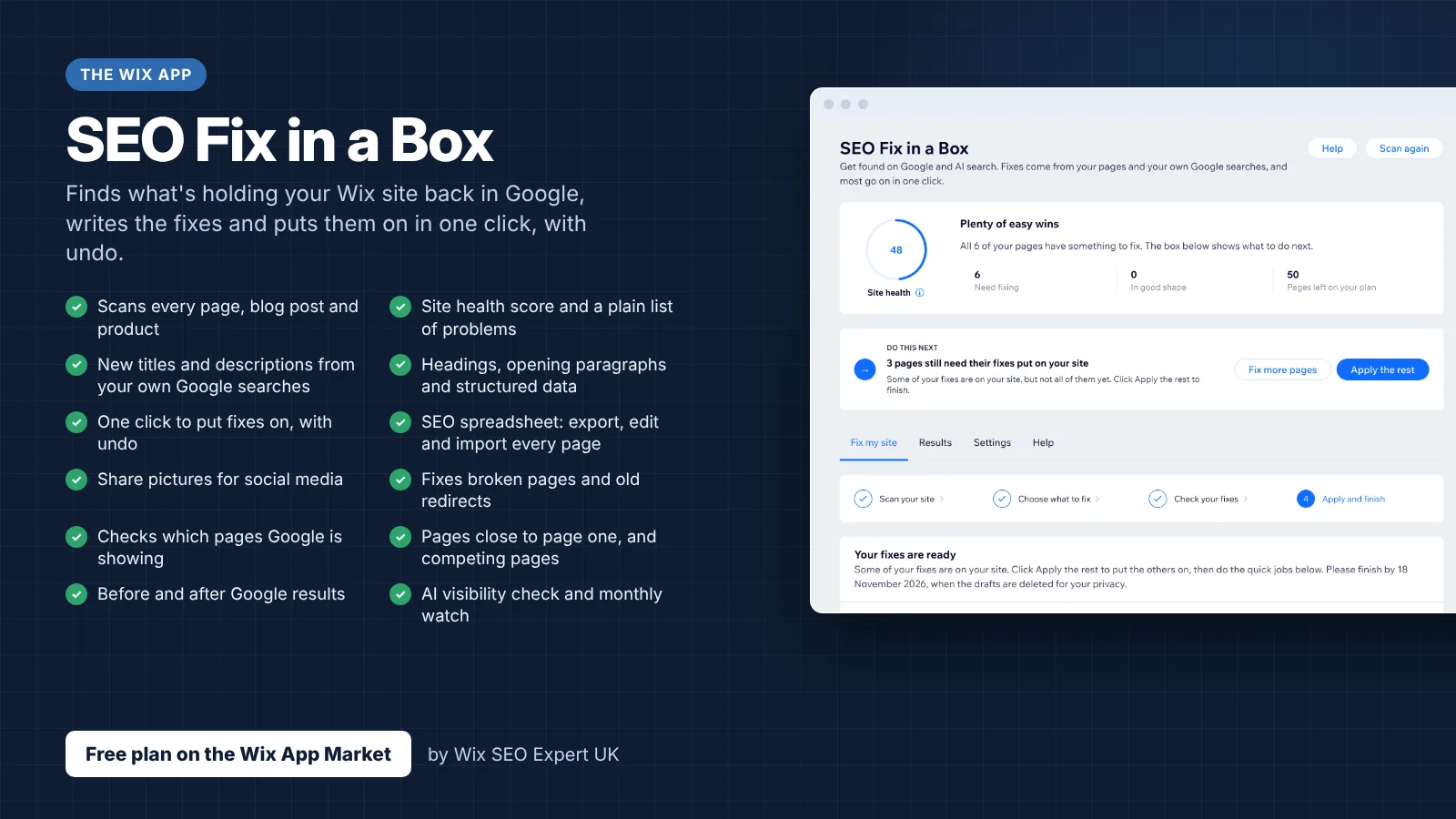
- SEO Fix in a Box: My Wix app. Free to install, it scans your site and shows what needs fixing, and paid plans write the fixes from your own Google searches
Was this lesson useful?
It takes 1 minute to tell me. The course is free and I want to keep it that way, and your feedback shows me what is working and helps other people find it.
This lesson on Ongoing competitive monitoring: tools, alerts and dashboards for tracking rival performance is part of Module 23: Competitor Analysis & Competitive SEO Strategy for Wix in The Most Comprehensive Complete Wix SEO Course in the World (2026 Edition). Created by Michael Andrews, a Wix Marketplace Legend Partner with 14 years of hands-on experience, 800 completed Wix SEO projects and 456 verified five-star reviews.