Multi-language technical SEO: indexing and crawling
Module 34: Multi-Language & RTL Website SEO on Wix | Lesson 400 of 683 | 50 min read
By Michael Andrews, Wix SEO Expert UK
Multi-language websites multiply your technical SEO challenges proportionally. A site with five languages has five times the URLs, five times the sitemap entries, and five times the potential for crawl errors. This lesson addresses the technical SEO fundamentals specific to multi-language Wix sites, starting with a step-by-step Wix Multilingual configuration walkthrough, followed by hreflang verification, Google Search Console International Targeting setup, crawl budget management, and indexing strategy. Wix Multilingual uses a subdirectory structure (/fr/, /de/, /es/ and so on), meaning all language versions share the same root domain and pool their authority, which is the approach recommended by Google.
Wix Multilingual Setup: Subdirectory Structure Walkthrough
Before diving into crawl budgets and indexing strategies, it is worth confirming exactly how Wix Multilingual generates URLs. Every secondary language gets a two-letter ISO 639-1 prefix injected as a subdirectory. Your French pages live at yoursite.com/fr/, your German pages at yoursite.com/de/, your Spanish pages at yoursite.com/es/, and so on. Your primary language remains at the root without a prefix. This is the subdirectory model and it is the best option for SEO because all domain authority stays consolidated.
Verifying and confirming your Wix Multilingual subdirectory setup
- Open your Wix Dashboard and navigate to Site Settings, then select Multilingual from the left menu
- Confirm that your primary language is listed without a URL prefix. This language lives at the root domain
- For each secondary language, verify the two-letter language prefix shown: French should show /fr, German /de, Spanish /es, Arabic /ar, Hebrew /he
- Click on any secondary language and open Site Preview to confirm that page URLs in that language include the subdirectory prefix (e.g. yoursite.com/fr/about)
- Check that the language switcher on your live site links to the correct subdirectory URL for each language, not to the homepage
- Navigate to yoursite.com/fr/sitemap.xml and confirm that French-specific URLs are included. Wix generates language-specific sitemaps automatically
- Open the browser developer tools Network tab on a translated page and verify that the HTML lang attribute in the response matches the language code (lang="fr" for French pages)
- Confirm that hreflang annotations in the page source reference the correct subdirectory URLs for all available languages
- If you add a new language after initial setup, clear your Wix site cache and re-check all of the above steps for the new language subdirectory
Verifying Hreflang Implementation on Wix
Wix automatically adds hreflang tags to every translated page, but automatic generation does not guarantee accuracy. After configuring your languages and completing your initial translations, run through this verification process to confirm that hreflang is working correctly before your site receives significant traffic.
Step-by-step hreflang verification for Wix Multilingual sites
- Navigate to a page on your live site that exists in all your target languages, such as your homepage or a core service page
- Right-click and select View Page Source (or press Ctrl+U on Windows, Cmd+Option+U on Mac)
- Search the source code for hreflang. You should find a block of link rel="alternate" tags near the top of the head section
- Count the hreflang tags: you should see one for each language version of the page, one self-referencing tag for the current language, and one x-default tag
- Verify each hreflang tag uses the correct ISO 639-1 language code: en for English, fr for French, de for German, ar for Arabic, he for Hebrew, fa for Farsi
- Confirm each hreflang URL uses the correct subdirectory format: yoursite.com/fr/page-slug for French, yoursite.com/de/page-slug for German
- Visit each URL listed in the hreflang tags and confirm each page loads correctly without redirects or 404 errors
- Use the Hreflang Tag Testing Tool from Aleyda Solis to paste in the page URL and get a visual audit of all hreflang relationships
- Repeat this check on a blog post, a product page, and a contact page to ensure hreflang works consistently across different page types
- After any major site restructure or adding a new language, re-run this verification process from step one
Google Search Console International Targeting Setup
Google Search Console includes an International Targeting section that lets you signal country preferences and monitor hreflang errors across your entire multi-language site. Even if Wix handles hreflang automatically, you must configure GSC to monitor it correctly and resolve any errors it detects.
Configuring GSC International Targeting for your Wix site
- Open Google Search Console and select your verified property. Use the domain-level property if available, as it covers all subdirectories
- Navigate to the Legacy Tools and Reports section in the left sidebar, then select International Targeting
- On the Language tab, verify that Google has detected your hreflang implementation. A green status indicator means hreflang tags have been found and are valid
- Review the hreflang errors listed: common errors include missing return tags (bidirectionality failures), invalid language codes, and hreflang tags pointing to non-indexed pages
- For each error, note the affected URL, diagnose the cause, and check whether a recent content change or translation deletion caused the problem
- On the Country tab, review whether you want to assign a geographic target for your primary language. Only do this if your primary language serves one specific country exclusively
- For multilingual sites with language-specific subdirectories, leave the Country target on "Unlisted" for the domain level and let hreflang handle country signalling for each language version
- Set up a recurring monthly reminder to check the International Targeting report for new errors, especially after publishing new translations or restructuring pages
- Use the URL Inspection tool in GSC to check individual translated pages. It shows the detected hreflang tags and whether Google has canonicalised the page to itself or to a different language version
Crawl Budget and Multi-Language Sites
Crawl budget is the number of pages Googlebot will crawl on your site within a given timeframe. Adding five languages to a 200-page site creates 1,000 URLs that all need crawling. If your crawl budget is limited, Googlebot may not reach all language versions, leaving some unindexed. Understanding and optimising crawl budget is essential for multi-language sites.

- Googlebot allocates crawl budget based on site authority, server speed, and content freshness
- Each language version counts as a separate URL that needs its own crawl allocation
- Wix sites generally have good server response times, which helps maintain crawl budget
- Unnecessary language versions of low-value pages waste crawl budget that should go to important pages
- Pages returning 404 errors, redirect chains, and soft 404s consume crawl budget without benefit
- Monitor crawl stats in Google Search Console under Settings then Crawl Stats to track how Googlebot crawls your multi-language site
XML Sitemaps for Multi-Language Wix Sites
Wix automatically generates sitemaps that include all language versions of your pages. Each language version gets its own URL entry in the sitemap. For multi-language sites, sitemaps also include hreflang annotations that link language versions together. This gives Google a clear map of your entire multi-language site structure without relying solely on crawling internal links.
Verifying and optimising your multi-language sitemap
- Access your sitemap at yoursite.com/sitemap.xml and verify it loads correctly
- Check that the sitemap includes URLs for all language versions, not just the primary language
- Verify each URL entry includes xhtml:link elements with hreflang annotations pointing to alternate language versions
- Ensure the lastmod dates are accurate and update when content changes
- Submit the sitemap in Google Search Console if you have not already
- Monitor the sitemap report in Google Search Console for any errors or warnings
- If your site has more than 50,000 URLs across all languages, verify Wix generates a sitemap index with multiple child sitemaps
Indexing Strategy for Multi-Language Pages
Not every page in every language should be indexed. A deliberate indexing strategy prevents search engines from wasting resources on low-value pages and ensures your most important pages get priority. Use noindex strategically to control what Google indexes across your language versions.
- Index: all translated pages with unique, quality content that target keywords with search demand
- Noindex: partially translated pages where significant content remains in the primary language
- Noindex: automatically generated tag and category pages in languages where they have no search value
- Noindex: duplicate or near-duplicate content across language versions that target the same market
- Index with care: pages with thin content in secondary languages, only index if the content provides genuine value
- Remove from language: pages that are completely irrelevant to a specific language audience should not exist in that language at all
Internal Linking Across Languages
Internal linking on a multi-language site follows a critical rule: links within content should point to pages in the same language. An Arabic blog post linking to an English service page breaks the user experience and sends confused signals to search engines. Each language version should have its own internal linking ecosystem that keeps users within their language.
Building language-consistent internal links
- Audit all internal links on translated pages to ensure they point to the same-language version of the target page
- When the target page does not exist in the current language, either translate it or remove the link
- Use relative URLs in internal links so they automatically resolve to the correct language subdirectory
- Create language-specific navigation menus that only link to pages available in that language
- Build topic clusters within each language by linking related blog posts and service pages together
- Ensure breadcrumbs reflect the correct language path structure
- Test internal links on RTL pages to verify they display and function correctly in the mirrored layout
Page Speed Considerations for Multi-Language Sites
Multi-language sites can suffer from page speed issues that do not affect single-language sites. Additional hreflang tags in the HTML head increase page size. Language detection scripts add to JavaScript execution time. RTL stylesheets add additional CSS. Font files for non-Latin scripts like Arabic, Hebrew, and Farsi can be substantially larger than Latin fonts. Each of these factors must be monitored and optimised.
- Test page speed for each language version separately using Google PageSpeed Insights, as speeds can vary
- Arabic, Hebrew, and Farsi pages may load slower due to larger font files, consider using system fonts or subset font loading
- Monitor Core Web Vitals in Google Search Console filtered by language subdirectory
- RTL CSS should be served conditionally only on RTL pages, not loaded on LTR pages
- Verify that language detection and redirection scripts do not block the critical rendering path
- Use browser caching for font files so users who switch between pages in the same language do not re-download fonts
Robots.txt and Multi-Language Considerations
Your robots.txt file applies to all language versions of your Wix site. Since Wix uses subdirectories for languages, you can use robots.txt to manage crawling at the language level if needed. However, in most cases, you should allow crawling of all language versions and use noindex instead to control indexing. Blocking language subdirectories in robots.txt prevents Google from seeing hreflang tags on those pages.
Technical Multi-Language SEO Tools
- Screaming Frog: Crawl multi-language sites and audit hreflang, canonicals, and indexing across all language versions
- Google Search Console International Targeting: Monitor hreflang errors, country targeting and international indexing for all language versions
- Hreflang Tag Testing Tool: Validate hreflang implementation and spot bidirectionality errors across your Wix language versions
- Google PageSpeed Insights: Test page speed for each language version individually
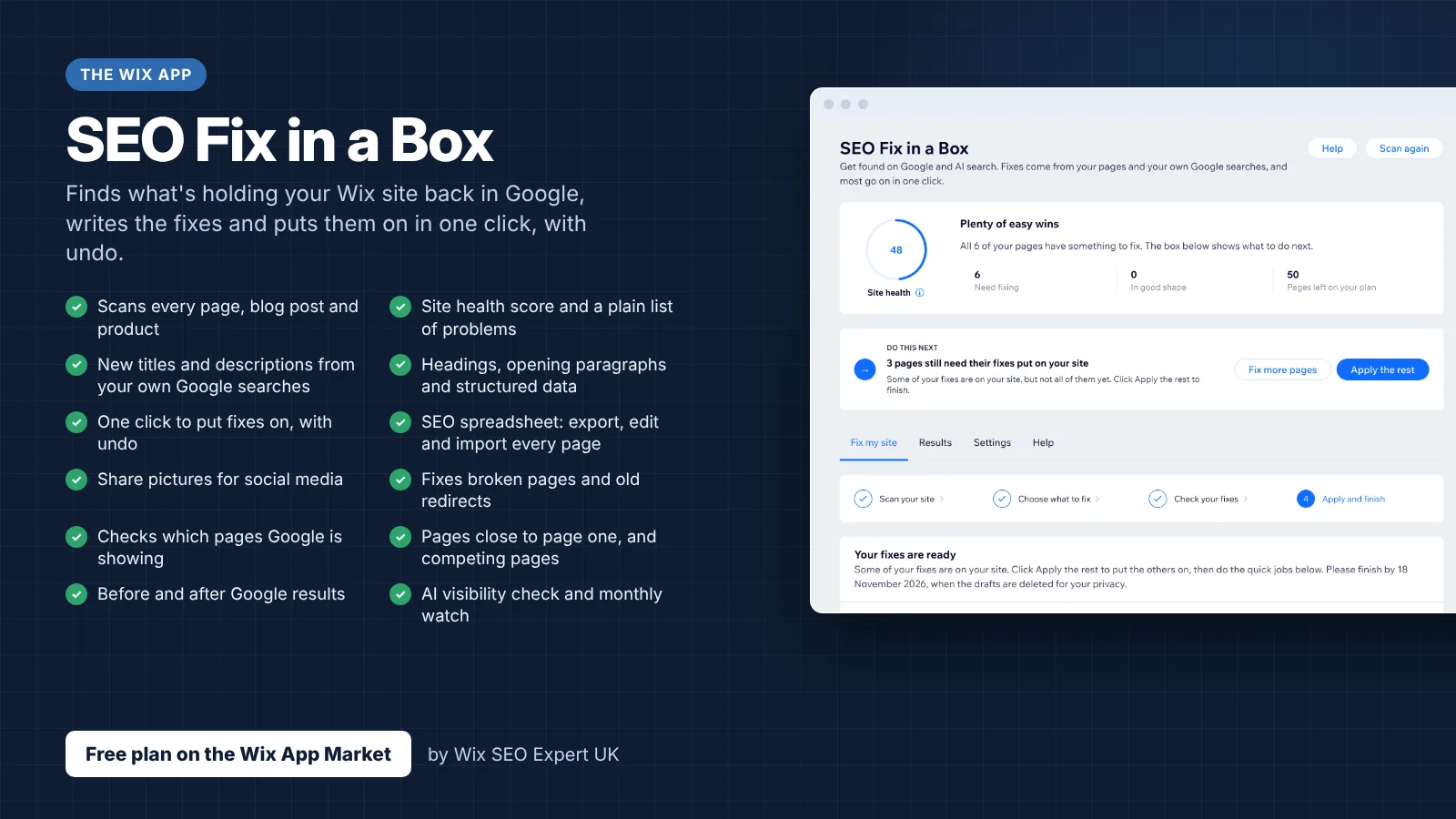
- SEO Fix in a Box: My Wix app. Free to install, it scans your site and shows what needs fixing, and paid plans write the fixes from your own Google searches
Was this lesson useful?
It takes 1 minute to tell me. The course is free and I want to keep it that way, and your feedback shows me what is working and helps other people find it.
This lesson on Multi-language technical SEO: indexing and crawling is part of Module 34: Multi-Language & RTL Website SEO on Wix in The Most Comprehensive Complete Wix SEO Course in the World (2026 Edition). Created by Michael Andrews, a Wix Marketplace Legend Partner with 14 years of hands-on experience, 800 completed Wix SEO projects and 456 verified five-star reviews.