Local link building: 10 proven tactics in your town
Module 10: Link Building & Off-Page SEO | Lesson 127 of 683 | 62 min read
By Michael Andrews, Wix SEO Expert UK
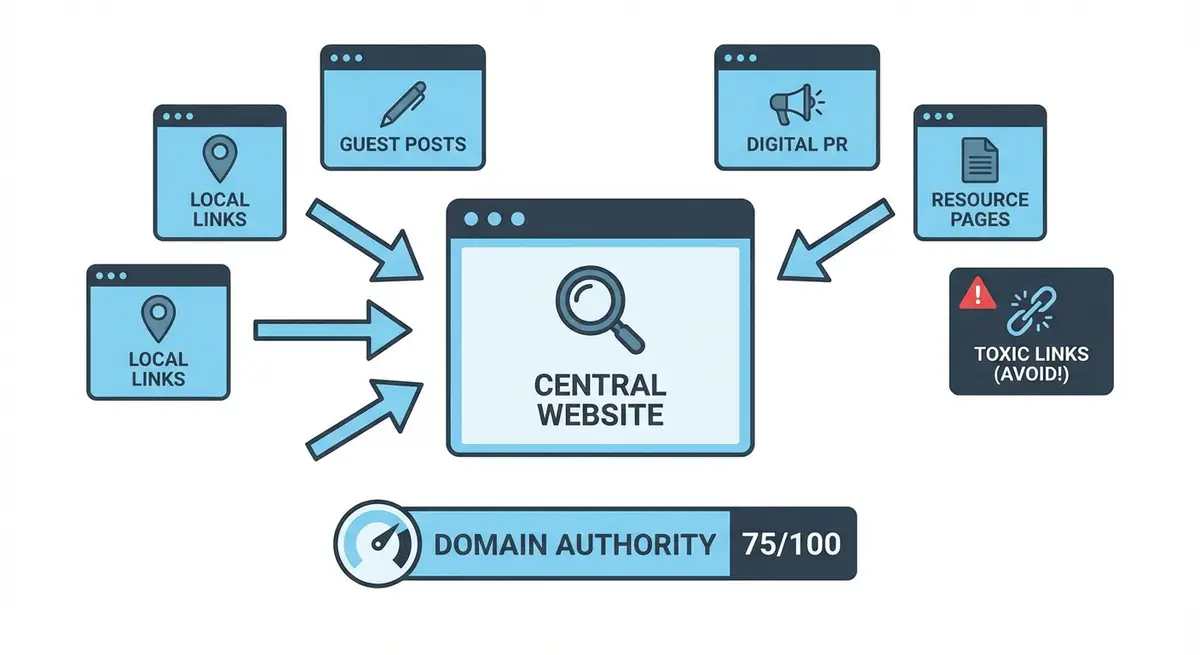
Local backlinks, links from websites geographically relevant to your business location, are among the most powerful signals in local SEO. They signal to Google that your business is a genuine, established part of its community. Unlike national or international link building, local links leverage relationships, community involvement and geographic proximity, giving small businesses advantages that multinational competitors simply cannot replicate. For Wix site owners targeting local customers, a focused local link building campaign can deliver faster ranking improvements than almost any other SEO activity. This lesson covers ten proven tactics in depth, with real-world examples, outreach templates and a systematic campaign framework that any local business can execute.
Why Local Links Are Uniquely Powerful
Google's local search algorithm uses three primary factors: relevance, distance and prominence. Local backlinks directly strengthen the prominence signal, which measures how well-known and established your business is. A link from your local Chamber of Commerce, a town council website or a regional newspaper tells Google that recognised local institutions consider your business noteworthy enough to link to. This geographic relevance signal is separate from general domain authority and specifically boosts your visibility in local search results and the Map Pack.
Local links also tend to have higher click-through rates and generate more qualified referral traffic than national links. Someone browsing their local council's business directory or reading the local newspaper is far more likely to be a potential customer than someone stumbling across your link on a random national directory. This means local link building delivers both ranking improvements and direct business value simultaneously.
Tactic 1: Chamber of Commerce Membership Links
Local Chambers of Commerce operate in virtually every town and city. Membership typically costs between 100 and 500 pounds per year, and almost every Chamber provides a member directory listing with a followed backlink to your website. These links carry strong local relevance signals and come from domains that Google recognises as legitimate local business authorities.
How to maximise your Chamber of Commerce link
- Search Google for "[your town] Chamber of Commerce" and visit their membership page to understand the tiers and benefits available.
- Choose the membership tier that includes a website link in the directory. Some Chambers offer enhanced listings with descriptions, logos and featured placements at higher tiers.
- When completing your directory profile, use your exact business name as it appears on your Google Business Profile. Include a keyword-rich business description and ensure your NAP details are identical to all other listings.
- Request that your listing links to a specific landing page on your Wix site rather than just your homepage, if the directory allows it. A link to your services page or a location-specific landing page passes more targeted relevance.
- Attend Chamber events and networking sessions to build relationships that can lead to additional link opportunities such as event sponsorships, newsletter features and committee membership.
Tactic 2: Local Business Associations and Networking Groups
Beyond the Chamber of Commerce, most areas have multiple business associations and networking groups with online directories. The Federation of Small Businesses (FSB), BNI (Business Network International), local enterprise partnerships, trade associations and industry-specific groups all offer member directories with backlinks. Each directory link adds another locally relevant referring domain to your profile.
- FSB membership includes a directory listing at fsb.org.uk which has strong domain authority and local business relevance.
- BNI chapters maintain local websites with member profiles and links. BNI domains carry good authority because of the organisation's global network.
- Trade associations for your specific industry (e.g., Federation of Master Builders, Institute of Plumbing and Heating Engineering) provide niche-relevant directory links.
- Local enterprise partnerships and business hubs often maintain online directories of local businesses they support.
- Aim to join 3-5 organisations that are genuinely relevant to your business. Each one adds a unique referring domain with local relevance.
Tactic 3: Local Press and News Coverage
Links from local newspapers and news websites are among the most valuable local backlinks available. Local press domains like your regional BBC news site, local newspaper website, or online-only local news publications carry strong authority and high trust signals. A single editorial link from a local news site can be worth more than 50 directory links combined.
The key to earning press links is providing genuinely newsworthy angles. Journalists do not care about your new website, product launch or business anniversary unless there is a story that serves their readers. Focus on angles that are genuinely interesting to the local community.
- Charity initiatives: "Local business raises X amount for Y charity through community event"
- Job creation: "Manchester firm creates 20 new jobs in local expansion"
- Expert commentary: position yourself as a local expert source on trending topics in your industry
- Community impact stories: how your business is making a tangible difference in the local area
- Data and research: "Survey reveals X% of [town] residents struggle with [problem your business solves]"
- Milestones with human interest: a family business reaching a significant anniversary, especially with personal stories
Tactic 4: Charity and Community Sponsorships
Sponsoring local charities, community events, school fairs and sports tournaments is one of the most reliable ways to earn local backlinks. Organisations that receive sponsorship almost always acknowledge their sponsors on their website, typically on a dedicated sponsors page with logos and links. These links carry genuine local relevance and the added benefit of positive community association for your brand.
How to find and leverage sponsorship opportunities
- Search Google for "[your town] charity events" and "[your town] community events" to identify upcoming opportunities.
- Contact local schools about sponsoring sports days, fairs, or educational programmes. School websites often link to sponsors.
- Approach local sports clubs about kit sponsorship, match day sponsorship or tournament sponsorship. Most clubs maintain a sponsors section on their website.
- Before committing, verify that the sponsorship package includes a website link. Some organisations only offer logo placement without a hyperlink.
- Provide the exact URL and anchor text you want used, making it easy for the organisation to add your link correctly.
- Ask for the link to be a followed link within the main content area, not a nofollow link in a footer or sidebar.
Tactic 5: Local Sports Team Sponsorship
Local football clubs, cricket teams, rugby clubs and other sports organisations actively seek sponsors and almost universally maintain websites with sponsor sections. Kit sponsors typically receive prominent placement including a logo and link on the club homepage or a dedicated sponsors page. These links are locally relevant, often from domains with moderate authority, and they tend to persist for the duration of the sponsorship agreement.
The cost of sponsoring a local sports team is often surprisingly low. Grassroots and youth teams may offer kit sponsorship for as little as 200-500 pounds, which buys a full season of brand visibility plus a permanent backlink on their website. Compare this to the cost of acquiring a similar-quality link through content creation and outreach, and sports sponsorship often represents the best ROI in local link building.
Tactic 6: Supplier and Partner Cross-Linking
If your business has suppliers, partners, or complementary local businesses, there are natural link opportunities that both parties benefit from. The key is to make these links editorial and contextual rather than simple reciprocal link exchanges, which Google devalues.
- Ask suppliers if they have a "stockists" or "our customers" page where they list businesses that use their products.
- Propose writing a case study or testimonial for a supplier's website that includes a link back to your Wix site.
- Create a "partners and suppliers we trust" page on your Wix site that links to local businesses you genuinely recommend. Let them know, and many will reciprocate with a similar page.
- Collaborate on joint content with complementary businesses. A plumber and an electrician could co-create a "complete home renovation guide" and both host it with cross-links.
- Avoid simple link swaps where two sites just add each other to a blogroll. Google recognises and devalues obvious reciprocal link schemes.
Tactic 7: Local Bloggers and Content Creators
Most towns and cities have local bloggers, influencers and content creators who write about food, lifestyle, events and businesses in the area. A feature on a local blog provides a contextual, editorially-placed backlink wrapped in positive content about your business. These links are particularly valuable because they come with genuine brand exposure and often drive referral traffic from a highly relevant local audience.
Identify local bloggers by searching for "[your town] blog," "[your town] food blogger," or "[your town] lifestyle" on Google and social media. Follow their work, engage with their content genuinely, and then propose a collaboration that benefits their audience. This could be a product review, a behind-the-scenes tour of your business, a sponsored post (with appropriate disclosure), or an expert interview on a topic related to your industry.
Tactic 8: Local Events and Listings
If your business hosts workshops, open days, classes or community events, local events listing sites provide free backlink opportunities. Many local councils maintain "What's On" pages, and sites like Eventbrite, Meetup and local community calendars offer profile and event pages with links back to your website.
- Submit events to your local council's events calendar or What's On page.
- Create events on Eventbrite even for free workshops, as Eventbrite pages pass link equity and drive registrations.
- List recurring classes or meetups on Meetup.com for additional referral traffic and backlinks.
- Submit to local entertainment and lifestyle listing sites specific to your area.
- If you do not currently host events, consider starting a monthly workshop, talk or networking event specifically to generate these linking opportunities.
Tactic 9: Educational Institution Links
Links from .ac.uk (UK) and .edu (US) domains carry exceptional authority because Google recognises these as trustworthy institutional domains. Local schools, colleges and universities offer multiple link building opportunities if you are willing to contribute genuine value to their educational mission.
- Offer to give guest lectures, career talks or industry presentations. Universities often link to guest speakers on their events pages.
- Provide work placements, internships or apprenticeships. Educational institutions typically link to companies that offer these opportunities.
- Sponsor student awards, scholarships or competitions. These almost always earn links from the institution's website.
- Contribute to careers fairs or industry days. Schools link to participating businesses on their careers pages.
- Collaborate on student projects or research initiatives. Academic departments often link to industry partners on their project pages.
Tactic 10: Local Council and Government Resource Pages
Local council websites (.gov.uk domains) carry exceptional authority and trust. Many councils maintain business directories, resource pages, local service listings and community partner pages. Getting your Wix site listed on these pages provides one of the most authoritative local backlinks available.
How to get listed on local council resource pages
- Visit your local council website and search for business directories, resource pages, or "support local business" sections.
- Check if your council has an approved trader or trusted business scheme with an online directory.
- Look for community partner listings if your business participates in community initiatives.
- Contact the council's business development or economic development team to ask about directory inclusion opportunities.
- If your business provides a community service (e.g., mental health support, youth services), check if the council has a relevant service directory.
Complete How-To Guide: Executing a Local Link Building Campaign
This systematic guide takes you through the entire local link building process from initial audit through to a fully operational, repeatable campaign that generates high-quality local backlinks month after month.
Follow these steps to execute a local link building campaign
- Step 1: Audit your existing local backlinks by going to Google Search Console, then Links, then Top Linking Sites. Identify which local websites already link to you and categorise them by type (directory, press, partner, sponsorship, other) to understand your starting point.
- Step 2: Search Google for your local Chamber of Commerce and apply for membership. Complete your directory profile with your exact business name, NAP details matching your Google Business Profile, a keyword-rich description and a link to your most relevant page.
- Step 3: Identify and join 3-5 additional local business associations and networking groups such as FSB, BNI and industry-specific trade bodies. Complete your online directory profiles for each with consistent NAP information and website links.
- Step 4: Build a local media list of every journalist, blogger and content creator covering business or your industry in your area. Include their name, publication, email, social handles and recent relevant articles. Aim for at least 20 contacts.
- Step 5: Develop 3 genuinely newsworthy story angles about your business that would interest local readers. Focus on community impact, job creation, charity work, expert commentary or original local data rather than product promotions.
- Step 6: Pitch your strongest story to your top 5 local press contacts with a personalised email that leads with the reader benefit, provides a ready-to-use quote and offers high-resolution images.
- Step 7: Research local sponsorship opportunities by searching for community events, charity fundraisers, school fairs and sports clubs in your area. Create a shortlist of 10 opportunities that include website backlinks in their sponsorship packages.
- Step 8: Commit to 2-3 sponsorships per year that provide the best combination of brand visibility, community goodwill and website link value. Provide your preferred URL and anchor text to each organisation.
- Step 9: Identify complementary local businesses that are not direct competitors and propose mutually beneficial content collaborations or cross-linking partnerships with genuine editorial context.
- Step 10: Search for local council resource pages, business directories and service listings on your council website. Submit your business for inclusion with accurate category selection and a compelling description.
- Step 11: Research local educational institutions and identify opportunities to contribute as a guest speaker, work placement provider, student competition sponsor or careers fair participant. Contact the relevant departments to propose your involvement.
- Step 12: Create a tracking spreadsheet recording every outreach activity with columns for target website, contact person, date contacted, follow-up date, outcome and link status. Review this weekly to maintain momentum.
- Step 13: Set a recurring monthly audit where you re-export your GSC backlink data, check for new local referring domains, verify that existing links are still live and identify any new local link opportunities that have emerged.
- Step 14: After 3 months, review your results to determine which tactics generated the most links per hour invested. Double down on the highest-performing approaches and scale back those with low response rates.
Essential Tools for This Lesson
- Google Search Console - Links: Audit your existing backlink profile and monitor new referring domains
- Hunter.io: Find email addresses for local journalists, bloggers and business contacts
- Ahrefs Free Backlink Checker: Check Domain Rating and referring domains for potential link targets
- BrightLocal: Local SEO audit tool that identifies citation and link opportunities in your area
- SEO Fix in a Box: My Wix app. Free to install, it scans your site and shows what needs fixing, and paid plans write the fixes from your own Google searches
Was this lesson useful?
It takes 1 minute to tell me. The course is free and I want to keep it that way, and your feedback shows me what is working and helps other people find it.
This lesson on Local link building: 10 proven tactics in your town is part of Module 10: Link Building & Off-Page SEO in The Most Comprehensive Complete Wix SEO Course in the World (2026 Edition). Created by Michael Andrews, a Wix Marketplace Legend Partner with 14 years of hands-on experience, 800 completed Wix SEO projects and 456 verified five-star reviews.