How to identify your real SEO competitors (not who you think they are)
Module 23: Competitor Analysis & Competitive SEO Strategy for Wix | Lesson 279 of 683 | 55 min read
By Michael Andrews, Wix SEO Expert UK
Most Wix website owners make a critical mistake before they even begin competitor analysis: they assume their business competitors are the same as their SEO competitors. They are not. Your business competitor is the company down the road that offers the same service. Your SEO competitor is whoever ranks in the top ten Google results for the keywords you want to rank for, and that could be a blog, a directory, a news site, an international corporation or a completely unrelated business that happens to target the same search terms. This comprehensive lesson teaches you how to identify your real SEO competitors, categorise them into actionable groups, and build a competitor hit list that will inform every strategic SEO decision you make for your Wix website.

Why Your Business Competitors Are Not Your SEO Competitors
Imagine you run a boutique wedding photography business in Manchester. Your offline business competitors are other wedding photographers in Manchester. But when you search for "wedding photographer Manchester" on Google, you might find that the first page is dominated by directories like Hitched, Bark, and The Wedding Guide, along with a few aggregate review sites and perhaps one or two individual photography studios. Those directories and review platforms are your SEO competitors. They are the websites you need to outrank to gain visibility, and they require entirely different strategies to overtake than another local photographer.
This distinction matters because your SEO strategy must be calibrated against the sites you actually need to beat in the SERPs, not against businesses you think you are competing with. If you analyse the wrong competitors, you will draw the wrong conclusions about content length, backlink requirements, domain authority thresholds, and keyword targeting strategies. Everything downstream from competitor identification depends on getting this step right.
The Three Types of SEO Competitors
1. Direct SEO Competitors
Direct SEO competitors are websites that sell similar products or services and target the same keywords as you. These are the closest to your traditional business competitors but filtered through the lens of organic search. A direct SEO competitor for a Wix-built bakery in Leeds would be another bakery that ranks for "custom birthday cakes Leeds" or "wedding cakes near me". They are targeting the same customers with the same intent through the same search queries.
2. Indirect SEO Competitors
Indirect SEO competitors are websites that do not sell the same products or services but compete for the same keyword real estate. Directories like Yelp, Yell, and Bark dominate local search results across hundreds of industries. Recipe blogs compete with restaurant websites for food-related keywords. Review aggregators compete with service providers for "best [service] in [location]" queries. These indirect competitors often have massive domain authority that makes them formidable opponents in the SERPs.
3. Aspirational SEO Competitors
Aspirational SEO competitors are websites with significantly more authority, traffic and resources than yours, but they represent where you want to be in 12 to 24 months. You probably cannot outrank them today, but studying their strategies reveals the playbook you need to follow. For a Wix-based ecommerce store selling handmade jewellery, an aspirational competitor might be Etsy or Not On The High Street. You will not outrank them for "handmade silver necklace" anytime soon, but analysing their content structure, internal linking and keyword coverage shows you exactly what Google considers authoritative in your space.
Method 1: Manual Google Search Analysis
The simplest and most immediate method for identifying SEO competitors is performing the searches yourself. Open a Google Incognito or Private Browsing window to avoid personalised results, and systematically search for your target keywords. Record every domain that appears on page one for each keyword. After 15 to 20 searches, you will begin to see patterns: certain domains appear repeatedly, and those are your primary SEO competitors.
How to perform a manual SEO competitor audit
- Open a Google Incognito window (Ctrl+Shift+N in Chrome) to remove personalisation
- Prepare a spreadsheet with columns for Keyword, Position, Domain, Page URL, Content Type and Notes
- Search for your 15-20 most important target keywords one at a time
- For each search, record every domain on page one (positions 1-10), ignoring paid ads
- Note the content type for each result: homepage, service page, blog post, directory listing, video, or other
- Highlight domains that appear for 3 or more of your target keywords as they are your primary competitors
- Note any SERP features present: featured snippets, People Also Ask, local pack, image pack, video carousel
- Record which domains own those SERP features as these represent additional competitive positions
- Repeat this process using location-modified keywords if you serve specific geographic areas
- Categorise each competing domain as Direct, Indirect or Aspirational using the framework above
Method 2: Using Google Search Console to Find SERP Competitors
Google Search Console is an underutilised goldmine for competitor identification. While it does not directly show you your competitors, it reveals the keywords your site already appears for, which positions you hold, and your click-through rates. This data tells you exactly where competitors are outranking you and by how much.
Using GSC for competitor identification
- Open Google Search Console and navigate to Search Results (Performance) report
- Set the date range to the last 6 months for a meaningful data set
- Enable Average Position, Total Impressions, Total Clicks and Average CTR columns
- Sort by Impressions (highest first) to see keywords where you have the most visibility
- Filter for keywords where your average position is 5-20: these are your "striking distance" keywords where competitors are just ahead of you
- For each striking distance keyword, open a new Incognito tab and search for it on Google
- Record the domains ranking in positions 1-4 above you for each keyword
- These domains are your most actionable SEO competitors because small improvements could leapfrog them
- Export the full GSC data to a spreadsheet for cross-referencing with tool-based analysis
Method 3: Ahrefs for Discovering Organic Competitors
Ahrefs is the industry-standard tool for competitor analysis. Its Site Explorer and Organic Competitors features use a database of billions of keywords to identify which websites share the most organic keyword overlap with your site. This data-driven approach reveals competitors you might never have found through manual searching.
How to use Ahrefs to find SEO competitors
- Log in to Ahrefs and navigate to Site Explorer
- Enter your Wix website domain and select the appropriate country for your target market
- Click on Organic Competitors in the left sidebar under Organic Search
- Ahrefs will display a bubble chart showing your organic competitors plotted by shared keywords and traffic
- Domains in the top-right quadrant share the most keywords with you and receive the most traffic: these are your primary SEO competitors
- Click on any competitor domain to see exactly which keywords you both rank for
- Use the Content Gap tool (under Site Explorer) to find keywords your competitors rank for that you do not
- Export the competitor list and categorise each domain as Direct, Indirect or Aspirational
- Note each competitor's Domain Rating (DR) as a benchmark for the authority level required in your niche
Understanding the Ahrefs Organic Competitors Report
The Organic Competitors report displays a scatter plot where the X axis represents the number of shared keywords between your site and a competitor, and the Y axis represents the competitor's total organic traffic. Competitors positioned further to the right share more keywords with you, making them more relevant to your analysis. Competitors positioned higher on the Y axis receive more overall organic traffic, suggesting higher domain authority and more established SEO.
Focus your initial analysis on competitors in the top-right quadrant: they share many of your keywords and receive significant traffic. Then examine the bottom-right quadrant for smaller competitors who target similar keywords but have not yet achieved high traffic, as these may be the most beatable targets.
Method 4: SEMrush for Competitor Discovery
SEMrush offers a Competitors report that identifies domains competing with yours in organic search. It also provides the Keyword Gap tool, Market Explorer and Traffic Analytics for comprehensive competitive intelligence. If you do not have an Ahrefs subscription, SEMrush is an equally powerful alternative.
Using SEMrush to find organic competitors
- Log in to SEMrush and enter your domain in the search bar
- Navigate to Organic Research > Competitors from the left sidebar
- SEMrush displays a competitive positioning map showing your domain against identified competitors
- Review the Common Keywords column to see how much keyword overlap exists with each competitor
- Sort by Common Keywords to prioritise competitors with the highest overlap
- Click on any competitor to deep-dive into their keyword profile
- Use the Keyword Gap tool to compare up to 5 domains simultaneously, revealing keyword opportunities
- Export the competitor list and cross-reference with your Ahrefs findings for a comprehensive view
Method 5: Free Alternatives for Budget-Conscious Wix Owners
Not every Wix site owner has the budget for Ahrefs or SEMrush. Fortunately, several free and freemium tools can help you identify SEO competitors effectively.
- Ubersuggest (neilpatel.com/ubersuggest): Enter your domain to see a basic organic competitors list with shared keywords and estimated traffic. The free tier allows 3 searches per day.
- Google Search Console: Completely free. Identifies keywords you rank for and reveals striking distance opportunities where competitors sit above you.
- Similarweb Free: Enter any competitor domain to see estimated traffic sources, top keywords and related sites. Limited to 5 results per query on the free plan.
- SpyFu: Enter your domain to see organic competitors with keyword overlap data. The free version provides limited but useful competitive insights.
- Moz Free Domain Analysis: Check any domain's Domain Authority and top ranking keywords. Limited to 10 queries per month on the free plan.
- Keyword Surfer (Chrome extension): Shows search volume and related keywords directly in Google SERPs as you search, free and unlimited.
- SEOquake (Chrome extension): Displays SEO metrics for every result in Google SERPs, helping you assess competitor authority as you search.
Domain-Level vs Keyword-Level Competitors
An important distinction in competitor analysis is between domain-level competitors and keyword-level competitors. Domain-level competitors are websites that consistently appear alongside yours across many keywords, indicating broad competitive overlap. Keyword-level competitors are websites that compete with you for specific individual keywords but may not be overall rivals.
Domain-Level Competitors
These are the websites that share the highest percentage of your total keyword portfolio. If you track 200 keywords and a competitor ranks for 150 of them, that is a domain-level competitor. Understanding domain-level competitors helps you benchmark overall site authority, content volume and link profile requirements. Use Ahrefs Organic Competitors or SEMrush Competitive Positioning Map to identify these.
Keyword-Level Competitors
These are the specific pages that rank for individual keywords you are targeting. For any given keyword, the top 10 results might include a mix of domains, some of which only compete with you for that single term. Keyword-level analysis is more granular and informs your page-level optimisation strategy. Identify these through manual SERP analysis or by examining individual keyword rankings in Ahrefs or SEMrush.
Local vs National SEO Competitors
If your Wix site serves a local area, your competitive landscape splits into two distinct arenas: the local pack (map results) and the organic results below. These often feature entirely different competitors.
Local Pack Competitors
The Google Local Pack (the map with three business listings) is dominated by businesses with Google Business Profiles. Your local pack competitors are other businesses in your area with optimised GBP listings, strong review profiles, and consistent NAP citations. Tools like BrightLocal, Whitespark and Local Falcon help identify and track local pack competitors.
Organic Competitors Below the Map
The organic results below the local pack are often dominated by directories, review sites and aggregators. Yelp, Bark, Checkatrade, Trustpilot and industry-specific directories frequently outrank individual business websites. These indirect competitors require different strategies to compete against, often focusing on content quality, topical authority and niche-specific backlinks rather than local signals.
The Competitor Categorisation Framework
Once you have identified your SEO competitors using the methods above, categorise every competitor using this framework. This categorisation will determine how you approach each competitor in subsequent lessons on content gap analysis, backlink gap analysis and SERP strategy.
Categorise each competitor using this framework
- Tier 1 - Primary Targets: Direct competitors with similar domain authority (within 20 DR/DA points of your site) that you can realistically outrank within 6 months. These are your immediate focus.
- Tier 2 - Secondary Targets: Indirect competitors like directories and aggregators that dominate your keywords. You may not outrank them, but you can earn listings on their platforms while targeting keywords they miss.
- Tier 3 - Aspirational Targets: High-authority competitors with DR 70+ that represent your long-term goal. Study their strategies but do not try to compete head-on until you have built sufficient authority.
- Tier 4 - Quick Wins: Competitors with weaker content, fewer backlinks or lower authority that you could overtake with a single well-optimised page. Prioritise these for immediate results.
- Tier 5 - Monitor Only: Large platforms (Wikipedia, Amazon, government sites) that rank for some of your keywords. You will not outrank them; track them only to understand what Google values for those terms.
Building Your Competitor Hit List for Your Wix Site
The output of this entire process should be a structured Competitor Hit List: a living document that captures every important competitor, their key metrics, their tier classification and the specific keywords they compete with you for. This document becomes the foundation of your competitive SEO strategy and should be updated monthly.
How to build your competitor hit list
- Create a Google Sheet or Excel spreadsheet with the following columns: Competitor Domain, Competitor Type (Direct/Indirect/Aspirational), Tier (1-5), Domain Rating or Authority, Estimated Monthly Traffic, Number of Shared Keywords, Top Competing Keywords (list the top 5), Primary Content Type (blog, service pages, ecommerce, etc.), and Notes
- Populate the sheet using data from your manual SERP analysis, GSC findings and tool-based research
- Aim for 15-25 total competitors: 5-8 Tier 1, 3-5 Tier 2, 2-3 Tier 3, 3-5 Tier 4, and 2-3 Tier 5
- For each Tier 1 competitor, note their top 10 ranking keywords that overlap with your targets
- For each Tier 4 quick-win competitor, note the specific keywords and pages where you could realistically overtake them
- Add a Priority Score column (1-10) based on how actionable each competitor insight is
- Sort by Priority Score to create your order of operations for subsequent competitor analysis lessons
- Set a monthly calendar reminder to update this document with fresh data from your SEO tools
Competitor Overlap Analysis: Finding Your True Battleground
Competitor overlap analysis examines where multiple competitors converge on the same keywords, revealing the true battleground of your niche. Keywords where 3 or more of your competitors rank are likely the core terms of your industry and should be top priorities. Keywords where only one competitor ranks might represent untapped niches or less competitive opportunities.
How to run a competitor overlap analysis
- In Ahrefs, use the Content Gap tool and enter 3-5 of your Tier 1 competitors in the target fields
- Set the filter to show keywords where at least 2 of the listed competitors rank in the top 10
- Export the results and sort by search volume to see the highest-value shared keywords
- In SEMrush, use the Keyword Gap tool with the same competitors to cross-validate
- Create a Venn diagram (use a tool like Canva or Lucidchart) showing keyword overlap between your top 3 competitors
- Identify keywords that ALL competitors rank for: these are your must-have keywords
- Identify keywords that only ONE competitor ranks for: these are potential easy wins or niche opportunities
- Map each overlap keyword to a specific page on your Wix site, or note it as a new page to create
How to Track Competitor Movements Over Time
Competitor analysis is not a one-time activity. Your competitors are constantly publishing new content, building new backlinks, and adjusting their strategies. Set up ongoing monitoring to detect competitive shifts before they impact your rankings.
- Set up Ahrefs Alerts for your top 5 competitors to receive email notifications when they gain or lose significant keywords or backlinks
- Use SEMrush Position Tracking to monitor your keyword rankings against specific competitors over time
- Create a Google Alert for each competitor's brand name to stay informed about their PR, partnerships and content marketing
- Check competitors' blogs and social media monthly to identify new content themes or strategy shifts
- Use Wayback Machine (web.archive.org) to view historical versions of competitor sites and track their evolution
- Review your GSC data monthly to identify new domains that have started appearing for your keywords
- Run a full competitor audit quarterly using the complete process outlined in this lesson
Complete How-To Guide: Building Your SEO Competitor Hit List from Scratch
This step-by-step guide consolidates everything covered in this lesson into a single actionable workflow. Follow these steps in order to build a comprehensive competitor hit list for your Wix website.
Follow these steps to build a complete SEO competitor hit list
- Prepare your keyword list: compile 20-30 of your most important target keywords across all categories (head terms, long-tail, local, informational and transactional)
- Open a Google Incognito window and search for each keyword, recording every domain that appears on page one in a spreadsheet
- Open Google Search Console and export your Performance data for the last 6 months, filtering for keywords in positions 5-20 to identify striking distance competitors
- If you have Ahrefs access, enter your domain in Site Explorer and visit Organic Competitors to identify data-driven competitors
- If you have SEMrush access, run the Organic Research Competitors report and the Keyword Gap tool for additional competitor data
- If you are using free tools, run your domain through Ubersuggest and Similarweb Free to identify basic competitor information
- Compile all identified competitors into a single master spreadsheet, removing duplicates
- For each competitor, record their domain authority (using Moz, Ahrefs DR or SEMrush Authority Score), estimated monthly organic traffic, and number of shared keywords with your site
- Categorise each competitor as Direct, Indirect or Aspirational based on the framework in this lesson
- Assign each competitor a Tier (1-5) based on their authority relative to yours and the realistic timeframe to outrank them
- For Tier 1 competitors, list the top 10 keywords where they outrank you and note the content format they use for each
- For Tier 4 quick-win competitors, identify the specific pages and keywords where you could overtake them with minimal effort
- Add a Priority Score (1-10) to each competitor based on how actionable and impactful the insights are
- Sort the entire spreadsheet by Priority Score to create your order of operations
- Save this document and set a monthly calendar reminder to refresh the data and check for new competitors entering your space
- Share the competitor hit list with anyone involved in your Wix site content creation and SEO strategy
Competitor Identification Tools
- Ahrefs Site Explorer: Industry-leading organic competitor analysis with Organic Competitors report and Content Gap tool
- SEMrush: Comprehensive competitor analysis with Keyword Gap, Organic Research and Market Explorer tools
- Google Search Console: Free tool to identify striking distance keywords where competitors outrank you
- Ubersuggest: Free competitor analysis showing organic competitors, keyword overlap and traffic estimates
- Similarweb: Free traffic analysis and competitor discovery showing top keywords and referral sources
- SpyFu: Competitor keyword research showing organic and paid keyword overlap
- BrightLocal: Local SEO competitor tracking, local pack monitoring and citation analysis
- BuiltWith: Technology lookup tool to identify which CMS (including Wix) competitors use
- Keyword Surfer: Free Chrome extension showing search volume and related keywords in Google SERPs
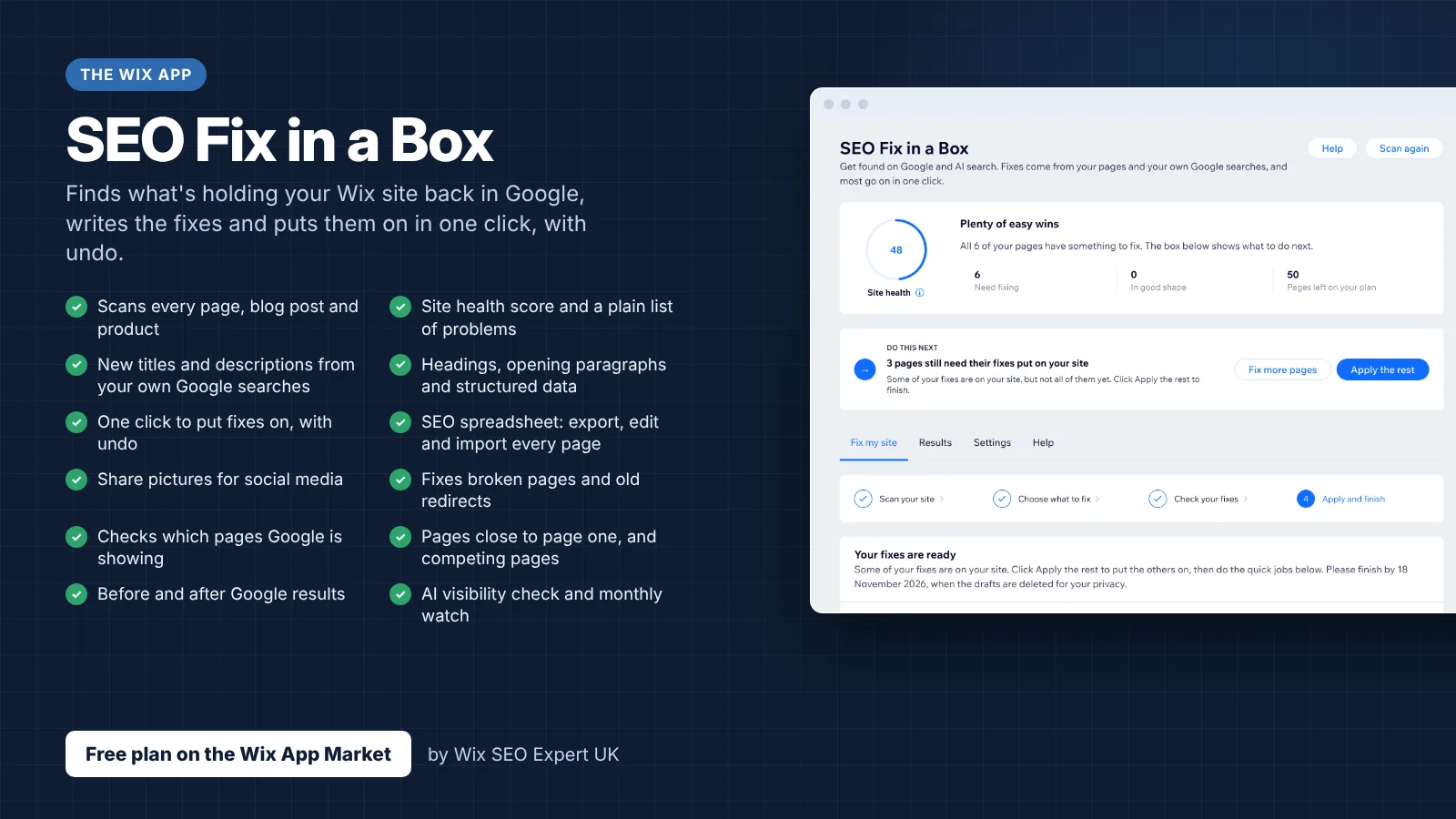
- SEO Fix in a Box: My Wix app. Free to install, it scans your site and shows what needs fixing, and paid plans write the fixes from your own Google searches
Was this lesson useful?
It takes 1 minute to tell me. The course is free and I want to keep it that way, and your feedback shows me what is working and helps other people find it.
This lesson on How to identify your real SEO competitors (not who you think they are) is part of Module 23: Competitor Analysis & Competitive SEO Strategy for Wix in The Most Comprehensive Complete Wix SEO Course in the World (2026 Edition). Created by Michael Andrews, a Wix Marketplace Legend Partner with 14 years of hands-on experience, 800 completed Wix SEO projects and 456 verified five-star reviews.