How to beat big brands in local search with a Wix site
Module 9: Local SEO Domination | Lesson 118 of 683 | 55 min read
By Michael Andrews, Wix SEO Expert UK
Local search is the great equaliser in digital marketing. A well-optimised Wix website run by a single business owner can consistently outrank national chains with million-pound marketing budgets. This is not motivational speak; it is a structural feature of how Google's local algorithm works. Local search rewards relevance, proximity, engagement and authentic local presence. Big brands struggle with all four of these because their scale prevents the personalisation, speed and community connection that local search rewards. This lesson dissects exactly why big brands fail in local search and gives you a systematic playbook for exploiting their structural weaknesses to dominate your local market.
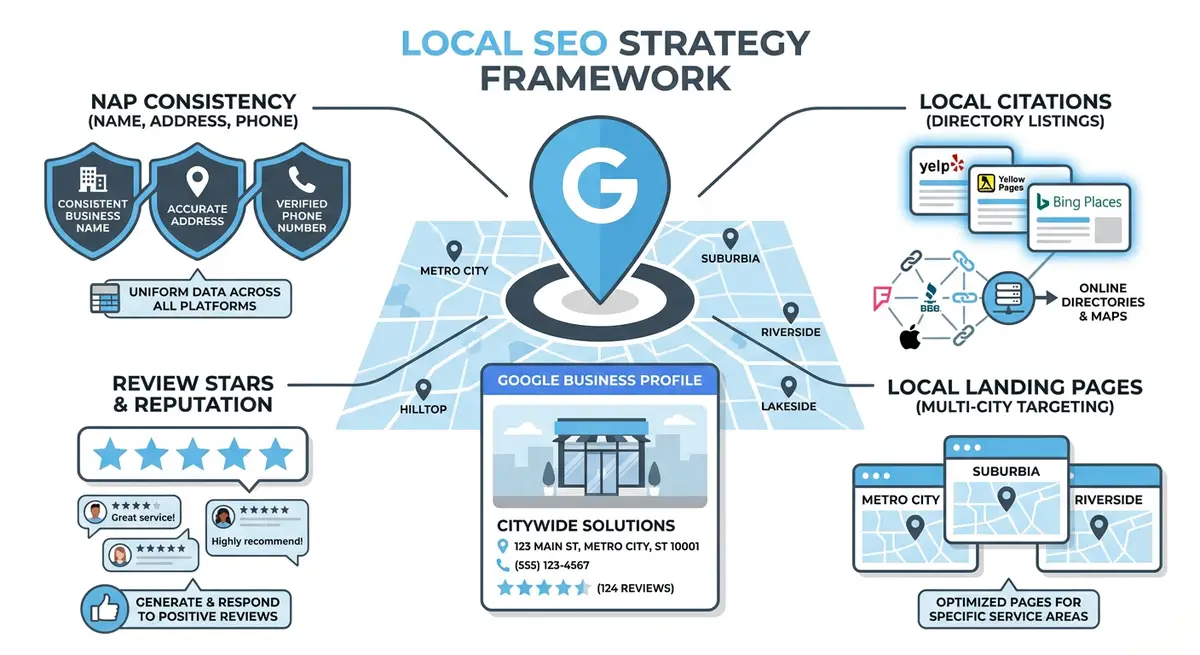
Why Big Brands Structurally Underperform in Local Search
Understanding the specific weaknesses of big brand local SEO explains why you have a genuine competitive advantage. These are not temporary oversights; they are structural limitations inherent to operating at scale.
- Generic location pages: national chains typically generate location pages from a central template where only the city name, address and phone number change. The remaining content is identical across hundreds of pages. Google treats this as thin, duplicate content.
- Neglected Google Business Profiles: big brands manage hundreds or thousands of GBP listings through centralised dashboards. Individual profiles rarely receive the weekly attention (posts, review responses, photo uploads) that drives Map Pack rankings.
- Template review responses: large brands use automated or template-based review responses. "Thank you for your feedback, [NAME]" with no personalisation signals disengagement to both Google and potential customers.
- No hyperlocal content: a national plumbing chain cannot write authentic content about the specific plumbing challenges in your neighbourhood. They lack the local knowledge that Google's algorithms increasingly reward.
- Slow adaptation: corporate decision-making means big brands take months to implement GBP changes, add new services or respond to local market conditions. You can act immediately.
- No local link building: big brands rarely invest in local link building at the individual branch level. They rely on domain authority rather than local relevance.
- Misaligned incentives: the marketing team at a national chain is measured on national KPIs, not on whether the Bolton branch ranks for "plumber in Bolton". Local SEO is systematically under-resourced.
Auditing Your Big Brand Competitors
How to identify and analyse big brand weaknesses
- Search Google for your top 10 "[service] [city]" keywords and note which national brands appear in results.
- For each big brand, visit their local landing page. Assess: is the content unique to this location? Or is it a template with the city name swapped?
- Check their Google Business Profile: when was their last post? How recent are their reviews? Do they respond to reviews? How many photos do they have?
- Compare their review response quality to a potential personalised response. Are they using templates?
- Check their local landing page word count. Big brand location pages are typically 200-400 words of template text.
- Look for local blog content on their site about your specific area. Most national brands have none.
- Check their backlink profile for local links: local press mentions, local business partnerships, local sponsorships. National brands rarely have these.
- Create a competitor weakness spreadsheet documenting every shortcoming you can exploit.
The Hyperlocal Content Advantage
Your greatest competitive advantage is authentic local knowledge. You live and work in your area. You know the neighbourhoods, the local issues, the community events and the specific needs of local customers. This knowledge is impossible for a national chain to replicate at scale.
- Write about specific local areas using neighbourhood names, not just city names. "Plumbing Services in Didsbury, South Manchester" is more targeted than what any national chain will create.
- Reference local landmarks, streets and areas that only someone who works there would mention.
- Comment on local developments that affect your service: new housing developments, local infrastructure changes, seasonal local conditions.
- Share local knowledge that demonstrates genuine expertise: "Victorian terraces in Chorlton commonly have lead pipe issues" shows specific local experience.
- Create local guides: "Best local suppliers for kitchen renovations in [City]" or "Understanding local building regulations in [Area]".
- Cover local events and community news related to your industry.
- Use real local photography from your actual work in the area, not stock photos.
Outperforming Big Brands on Google Business Profile
GBP actions that big brands cannot match
- Post on your GBP at least weekly with genuinely local content: recent work in the area, local tips, community involvement.
- Respond to every review within 24 hours with personalised, non-template responses that reference the specific service and location.
- Upload 3-5 new photos monthly showing real local work, team members and community involvement.
- Answer every Q&A question within 24 hours from the business owner account.
- Seed your Q&A section with 10-15 frequently asked local questions and detailed answers.
- Add every service as a separate entry with location-specific descriptions.
- Keep your products section updated with current offerings and pricing.
- Use Google Posts to share local offers, events and news that national brands ignore.
- Monitor and update your attributes regularly, checking for new options quarterly.
Local Link Building: Your Structural Advantage
Local link building is where small businesses have the most dramatic advantage over national chains. You have personal relationships in your community that can translate into high-authority local backlinks that no national brand will ever earn.
- Local Chamber of Commerce membership: provides a directory link and often networking opportunities that lead to additional links.
- Local press coverage: pitch genuine local stories to your local newspaper, BBC regional site or local online publications. A single editorial link from your local newspaper carries enormous local authority.
- Local charity sponsorship: sponsor a local event, fundraiser or charity initiative and earn a link from their website.
- Local sports team sponsorship: kit sponsorship for a local team typically includes a link on their website.
- Local business partnerships: partner with complementary local businesses for mutual website links and referrals.
- Local events: host or participate in local events and get listed on event pages with links to your site.
- Local educational connections: offer guest lectures, career talks or work placements to earn links from .ac.uk or .edu domains.
- Local council and government pages: submit your business for local business resource pages, support directories and community listings.
Review Strategy to Outpace Big Brands
Big brand local branches typically have moderate review counts (50-150) with average ratings (3.8-4.2). Their reviews are often mixed because corporate policy prevents branch-level personalisation in service delivery. Your personal, hands-on service naturally generates higher satisfaction and better reviews.
- Aim for higher review volume than your biggest local competitor. Check their review count and set a target to exceed it within 12 months.
- Maintain a rating above 4.5 through consistently excellent service (you cannot fake this with review generation tactics).
- Encourage customers to mention specific services and locations in their reviews.
- Respond to every review with genuine, personalised responses that showcase your personality and local knowledge.
- Display a side-by-side comparison on your Wix site: "Rated 4.9 stars with 200+ reviews" versus the big brand's lower rating.
- Use review content in your marketing: testimonials on location pages, review screenshots on social media.
Long-Term Local SEO Moat Building
The ultimate goal is to build a local SEO position so strong that it becomes extremely difficult for any competitor, big or small, to displace you. This requires sustained effort across multiple local ranking factors.
- Consistent content publication: 2-4 blog posts per month with local relevance builds topical authority over time.
- Growing review portfolio: steady monthly review accumulation creates a compounding advantage.
- Deepening local link network: each local relationship you build adds another link that competitors cannot easily replicate.
- Community involvement: genuine community engagement creates mentions, links and reputation signals that no SEO tactic can manufacture.
- Customer relationship network: long-term customer relationships generate repeat reviews, referrals and word-of-mouth that feed back into your local authority.
- Local brand recognition: over 12-24 months of consistent local visibility, your business becomes the default choice, creating a self-reinforcing cycle of searches, clicks and engagement signals.
FAQ: Competing with Big Brands
Can a small Wix site really outrank a national chain?
Yes, and it happens regularly. Google's local algorithm is explicitly designed to surface the most relevant result for each specific local search. A well-optimised small business with strong local signals consistently beats national chains that have generic location pages and neglected GBP profiles. Your advantage is relevance and engagement, not domain authority.
What if a big brand starts investing in local SEO?
Even if a national chain invests in local SEO, they face structural limitations: centralised management, template-based content, corporate approval processes and the inability to build genuine local relationships. Your advantage is speed, personalisation and authenticity. Continue investing in these strengths and the gap remains.
Essential Tools for This Lesson
- Google Business Profile: Manage your GBP listing to outperform big brand competitors on engagement and completeness
- BrightLocal Local Search Grid: Track your local rankings versus big brand competitors across your service area
- Ahrefs Free Backlink Checker: Compare your backlink profile to big brand competitors to find link building opportunities
- Google Search Console: Monitor your local page performance and identify keyword opportunities big brands are missing
- SEO Fix in a Box: My Wix app. Free to install, it scans your site and shows what needs fixing, and paid plans write the fixes from your own Google searches
Was this lesson useful?
It takes 1 minute to tell me. The course is free and I want to keep it that way, and your feedback shows me what is working and helps other people find it.
This lesson on How to beat big brands in local search with a Wix site is part of Module 9: Local SEO Domination in The Most Comprehensive Complete Wix SEO Course in the World (2026 Edition). Created by Michael Andrews, a Wix Marketplace Legend Partner with 14 years of hands-on experience, 800 completed Wix SEO projects and 456 verified five-star reviews.