How Google selects and generates sitelinks algorithmically
Module 7: Google Sitelinks: What They Are & How to Get Them on Wix | Lesson 93 of 683 | 50 min read
By Michael Andrews, Wix SEO Expert UK
Google uses a combination of algorithmic signals to decide which pages from your Wix website appear as sitelinks. Understanding exactly how this selection process works gives you a massive advantage because you can deliberately optimise each signal. This lesson breaks down every known ranking factor for sitelinks, backed by Google documentation and real-world testing across hundreds of Wix websites.
The Sitelinks Algorithm: What Google Has Confirmed
Google has published limited but important information about how sitelinks are generated. In their official documentation, Google states: "We only show sitelinks for results when we think they will be useful to the user. If the structure of your site does not allow our algorithms to find good sitelinks, or we do not think that the sitelinks for your site are relevant for the user's query, we will not show them."
This tells us three critical things. First, sitelinks are algorithmically generated, not manually assigned. Second, site structure is the primary factor. Third, relevance to the user query matters. For Wix website owners, this means your focus should be on creating a clear site structure with descriptive page titles and strong internal linking.
Signal 1: Site Hierarchy and Information Architecture
The single most important factor for earning sitelinks is having a clear, logical site hierarchy. Google needs to understand your website structure in order to identify your most important pages. For Wix sites, this means organising your pages into a clear parent-child relationship using the Wix page manager.

Ideal Wix site hierarchy for sitelinks
- Level 1 (Homepage): Your main landing page that establishes your brand and links to all major sections
- Level 2 (Main pages): 5-8 core pages such as Services, About, Contact, Blog, Portfolio, Pricing, FAQ. These are your primary sitelink candidates.
- Level 3 (Sub-pages): Individual service pages, blog posts, case studies, and other detailed content that supports Level 2 pages
- Level 4 (Deep pages): Only if necessary. Lesson pages, product variants, archived content. Keep depth to a minimum.
Signal 2: Internal Linking Weight and Distribution
Google uses internal links as a proxy for page importance. Pages that receive the most internal links from across your Wix site are considered more important and are therefore more likely to appear as sitelinks. This is similar to how PageRank works for external links, but applied within your own site.
- Header navigation links carry the most weight because they appear on every page of your site, giving those linked pages site-wide internal link equity
- Footer links carry moderate weight. Including your core pages in the footer reinforces their importance to Google
- In-content links within blog posts and page body text carry contextual weight, which Google values highly for understanding page relevance
- Sidebar and widget links carry some weight but less than primary navigation and in-content links
- The number of unique pages linking to a page matters more than the total number of links from a single page
Signal 3: Page Title Tags and Relevance
Each potential sitelink page must have a clear, descriptive title tag that tells Google what the page is about. Google uses title tags to generate the clickable text for each sitelink. If your title tags are vague, duplicated, or keyword-stuffed, Google will either skip that page or display a poor representation of your content.
Title tag best practices for sitelinks on Wix
- Keep each title tag unique across your entire Wix site. Duplicate titles confuse Google about which page to feature.
- Use descriptive, user-friendly language. "Our Services" is better than "Services Page" and "About Michael Andrews - Wix SEO Expert" is better than "About".
- Include your brand name consistently. A common pattern is "Page Description | Brand Name" or "Page Description - Brand Name".
- Keep titles under 60 characters to avoid truncation in the sitelinks display.
- Match the title to what users actually search for. If users search "Brand Name contact", your contact page title should clearly reflect that.
Signal 4: URL Structure and Click Patterns
Google considers your URL structure when selecting sitelinks. Clean, readable URLs that match your site hierarchy reinforce the structural signals Google needs. On Wix, you can customise each page URL slug in the Page SEO settings.
- Short, descriptive URL slugs like /services, /about, /contact work best for sitelink pages
- Avoid auto-generated Wix URLs with random characters or numbers
- Match your URL slug to your page title for consistency signals
- Use hyphens to separate words in URLs, never underscores or spaces
- Remove unnecessary Wix-generated URL prefixes where possible
Signal 5: User Click Behaviour (CTR Data)
Google tracks which pages users visit most frequently after clicking through to your site from search results. Pages that consistently receive more traffic and engagement are stronger candidates for sitelinks. This creates a reinforcing cycle: pages with sitelinks get more clicks, which strengthens their position as sitelinks.
Signal 6: Structured Data and Schema Markup
While schema markup alone does not guarantee sitelinks, it provides Google with additional structured information about your site that can influence sitelink selection and presentation. WebSite schema with a SiteNavigationElement and SearchAction can explicitly tell Google about your site structure and internal search functionality.
On Wix, you can add schema markup through the Wix SEO settings panel, custom code in the header, or through Velo for dynamic implementation. Lesson 6 in this module covers the specific schema types that support sitelinks in full detail.
Signal 7: Domain Age and Authority Metrics
Newer Wix websites need time to build the authority signals that trigger sitelinks. Google typically requires a website to have been indexed for several months and to have accumulated external links and brand mentions before it considers displaying sitelinks. There is no exact timeline, but most Wix sites that do earn sitelinks have been live for at least three to six months.
- Domain age: Older domains with consistent history are favoured. If you recently moved to Wix, your existing domain authority carries over.
- Backlink profile: External links from other websites signal authority. The more quality backlinks your Wix site has, the more likely sitelinks become.
- Brand mentions: Unlinked brand mentions across the web help Google associate your brand name with your website.
- Google Business Profile: Having a verified GBP linked to your domain strengthens brand authority signals.
- Social profiles: Consistent brand presence across social media platforms reinforces your entity in Google Knowledge Graph.
Why Some Wix Websites Never Get Sitelinks
Understanding common failure points helps you avoid the mistakes that prevent sitelinks from appearing.
- Generic brand name: If your business name is a common phrase, Google cannot determine a single definitive website for that query
- No clear site structure: Flat sites with all pages at the same level and no logical grouping confuse Google about page hierarchy
- Weak or missing navigation: If your Wix header menu does not link to all core pages, Google misses critical structural signals
- Duplicate or vague title tags: Multiple pages with the same or similar titles prevent Google from differentiating sitelink candidates
- Very thin content: Pages with only a few sentences do not qualify as useful sitelink destinations
- New domain with no backlinks: Without external authority signals, Google has insufficient confidence to display sitelinks
- Noindex on key pages: If important pages are accidentally set to noindex in Wix SEO settings, they cannot become sitelinks
Tools for Analysing Sitelink Signals
- Google Search Console: Performance data showing which pages rank for branded queries
- Screaming Frog: Crawl your Wix site to audit internal linking patterns and site hierarchy
- Sitebulb: Visual site architecture analysis and internal link distribution reports
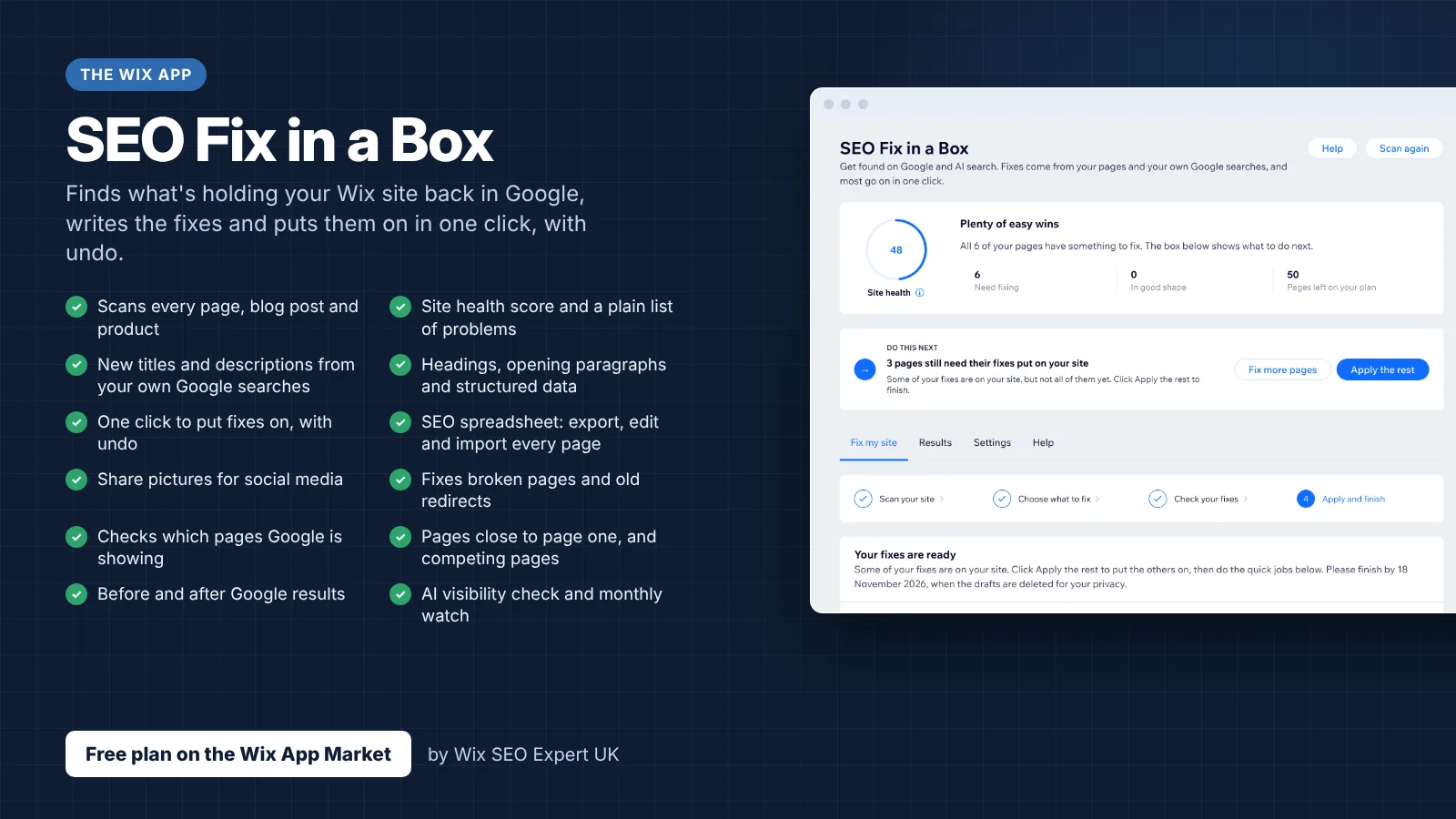
- SEO Fix in a Box: My Wix app. Free to install, it scans your site and shows what needs fixing, and paid plans write the fixes from your own Google searches
Was this lesson useful?
It takes 1 minute to tell me. The course is free and I want to keep it that way, and your feedback shows me what is working and helps other people find it.
This lesson on How Google selects and generates sitelinks algorithmically is part of Module 7: Google Sitelinks: What They Are & How to Get Them on Wix in The Most Comprehensive Complete Wix SEO Course in the World (2026 Edition). Created by Michael Andrews, a Wix Marketplace Legend Partner with 14 years of hands-on experience, 800 completed Wix SEO projects and 456 verified five-star reviews.