Guest posting: the right way (and pitfalls to avoid)
Module 10: Link Building & Off-Page SEO | Lesson 128 of 683 | 60 min read
By Michael Andrews, Wix SEO Expert UK
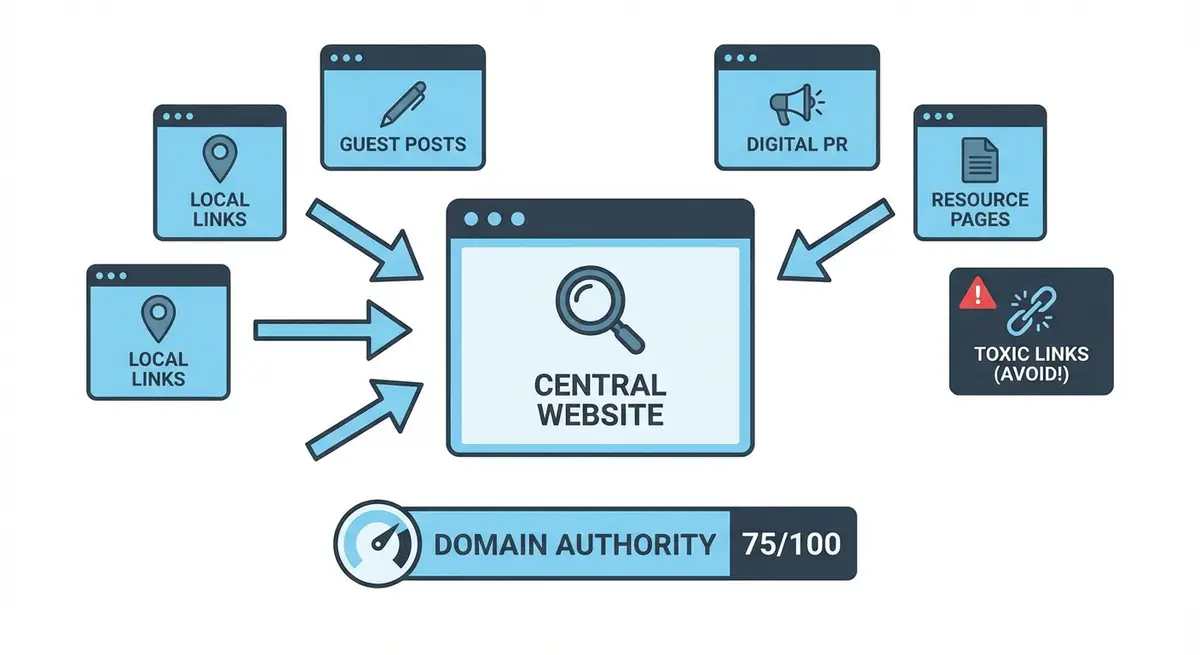
Guest posting on genuinely authoritative, relevant websites remains one of the most effective link-building strategies available in 2026. A well-placed guest article on a respected industry publication does three things simultaneously: it earns a high-quality backlink to your Wix site, positions you as an expert in your field, and exposes your brand to an entirely new audience that is already interested in your topic. However, the internet is littered with low-quality guest post farms, pay-for-placement schemes and private blog networks that can devastate your rankings rather than improve them. This lesson teaches you the complete guest posting process, from identifying legitimate opportunities to building lasting relationships with editors that yield links for years to come, while avoiding every pitfall that could trigger a Google penalty.
Why Guest Posting Still Works in 2026
Google has repeatedly stated that large-scale guest posting for links is a violation of its guidelines. Yet guest posting remains one of the most widely used and effective link building tactics among respected SEO professionals. The distinction lies in approach. Google targets mass-produced, low-quality guest posts placed on irrelevant sites purely for link acquisition. It does not penalise genuine expert contributions published on authoritative sites because these represent exactly the kind of editorial endorsement that links were designed to capture.
The key factors that make a guest post legitimate in Google's eyes are: the hosting site is a genuine publication with real readership, the content provides genuine value to readers, the author has genuine expertise in the topic, and the link is a natural part of the content rather than a forced insertion. When all four conditions are met, guest posting is simply what the content industry calls "contributed content," and it is a perfectly legitimate marketing channel.
Finding Quality Guest Post Opportunities
The quality of the sites you contribute to determines whether guest posting builds or damages your link profile. Spending time on rigorous vetting saves you from wasting effort on placements that provide no value or actively harm your rankings.
How to find legitimate guest posting opportunities
- Search Google for "[your niche] write for us," "[your niche] guest post guidelines," "[your niche] contribute an article," and "[your niche] submit a guest post" to find sites that openly accept contributions.
- Identify websites that regularly publish content in your niche by searching for your topic keywords and noting which sites consistently produce quality articles.
- Check each site's Domain Rating using the free Ahrefs Backlink Checker. Aim for DR 30 or higher for meaningful link value.
- Verify the site receives genuine organic traffic by checking it in Ahrefs, Semrush or SimilarWeb. Sites with less than 1,000 monthly organic visits may not pass meaningful authority.
- Read at least 5 recent articles on the site. Are they well-written by identifiable authors with real bylines and bios? Is the content genuinely useful or is it thin filler?
- Check the site's social media engagement. Real publications have active social accounts with genuine followers and engagement on shared articles.
- Verify the site is not part of a private blog network. Red flags include: every article is by a different "guest author," no consistent editorial voice, topics jump randomly between unrelated niches, and the site exists solely to publish guest content.
Evaluating a Site Before Writing
Even sites that accept guest posts and appear legitimate need thorough evaluation before you invest time writing for them. A poor guest post placement wastes your time at best and provides a toxic link at worst.
- Check the site's outbound link profile. If every guest post contains followed links to random commercial sites, Google likely already discounts links from this domain.
- Look at the comments section. Real publications have genuine reader comments. Sites with zero comments or only spam comments suggest low engagement.
- Search Google for "site:domain.com" to see how many pages are indexed. A site with thousands of pages but low traffic per page may be a content farm.
- Check whether the site uses rel="nofollow" on guest post links. Many legitimate publications now nofollow all outbound links in contributed content. If the value is purely the link, nofollow sites may not be worth the effort.
- Verify the site has proper legal pages (privacy policy, terms), an about page with real people, and contact information. Anonymous sites are red flags.
- Search the site's domain in Ahrefs' "Referring Domains" report. If most of the site's own backlinks come from other guest post sites, it is likely part of a link network.
Writing Pitches That Actually Get Accepted
The biggest reason guest post pitches fail is that they are obviously templated mass emails. Editors at quality publications receive dozens of pitches daily and can instantly spot generic outreach. Your pitch needs to demonstrate genuine familiarity with their publication, propose topics their audience specifically needs, and establish your credibility as an expert.
Crafting a pitch that stands out
- Open with a specific reference to a recent article on their site. Mention the title, something specific you liked or found useful, and why it resonated with you. This immediately signals you are not sending a mass template.
- Introduce yourself briefly with your relevant credentials. One or two sentences establishing your expertise and why you are qualified to write about this topic.
- Propose 2-3 unique topic ideas that are relevant to their audience but have not been covered recently on their site. Include a headline and 3-4 bullet point subtopics for each idea.
- Explain why each topic is timely and valuable for their specific readership. Reference recent industry trends, data, or audience needs that make the topic relevant right now.
- Include links to 2-3 of your best published articles (on your own Wix site or other publications) as writing samples that demonstrate your quality and expertise.
- Keep the entire pitch under 300 words. Editors are busy. Respect their time with a concise, well-structured email that makes it easy to say yes.
- Close with a simple question: "Would any of these topics be a good fit for [publication name]?" This invites a response without being pushy.
Writing Guest Content That Earns Ongoing Links
The guest post itself should be the best article the publication has received in months. This is not an exaggeration. Your first guest post determines whether you get invited back, whether the editor shares it on social media, and whether the article ranks in Google and continues to drive value for years.
- Write content that is significantly more detailed, actionable and well-researched than existing articles on the same topic. The publication's readers should immediately recognise the value.
- Use original data, screenshots, examples and case studies wherever possible. Generic advice that could appear on any website does not establish you as an expert.
- Follow the publication's style guide exactly. Match their formatting, tone, word count expectations and content structure.
- Include 1-2 natural contextual links to relevant pages on your Wix site within the body text. These should genuinely enhance the article for the reader.
- Use branded or descriptive anchor text for your links rather than exact-match keyword anchors. "A comprehensive guide to local SEO on our site" is natural; "best local SEO services" is manipulative.
- Include relevant internal links to other articles on the host publication. This makes the editor's job easier and demonstrates you care about their site, not just your link.
- Add original images, charts or infographics where they add value. Visual content increases time on page and social sharing, making the editor more likely to publish your future pitches.
What to Avoid at All Costs
Google's SpamBrain algorithm is specifically trained to identify manipulative link building patterns, including guest post spam. The following practices can trigger manual actions or algorithmic penalties that devastate your rankings.
- Paid guest posts with followed links. Google explicitly targets these as link spam. If a site charges for placement, the link must be rel="sponsored" to comply with guidelines.
- Private blog networks (PBNs): sites that exist solely to pass links. They are identifiable by thin content, dozens of "guest authors" with no real online presence, and random topical coverage.
- Guest posting on sites completely unrelated to your niche. A plumber publishing on a fashion blog is an obvious signal of link manipulation.
- Exact-match keyword anchor text in your bio or article links. A natural anchor text profile includes branded terms, URL anchors, and generic phrases alongside occasional keyword-relevant text.
- Mass outreach sending the same template to dozens of sites simultaneously. This approach yields low-quality placements and can create a pattern of spammy links.
- Publishing the same article (or slightly rewritten versions) on multiple sites. Google treats this as duplicate content and may penalise both the host site and the linked page.
- Using AI to generate guest posts without substantial human editing and expertise. AI-generated filler content is increasingly detectable and provides no genuine value.
Building Long-Term Editorial Relationships
The most valuable guest posting strategy is not about individual placements; it is about building ongoing relationships with editors at publications your audience reads. A single relationship with an editor who publishes your content quarterly is worth more than 20 one-off placements on random sites.
How to build lasting editorial relationships
- After your first guest post is published, send a genuine thank-you email to the editor and share the article on all your social channels, tagging the publication.
- Promote the article to your email list and drive traffic to it. Editors notice when guest contributors bring their own audience.
- Within 2 weeks, reply to the editor with a new topic suggestion. Reference the performance of your first article if it did well.
- If the publication has a social media presence, engage with their content regularly. Comment on articles, share posts, and build genuine visibility.
- Offer to update older articles you have written for them when the information becomes outdated. This demonstrates long-term commitment.
- If the publication hosts events or webinars, participate as a speaker or attendee. Face-to-face interaction strengthens online relationships.
- Aim to contribute 3-4 articles per year to your best relationships rather than one-off placements across dozens of sites.
Complete How-To Guide: Running a Successful Guest Posting Campaign
This step-by-step guide takes you from initial research through to a fully operational guest posting programme that consistently earns high-quality backlinks while building your industry reputation.
Follow these steps to run a successful guest posting campaign
- Step 1: Search Google using 5-10 variations of guest post search operators for your niche. Combine "[your niche] write for us," "[your niche] guest post guidelines," "[your niche] contribute," and "[your niche] become a contributor" to build an initial list of at least 30 potential target sites.
- Step 2: Vet each target site rigorously. Check Domain Rating in Ahrefs (aim for DR 30+), verify organic traffic exceeds 1,000 monthly visits, confirm the site publishes quality content from identifiable authors, and rule out any PBN or content farm characteristics.
- Step 3: Review the guest post guidelines for each qualifying site. Note their preferred topics, word count requirements, formatting preferences, link policies and submission process.
- Step 4: Check whether published guest posts include followed author bio links. Right-click the link in any existing guest author bio and inspect the HTML for rel="nofollow" attributes.
- Step 5: Create a campaign spreadsheet with columns for Domain, DR, Monthly Traffic, Contact Email, Pitch Status, Topic Pitched, Date Sent, Response, Publication Date and Link URL.
- Step 6: Read at least 3 recent articles on each target site. Take notes on their editorial style, audience level, content gaps and topics that perform well based on comment counts and social shares.
- Step 7: Craft a personalised pitch email for each of your top 10 targets. Open with a specific compliment about a recent article, propose 2-3 unique topic ideas with brief outlines, and include links to your best published writing as samples.
- Step 8: Send no more than 5 pitches per day. Spreading your outreach ensures each pitch receives proper personalisation and you can manage responses without becoming overwhelmed.
- Step 9: Follow up once after 5-7 business days if you receive no response. Add a new angle or detail to your follow-up rather than simply asking "did you get my email?"
- Step 10: When a pitch is accepted, write content that significantly exceeds the quality of existing articles on that site. Include original examples, data, screenshots and actionable steps that demonstrate genuine expertise.
- Step 11: Include 1-2 natural contextual links to relevant pages on your Wix site using branded or descriptive anchor text. Also include 2-3 internal links to other articles on the host site to demonstrate editorial goodwill.
- Step 12: Submit the article in the exact format requested by the publication. Include a professional author bio with your name, credentials, a brief description of your expertise and a link to your Wix site.
- Step 13: After publication, promote the article on your social channels, email it to your list, and send a thank-you to the editor. Propose your next topic idea within 2 weeks to establish an ongoing relationship.
- Step 14: Track every published guest post in your spreadsheet. Note the publication date, live URL, anchor text used, referral traffic in GA4, and any ranking improvements on your linked pages over the following 8-12 weeks.
Essential Tools for This Lesson
- Ahrefs Free Backlink Checker: Check Domain Rating, traffic estimates and link profiles for target publications
- Hunter.io: Find email addresses for editors and content managers at target publications
- Moz Link Explorer: Evaluate Domain Authority and check link attributes on potential guest post sites
- SimilarWeb: Verify traffic estimates and audience demographics for target publications
- Google Rich Results Test: Check if target sites have proper structured data indicating a legitimate publication
- SEO Fix in a Box: My Wix app. Free to install, it scans your site and shows what needs fixing, and paid plans write the fixes from your own Google searches
Was this lesson useful?
It takes 1 minute to tell me. The course is free and I want to keep it that way, and your feedback shows me what is working and helps other people find it.
This lesson on Guest posting: the right way (and pitfalls to avoid) is part of Module 10: Link Building & Off-Page SEO in The Most Comprehensive Complete Wix SEO Course in the World (2026 Edition). Created by Michael Andrews, a Wix Marketplace Legend Partner with 14 years of hands-on experience, 800 completed Wix SEO projects and 456 verified five-star reviews.