Google is showing the wrong title or meta description: how to fix SERP display issues
Module 50: Wix SEO Troubleshooting, Diagnostics & Common Fixes | Lesson 552 of 683 | 45 min read
By Michael Andrews, Wix SEO Expert UK
You have carefully crafted the perfect title tag and meta description for your Wix page, optimised them for your target keywords, and made sure they are compelling enough to earn clicks. Then you search Google and see something completely different. Google is showing a title you did not write, or a description that pulls random text from your page instead of your carefully crafted meta description. This is infuriating, but it is also extremely common. Google rewrites title tags and meta descriptions more often than most people realise, and understanding why Google does this and how to write titles and descriptions that Google will actually use is a critical SEO skill. This lesson explains exactly how Google's title and description generation systems work, why your Wix titles and descriptions get rewritten, and provides proven strategies to write SERP elements that Google will display as intended.

Why Google Rewrites Title Tags: The Complete Explanation
Google has been rewriting title tags since 2021 when it introduced its title generation system. Before this, Google typically used your exact title tag in search results. Now, Google uses an algorithm that evaluates multiple signals to determine the best title to display. Google's stated goal is to produce titles that are more accessible, readable and relevant to the search query than the title tag the webmaster provided. In practice, Google rewrites approximately 33% of all title tags, and for some categories of queries, the rewrite rate is even higher.
Google's Title Generation System: How It Works
Google's title generation system considers multiple elements when deciding what title to display in search results. It does not simply use your HTML title tag. Instead, it evaluates a combination of sources and selects or generates the title it considers most useful for the searcher.
- The HTML title tag in your page's head section (the primary source and starting point)
- The main visual heading on the page (usually the H1 tag)
- Anchor text from links pointing to the page (both internal and external)
- Text content on the page itself, particularly text that relates to the search query
- Open Graph title tags (og:title)
- The breadcrumb structure and navigation labels for the page
- Text in structured data (schema markup) associated with the page
The Most Common Reasons Google Ignores Your Wix Title Tag
1. Your Title Tag Is Too Long
Google displays approximately 55-60 characters of a title tag in desktop search results and slightly fewer on mobile. If your title tag exceeds this length, Google will either truncate it (cutting it off with an ellipsis) or rewrite it entirely with a shorter alternative. Wix does not enforce a character limit in the SEO title field, so it is easy to write titles that are too long without realising it.
2. Keyword Stuffing in the Title
If your title tag contains excessive keyword repetition or reads unnaturally because you have crammed in too many keywords, Google is very likely to rewrite it. Titles like "Wix SEO Services | SEO for Wix | Wix SEO Expert | Best Wix SEO" are a textbook example of keyword stuffing that will trigger a rewrite. Google wants titles that read naturally and serve the user, not the search algorithm.
3. Title Does Not Match Page Content
If your title tag promises something that the page content does not deliver, Google will rewrite the title to more accurately reflect what the page is actually about. This happens when you optimise a title for a keyword but the page content does not substantively address that topic, or when you use a misleading clickbait-style title that does not match the page's actual content.
4. Duplicate Title Tags Across Multiple Pages
When multiple pages on your Wix site share the same or very similar title tags, Google often rewrites them to differentiate them in search results. This is particularly common on Wix sites that use SEO Patterns without proper customisation, resulting in identical or near-identical titles for blog posts, product pages or service pages.
5. Boilerplate or Template-Based Titles
If your titles follow a rigid template that prioritises your brand name over the page topic, Google may restructure them. For example, "Your Brand Name | Page Topic | Category" may get rewritten to put the page topic first if Google determines that is more useful for searchers. Wix SEO Patterns can inadvertently create overly templated titles if not customised carefully.
6. Title Tag and H1 Mismatch
When your title tag and H1 heading convey different information, Google may choose to use the H1 instead. Google considers the H1 to be a strong signal of the page's actual topic, and if it is more descriptive or relevant than your title tag, Google will use it or a hybrid of both. For best results, your title tag and H1 should be closely aligned in topic, though they do not need to be identical.
How to Write Title Tags That Google Will Actually Use
While you can never guarantee that Google will use your exact title, following these best practices dramatically increases the likelihood that your Wix page title will be displayed as intended in search results.
Best practices for Wix title tags that stick
- Keep titles between 50-60 characters including spaces. Use every character wisely but do not exceed the display limit
- Place your primary keyword near the beginning of the title. Front-loaded keywords are more likely to be preserved by Google
- Write naturally. If you would not say the title out loud to another person, it probably reads as keyword-stuffed to Google
- Ensure your title accurately describes the page content. Every word in the title should be supported by content on the page
- Align your title tag with your H1 heading. They should convey the same core topic, though the exact wording can differ
- Make each title unique across your entire Wix site. No two pages should share the same title tag
- Include your brand name at the end of the title, separated by a pipe (|) or dash (-), but keep it short. "Page Topic | Brand" is the standard format
- Do not use all caps, excessive punctuation or special characters in titles. These trigger rewrites
- Avoid vague titles like "Home" or "Welcome" or "Services". Be specific about what the page offers
- Test your titles using a SERP preview tool before publishing. Visualise exactly how they will appear in Google results
Why Google Rewrites Meta Descriptions
Google rewrites meta descriptions even more frequently than titles. Studies have shown that Google uses the webmaster-provided meta description only about 37% of the time. For the other 63%, Google generates its own snippet by pulling text from the page content that best matches the user's search query. Understanding why this happens is the first step to writing descriptions that Google will actually display.
- The meta description does not contain the search query terms. Google strongly prefers to show snippets that include the exact words the user searched for, and will pull page text that contains those words instead of using your description
- The meta description is too short or too vague to be useful. Descriptions under 120 characters are often supplemented or replaced with page content
- The meta description is too long. Google displays approximately 155-160 characters. Descriptions exceeding this are truncated or replaced
- The meta description is duplicated across multiple pages. Google will generate unique snippets for each page if you use the same description everywhere
- The meta description does not accurately describe the page content. Similar to titles, misleading descriptions get replaced
- No meta description is set at all. If the Wix SEO panel description field is empty, Google always generates its own snippet
- The search query matches a specific section of your page content better than your general meta description. Google will show the more relevant passage
How to Write Meta Descriptions That Google Will Display
Proven strategies for Wix meta descriptions
- Write descriptions between 140-155 characters. This is the sweet spot that is long enough to be useful but short enough to avoid truncation
- Include your primary target keyword naturally within the description. Google bolds matching query terms in the snippet, which improves CTR
- Also include semantic variations and related terms that searchers might use. This increases the chance your description matches diverse queries
- Write in active voice with a clear value proposition. Tell the searcher exactly what they will find on the page and why it is worth clicking
- Include a call to action when appropriate: "Learn how to...", "Discover...", "Get the complete guide to..."
- Make each description unique across your entire Wix site. Never duplicate descriptions between pages
- Match the tone and intent of the search query. Informational queries need informative descriptions. Commercial queries need persuasive descriptions
- Update descriptions regularly, especially for pages targeting trending or seasonal queries
- In Wix, set your meta description in the SEO panel for each page: click the page in the Editor, go to SEO Settings, and fill in the description field. For dynamic pages, use Wix SEO Patterns with dynamic variables
Checking What Google Shows vs What You Set in Wix
Before you can fix SERP display issues, you need to clearly identify the gap between what you have set in Wix and what Google is actually showing. This comparison process is straightforward but requires checking multiple sources.
How to compare your settings with Google's display
- In your Wix Editor, select the page and go to SEO Settings. Note the exact title and description you have set
- Open Google and search for site:yourdomain.com/page-slug to find the exact page in Google results. Note the title and description Google is displaying
- In Google Search Console, use the URL Inspection tool on the page. Check the detected title tag and meta description
- Compare all three: what you set in Wix, what Google shows in search results, and what GSC reports. Identify the differences
- View the page source code (Ctrl+U) and search for the <title> tag and the meta description tag. Verify that Wix is outputting what you set
- If the page source shows the correct tags but Google is displaying something different, Google is actively rewriting your elements
- If the page source does not match what you set in Wix, there may be a Wix SEO Patterns override or a caching issue
Wix SEO Panel Settings for Titles and Descriptions
Wix provides multiple places where titles and descriptions can be set, and understanding the hierarchy is essential for avoiding conflicts and ensuring the right settings are applied to each page.
- Individual Page SEO Settings: Set via the Wix Editor by selecting a page and clicking SEO Settings (or via Dashboard > Pages > select page > SEO). These override all other settings for that specific page
- Wix SEO Patterns: Set via Dashboard > Marketing & SEO > SEO Tools > SEO Patterns. These provide default title and description templates for dynamic page types (blog posts, products, categories). They use variables like {page title}, {site name}, {category}
- Wix Site-Level SEO Defaults: The site-level settings provide fallback values when no page-level or pattern-level settings are configured
- If you set a title in the individual page SEO settings, it takes priority over SEO Patterns. If the individual field is empty, the SEO Pattern template is used. If neither is set, Wix uses defaults
Wix SEO Patterns for Dynamic Pages: Getting Titles Right
Wix SEO Patterns are powerful for managing titles and descriptions across hundreds of dynamic pages (blog posts, products, service pages from databases). However, they require careful configuration to produce titles that Google will use rather than rewrite.
Optimising Wix SEO Patterns for dynamic page titles
- Go to Dashboard > Marketing & SEO > SEO Tools > SEO Patterns
- Select the page type you want to configure (Blog Posts, Products, etc.)
- Review the current title pattern. The default is often "{item name} | {site name}"
- Customise the pattern to include relevant context. For blog posts, consider "{item name} | Your Blog Category or Brand"
- Keep the total output length under 60 characters. If your item names are typically 40+ characters, simplify the pattern or shorten the appended elements
- For product pages, consider adding price or key feature variables if available: "{product name} - {price} | {brand}"
- Test the pattern output by viewing several generated pages in their source code. Verify the actual titles meet your quality standards
- For pages where the pattern produces poor results, override with individual page SEO settings
Fixing Sitewide Title Issues on Wix
If Google is rewriting titles across many pages on your Wix site, the problem is likely systemic rather than page-specific. Sitewide title issues usually stem from SEO Pattern misconfiguration, duplicate titles, or a pattern of title tag problems that signals to Google that your titles are generally unreliable.
Auditing and fixing sitewide title issues
- Use Google Search Console Performance report filtered by Pages. Check the page titles shown in search results against your intended titles
- Crawl your site with Screaming Frog or Sitebulb. Check for duplicate titles, titles over 60 characters, titles under 30 characters, and missing titles
- Export all page titles from your Wix site and review them in a spreadsheet. Look for patterns of duplication, keyword stuffing or poor formatting
- Fix the most common issues first: trim long titles, make duplicates unique, remove keyword stuffing and align titles with H1 headings
- Update your Wix SEO Patterns to produce better default titles for dynamic pages
- For static pages, set individual titles in the Wix SEO panel. Do not rely on defaults for important pages
- After fixing titles, use URL Inspection to request re-crawling of your most important pages
- Monitor Google search results over the next 2-4 weeks to see if Google begins displaying your updated titles
Open Graph Tags and Their Interaction with SERP Display
Open Graph (OG) tags control how your pages appear when shared on social media platforms like Facebook, LinkedIn and X. While OG tags are not a direct Google ranking factor, they can influence SERP display because Google considers OG titles as one of the signals in its title generation system. Additionally, mismatches between your OG tags and your title tags can create confusion.
- og:title: The title shown when your page is shared on social media. Google may use this as a title source if it differs from your HTML title tag
- og:description: The description shown on social media shares. Google does not typically use this for SERP snippets, but inconsistency can signal confusion
- og:image: Controls the preview image on social media. Not directly related to SERP display but important for overall click-through rates
- In Wix, OG tags are set in the Social Share section of each page's SEO settings. By default, Wix uses your page title and description for OG tags
- Best practice: keep your OG title and HTML title tag closely aligned. If they say different things, Google may choose the OG title over your preferred title
- If you deliberately want different titles for SEO and social (e.g., a more engaging social title), that is fine, but be aware Google may pick the OG version
Testing and Validating Your Fixes
After making changes to your Wix titles and descriptions, you need to verify that the changes are reflected in the page source code, that Google has recrawled the page and picked up the changes, and that Google is now displaying your intended SERP elements. This validation process requires patience as Google does not update its display instantly.
How to test and validate SERP display fixes
- After updating titles and descriptions in Wix, publish the changes and verify them in the page source code (Ctrl+U)
- In Google Search Console, use the URL Inspection tool and click Test Live URL. Verify the detected title and description match what you set
- Click Request Indexing to prompt Google to recrawl the page with the updated meta tags
- Wait 3-7 days for Google to process the changes. Check Google search results by searching site:yourdomain.com/page-slug
- If Google is still showing the old title or description, it may take another crawl cycle. Check back in 1-2 weeks
- If Google continues to rewrite your title after multiple crawl cycles, analyse why: is the title too long, keyword-stuffed, mismatched with content, or duplicated?
- Use the Rich Results Test (search.google.com/test/rich-results) to see how Google parses your page's structured data, titles and descriptions
- For social media previews, use the Facebook Sharing Debugger (developers.facebook.com/tools/debug/) and Twitter Card Validator to verify OG tag display
Complete How-To Guide: Fix Google SERP Display Issues on Your Wix Site
Follow this step-by-step guide to diagnose and fix title and description display issues
- Create a spreadsheet listing every important page on your Wix site. Add columns for: Page URL, Intended Title, Intended Description, Google Displayed Title, Google Displayed Description, Issues Found, Fix Applied, Date Fixed
- For each page, search Google using site:yourdomain.com/page-slug and record what Google is currently displaying in the title and description columns. Compare against your intended versions
- Identify the pattern of rewrites. Are they mostly title rewrites? Description rewrites? Both? Are specific page types more affected than others?
- Check every affected page's source code (Ctrl+U) and verify the HTML title tag and meta description tag match what you set in Wix. If they do not match, check Wix SEO Patterns and individual page settings for conflicts
- For each rewritten title, diagnose the specific cause: too long (over 60 chars), keyword-stuffed (unnatural repetition), content mismatch (title promises something the page does not deliver), duplicate (same as another page), H1 mismatch (H1 says something very different)
- Fix titles following the best practices: 50-60 characters, primary keyword near the beginning, natural language, accurate to content, aligned with H1, unique across the site, brand name at the end
- For each rewritten description, diagnose the cause: too short (under 120 chars), too long (over 160 chars), missing query terms, vague or generic, duplicated across pages, or simply not set at all
- Fix descriptions following best practices: 140-155 characters, includes primary keyword and semantic variations, clear value proposition, unique per page, includes call to action, matches search intent
- Check and optimise your Wix SEO Patterns for all dynamic page types. Verify the output length and quality for blog posts, products and any other dynamic pages
- Align OG titles with HTML title tags to prevent Google from using the social media title instead. Update in Wix page SEO settings under Social Share
- After applying all fixes, publish your Wix site and use URL Inspection in GSC to request re-crawling of every fixed page (up to 10-12 per day)
- Wait 1-2 weeks and then re-check Google search results for each fixed page. Update your tracking spreadsheet with the current Google display. Note which fixes worked and which titles or descriptions are still being rewritten
- For titles that Google continues to rewrite despite your fixes, accept that Google may have a valid reason (such as query-dependent title variation) and focus your energy on improving the overall content and authority of the page instead
The best way to stop Google rewriting your title is to write a strong one in the first place. Read SEO title tags: how to write titles that get clicks.
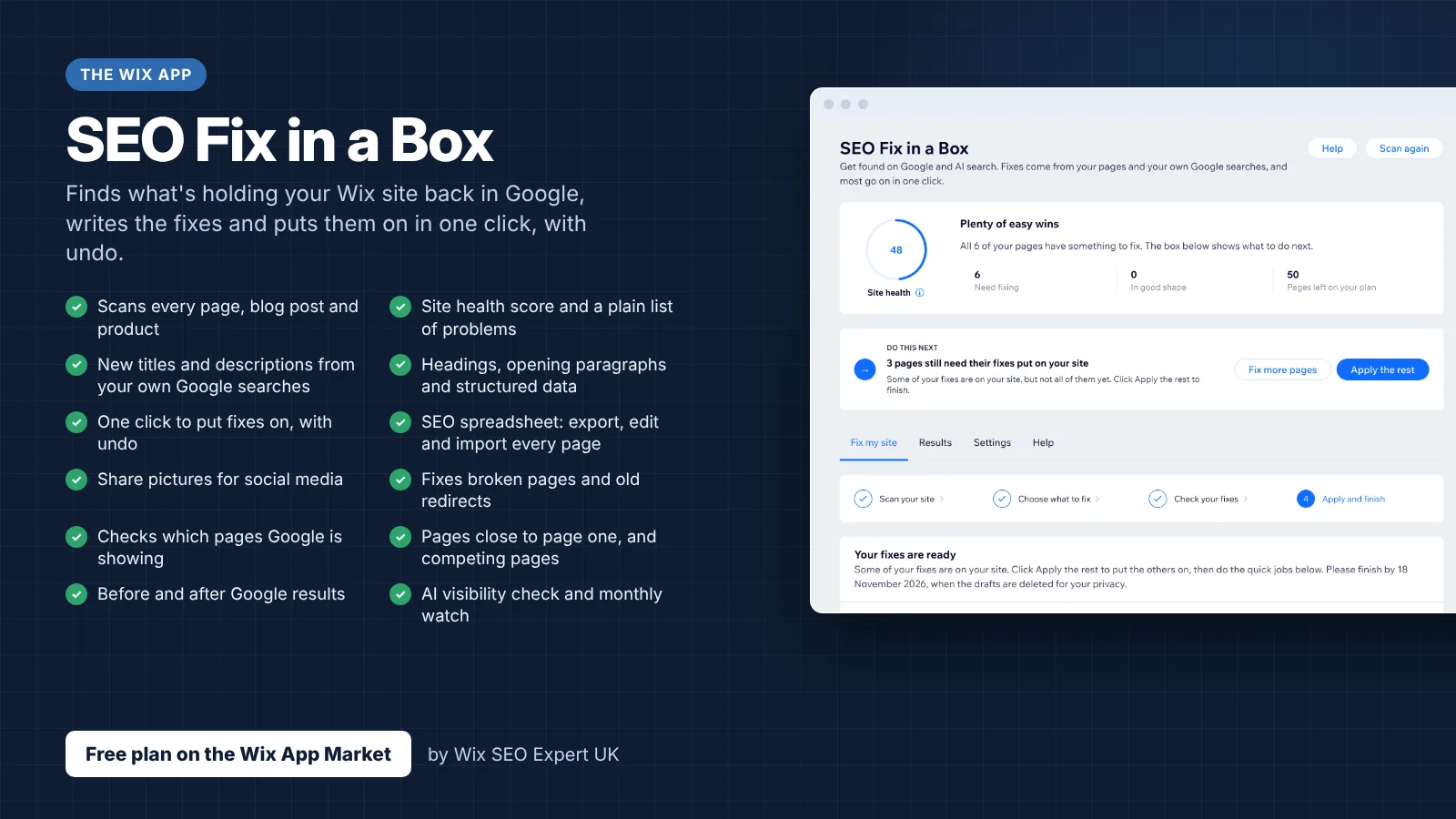
My Wix app, SEO Fix in a Box, flags titles and descriptions that run too long, a common reason Google rewrites them.
Essential SERP Display Tools
- Google Search Console: Verify how Google detects your title tags and meta descriptions, request re-indexing after changes
- Google Rich Results Test: See how Google parses your page including structured data, titles and descriptions
- SERP Simulator by Mangools: Preview exactly how your title and description will appear in Google search results before publishing
- Screaming Frog SEO Spider: Crawl your entire Wix site to find duplicate titles, missing descriptions, overlength tags and H1 mismatches
- Facebook Sharing Debugger: Verify how your Open Graph tags display on Facebook and force a cache refresh after updates
- Wix SEO Patterns Guide: Official Wix documentation on configuring SEO Patterns for dynamic page titles and descriptions
- SEO Fix in a Box: My Wix app. Free to install, it scans your site and shows what needs fixing, and paid plans write the fixes from your own Google searches
Was this lesson useful?
It takes 1 minute to tell me. The course is free and I want to keep it that way, and your feedback shows me what is working and helps other people find it.
This lesson on Google is showing the wrong title or meta description: how to fix SERP display issues is part of Module 50: Wix SEO Troubleshooting, Diagnostics & Common Fixes in The Most Comprehensive Complete Wix SEO Course in the World (2026 Edition). Created by Michael Andrews, a Wix Marketplace Legend Partner with 14 years of hands-on experience, 800 completed Wix SEO projects and 456 verified five-star reviews.