Google Search Console errors explained: every warning and how to fix it on Wix
Module 50: Wix SEO Troubleshooting, Diagnostics & Common Fixes | Lesson 557 of 683 | 65 min read
By Michael Andrews, Wix SEO Expert UK
Google Search Console (GSC) is the single most important free tool for diagnosing SEO problems on your Wix website. Every error, warning and status message in GSC tells you something specific about how Google perceives your site, and each one requires a different fix. The problem is that GSC reports can be overwhelming: dozens of different error types across multiple reports, cryptic status messages, and no clear indication of which issues to tackle first. This comprehensive reference guide explains every GSC error and warning you are likely to encounter on a Wix site, what each one means in plain language, how it affects your SEO, and exactly how to fix it. Bookmark this lesson and return to it whenever GSC flags something new.

Page Indexing Report: Every Status Explained
The Page Indexing report (formerly called the Coverage report) is your primary diagnostic tool for understanding which pages Google has indexed and which ones have problems. It categorises every URL Google knows about into specific status buckets. On Wix sites, this report frequently surfaces issues related to JavaScript rendering, canonical tag configuration and Wix-generated system pages. Navigate to Pages > Page Indexing in Google Search Console to access this report.
Status: "Not Indexed" Reasons
- "Discovered - currently not indexed": Google knows about the page but has not crawled it yet. This is common on new Wix sites or after publishing many new pages at once. Google is queuing the page for crawling. If pages remain in this status for more than 4 weeks, it suggests Google does not consider them high-priority. Fix: improve internal linking to these pages, add them to your sitemap, and request indexing via URL Inspection.
- "Crawled - currently not indexed": Google crawled the page but decided not to index it. This is the most frustrating status because Google is actively choosing to exclude your content. Common causes on Wix: thin content pages, duplicate content, low-quality pages, or pages Google deems not useful enough. Fix: substantially improve the content quality, ensure the page offers unique value, add at least 800 words of original content, and strengthen internal links pointing to the page.
- "Excluded by noindex tag": A noindex meta tag or HTTP header is telling Google not to index this page. On Wix, check the page SEO settings under Advanced SEO > Robots Meta Tags. This is intentional for pages like thank-you pages or member-only content, but if it appears on important pages, remove the noindex directive immediately.
- "Blocked by robots.txt": Your robots.txt file is preventing Google from crawling this page. Wix generates robots.txt automatically, but custom rules added through Wix SEO settings can accidentally block important pages. Check your robots.txt at yoursite.com/robots.txt and remove any unintentional disallow rules.
- "Alternate page with proper canonical tag": Google found this page but recognises it as an alternate version of another page via the canonical tag. This is normal for pages with URL parameters or www/non-www variants. No fix needed unless the wrong page is being treated as the canonical.
- "Duplicate without user-selected canonical": Google found duplicate content but no canonical tag was specified. Google chose which version to index. On Wix, this often happens with dynamic pages or filtered product views. Fix: set explicit canonical URLs in the page SEO settings for affected pages.
- "Duplicate, Google chose different canonical than user": You specified a canonical URL but Google disagrees and chose a different page as the canonical. This indicates Google believes another page is more authoritative or relevant. Fix: review whether your canonical tag is correct, strengthen the page you want indexed, and ensure the canonical target is crawlable.
- "Page with redirect": The URL redirects to another page. Google will index the destination, not this URL. This is normal for properly configured 301 redirects. Check that the redirect destination is the correct page.
- "Soft 404": The page returns a 200 OK status code but Google believes it should be a 404 (page not found). Common on Wix when a page has very little content, an empty product page, or a search results page with no results. Fix: either add substantial content to the page or return a proper 404 status.
- "Not found (404)": The page returns a 404 error. Either the page was deleted or the URL never existed. If you intentionally deleted the page, this is fine. If the page should exist, check the URL for typos or republish the page.
- "Server error (5xx)": Google received a server error when trying to crawl the page. On Wix, this is typically a temporary platform issue. If it persists for more than a week, contact Wix support. If it affects many pages simultaneously, it may indicate a wider Wix platform issue.
- "Blocked due to unauthorized request (401)": The page requires authentication. On Wix, this happens with member-only pages. If the page should be public, check its permissions in the Wix Editor.
- "Blocked due to access forbidden (403)": Similar to 401 but the server explicitly refuses access. Rare on Wix but can occur with certain security settings.
Performance Report Issues and What They Mean
The Performance report shows your search traffic data: impressions, clicks, average position and click-through rate (CTR). While this report does not show "errors" in the traditional sense, understanding anomalies and patterns helps diagnose underlying SEO problems on your Wix site.
- Sudden impression drop: If total impressions fall sharply, check whether pages were deindexed (Page Indexing report), whether you received a manual action, or whether a Google algorithm update occurred. On Wix, also check if site visibility settings were accidentally changed.
- Impressions high but clicks very low: Your pages are appearing in search results but nobody is clicking. This indicates poor title tags or meta descriptions. On Wix, edit these in the page SEO panel for every underperforming page.
- Average position suddenly worse: A ranking drop across many queries may indicate a site-wide issue such as a speed regression, loss of backlinks, or algorithm impact. For Wix sites, check if any recent template changes or app installations affected page speed.
- Queries showing for wrong pages: If Google is ranking the wrong page for a query, you have a cannibalisation issue. Use the Pages filter in the Performance report to identify which URLs rank for each query. Fix with canonical tags, content consolidation or internal linking adjustments.
- Missing queries you used to rank for: If specific keywords disappear from your query list, the ranking page may have been deindexed or pushed beyond page 5. Check the specific URL in the URL Inspection tool.
Core Web Vitals Report Errors Explained
The Core Web Vitals report in GSC uses real-world Chrome User Experience Report (CrUX) data to show how your Wix site performs for actual visitors. Pages are classified as Good, Needs Improvement, or Poor for each metric. Understanding these classifications is critical because Core Web Vitals are a confirmed Google ranking factor.
Largest Contentful Paint (LCP) Issues
- "LCP issue: longer than 2.5s (mobile)": Your largest visible content element takes too long to load on mobile devices. On Wix, the most common causes are oversized hero images, unoptimised banner videos, or heavy third-party apps loading above the fold. Fix: compress hero images to under 200KB, use Wix's built-in image optimisation, remove or defer heavy apps, and simplify the above-the-fold layout.
- "LCP issue: longer than 2.5s (desktop)": Same as above but for desktop. Desktop LCP issues on Wix are less common but can occur with extremely large images or multiple embedded videos.
- "LCP issue: longer than 4s": This is the "Poor" threshold. Pages with LCP above 4 seconds are severely underperforming and will be negatively affected in rankings. Immediate action is required.
Interaction to Next Paint (INP) Issues
- "INP issue: longer than 200ms (mobile)": User interactions (taps, clicks, key presses) take too long to produce a visual response. On Wix, common causes include heavy JavaScript from third-party apps, complex animations, or too many interactive elements loading simultaneously. Fix: remove unnecessary apps, simplify animations, and reduce the number of interactive widgets on a single page.
- "INP issue: longer than 200ms (desktop)": Same metric for desktop users. Less common on Wix but occurs with very complex pages featuring many interactive elements.
Cumulative Layout Shift (CLS) Issues
- "CLS issue: more than 0.1 (mobile)": Page elements shift position during loading, creating a poor visual experience. On Wix, common causes include images without defined dimensions, late-loading ads or banners, font loading causing text reflow, and dynamic content pushing elements down the page. Fix: ensure all images have explicit width and height attributes (Wix does this automatically for most elements), avoid inserting dynamic content above existing content, and reserve space for ads or embeds.
- "CLS issue: more than 0.1 (desktop)": Same issue on desktop. Often caused by sidebar elements loading late or header elements shifting.
Mobile Usability Errors Explained
The Mobile Usability report identifies pages that have problems when viewed on mobile devices. With Google using mobile-first indexing, these errors directly impact your rankings. Wix sites built with the responsive Editor X or Wix Studio generally have fewer mobile usability issues, but the classic Wix Editor can produce problems if the mobile layout is not manually optimised.
- "Text too small to read": Font size is below 12px on mobile. In the Wix mobile editor, increase font sizes for body text to at least 14px and heading text proportionally. Check every page individually as mobile font sizes may differ from desktop.
- "Clickable elements too close together": Buttons, links or tappable elements are spaced too tightly for comfortable mobile use. Ensure at least 8mm (approximately 48px) of spacing between tappable elements. In Wix, use the mobile editor to adjust spacing and padding.
- "Content wider than screen": Page content extends beyond the mobile viewport, causing horizontal scrolling. On Wix, this is usually caused by elements positioned outside the page boundaries in the desktop editor. Check for oversized images, tables or embedded content that does not scale down properly.
- "Viewport not set": The page lacks a viewport meta tag. Wix automatically sets this, so this error is extremely rare on Wix sites. If it appears, it may indicate a custom code issue overriding the default viewport settings.
Security and Manual Actions Explained
The Security Issues and Manual Actions reports are the most serious sections of Google Search Console. A manual action means a human reviewer at Google has determined your site violates Google's spam policies. A security issue means Google has detected malware, phishing, or other harmful content on your site. Both can result in dramatic ranking losses or complete removal from search results.
Manual Actions
- "User-generated spam": Spam content in comments, forum posts, or user profiles on your Wix site. Fix: remove all spam content, disable open commenting if necessary, and implement moderation. Then submit a reconsideration request.
- "Spammy free host": Extremely rare for Wix as it is a paid platform, but could appear for free Wix sites with your-username.wixsite.com domains if the subdomain is associated with spam.
- "Structured data issue": Your schema markup contains spam or misleading structured data. Fix: review all custom schema markup added via Wix Custom Code, remove any markup that does not accurately represent page content, and submit a reconsideration request.
- "Unnatural links to your site": Google detected manipulative backlinks pointing to your Wix site. Fix: audit your backlink profile using Ahrefs or Semrush, disavow toxic links via the Google Disavow Tool, and submit a reconsideration request.
- "Unnatural links from your site": Your Wix site contains paid or manipulative outbound links. Fix: remove or nofollow all paid links, affiliate links without disclosure, or link scheme participation, then submit a reconsideration request.
- "Thin content with little or no added value": Google determined your site has insufficient original content. Fix: substantially expand all thin pages, add unique value and expertise, remove or consolidate low-quality pages, then submit a reconsideration request.
- "Cloaking and/or sneaky redirects": Your site shows different content to Google than to users. Rare on Wix unless custom code is involved. Fix: remove any code that serves different content based on user agent, fix any sneaky redirects, and submit a reconsideration request.
- "Pure spam": The most severe manual action. Google considers the entire site spam. Fix: this is extremely difficult to recover from. Completely overhaul the site with genuine, high-quality content and submit a reconsideration request.
Security Issues
- "Hacked content": Google detected content on your site that was placed by a hacker. On Wix, this is extremely rare due to the platform's security infrastructure, but can happen via compromised third-party apps or custom code injection. Fix: remove the compromised code, change all passwords, remove suspicious apps, and request a security review.
- "Malware or unwanted software": Google detected malicious downloads or code on your site. Fix: identify and remove the source (usually a compromised embed or third-party script), then request a security review.
- "Social engineering": Your site is being used for phishing or deceptive practices. Fix: remove all deceptive content, check for compromised forms or pages, and request a security review.
Sitemaps Report Errors
The Sitemaps report shows the status of XML sitemaps you have submitted to Google Search Console. Wix automatically generates a sitemap at yoursite.com/sitemap.xml, but errors can still occur that prevent Google from properly reading your sitemap.
- "Couldn't fetch": Google could not access the sitemap URL. On Wix, check that your site is published and accessible. Try accessing the sitemap URL directly in your browser. If the site is live but the sitemap is inaccessible, contact Wix support.
- "Sitemap is HTML": Google expected an XML sitemap but received an HTML page. This can happen if a redirect sends the sitemap URL to your homepage. Ensure yoursite.com/sitemap.xml returns actual XML content.
- "Sitemap has errors (URL errors)": Some URLs in the sitemap have issues. Click into the error to see which specific URLs are problematic. Common causes include URLs that return 404 errors or URLs blocked by robots.txt.
- "Sitemap has warnings": Non-critical issues detected. Common warnings include URLs that redirect to other URLs (which should be updated to the final destination) or URLs returning non-200 status codes.
- "General HTTP error": Google received an unexpected HTTP response when fetching the sitemap. On Wix, this is usually a temporary server issue. Resubmit the sitemap after 24 hours.
URL Inspection Tool Errors
The URL Inspection tool provides detailed information about how Google sees a specific page. It shows indexing status, crawl details, canonical URL, mobile usability, and rich results status. Use this tool to diagnose individual page issues after identifying problems in the broader reports.
- "URL is not on Google": The page is not indexed. Check the reason code for why (covered in the Page Indexing section above). Use the "Request Indexing" button to prompt Google to recrawl the page.
- "URL is on Google, but has issues": The page is indexed but has warnings. These are typically mobile usability warnings or structured data issues that do not prevent indexing but may limit rich result eligibility.
- "Page cannot be indexed: noindex detected": A noindex directive is preventing indexing. Check the Wix page SEO settings and any custom meta tags added via Custom Code.
- "Referring page" and "Crawl details": These sections show how Google discovered the page and technical details about the crawl. "Last crawl" date tells you when Google last visited the page. If it was months ago, the page may have low crawl priority.
- "User-declared canonical" vs "Google-selected canonical": If these differ, Google disagrees with your canonical tag. Investigate which page Google prefers and why. Strengthen the page you want to be canonical through better content and internal links.
Enhancements Section Errors: Structured Data
The Enhancements section in GSC reports errors and warnings for structured data types Google has detected on your Wix site. Each enhancement type has its own sub-report showing valid items, items with warnings, and items with errors. Understanding these reports is essential for maintaining rich result eligibility.
Breadcrumbs Errors
- "Missing field name": The breadcrumb item is missing a required name property. On Wix, breadcrumb structured data is auto-generated. If this error appears, it may indicate a page with an empty title or a Wix bug. Fix: ensure every page has a proper title.
- "Invalid URL in field item": A breadcrumb URL is malformed. Check the page hierarchy and ensure all parent pages exist and have valid URLs.
FAQ Structured Data Errors
- "Missing field acceptedAnswer": An FAQ entry has a question but no answer. If you added FAQ schema via Custom Code, ensure every question has a corresponding answer.
- "Missing field name": The FAQ question text is missing. Check your custom FAQ schema markup for empty question fields.
- "Invalid value in field acceptedAnswer": The answer field contains invalid content. Ensure answers are plain text or properly formatted HTML.
How-To Structured Data Errors
- "Missing field step": The HowTo schema has no steps defined. Every HowTo must include at least one step.
- "Missing field name in step": A step is missing its title/name. Ensure every step in your HowTo schema has a name property.
- "Missing field text or image in step": Each step should have either a text description or an image. Add descriptive text to each step.
Product Structured Data Errors
- "Missing field offers": Product schema requires pricing information. On Wix Stores, this is auto-generated, but if prices are missing or set to zero, this error may appear.
- "Missing field review or aggregateRating": While not required, Google may flag this as a warning. Adding review markup improves rich result eligibility.
- "Invalid value in field price": The price value is not a valid number or is missing a currency. Check that your Wix Store products have valid prices set.
Links Report Interpretation
The Links report in GSC shows both external links pointing to your site and internal links within your site. While this report does not show errors per se, understanding it helps diagnose link-related issues that affect Wix SEO.
- Top linked pages (external): Shows which pages have the most backlinks. If important pages have very few external links, they may struggle to rank competitively. Prioritise link building for high-value pages with low external link counts.
- Top linking sites: Identifies which domains link to you most. Watch for sudden appearances of spammy domains which may indicate negative SEO. If you see suspicious linking sites, consider using the Disavow Tool.
- Top linking text: Shows the anchor text used in links pointing to your site. An unnatural concentration of exact-match keyword anchor text may trigger a manual action. Healthy anchor text profiles are diverse, including brand name, URL, generic terms and some keyword variations.
- Internal links: Shows the internal link structure of your Wix site. Pages with very few internal links are harder for Google to discover and rank. Ensure every important page has at least 3-5 internal links pointing to it.
Priority Order for Fixing GSC Errors
Not all GSC errors are equally important. When facing multiple issues, follow this priority framework to maximise your SEO recovery speed on Wix.
GSC error priority framework (fix in this order)
- Priority 1 - Security issues and manual actions: These are the most urgent. They can result in complete deindexing or search suppression. Fix immediately and submit reconsideration requests.
- Priority 2 - Indexing errors on important pages: If your highest-traffic or highest-revenue pages are not indexed, address these next. Check for noindex tags, canonical issues or crawl blocks.
- Priority 3 - Core Web Vitals failures on key pages: Pages flagged as "Poor" for CWV metrics are being actively penalised in rankings. Focus on your top 20 traffic pages first.
- Priority 4 - Mobile usability errors: With mobile-first indexing, mobile usability problems affect all rankings. Fix these across the site systematically.
- Priority 5 - Structured data errors: These prevent rich results but do not typically affect basic ranking position. Fix them to regain rich snippets and enhanced search appearances.
- Priority 6 - Sitemap warnings: Non-critical but worth cleaning up to ensure Google can efficiently discover all your content.
- Priority 7 - "Discovered but not indexed" pages: These indicate quality or priority issues. Improve content quality and internal linking for these pages over time.
- Priority 8 - Soft 404 errors: Clean up pages that Google considers effectively empty. Either add real content or remove the pages entirely.
Creating a GSC Error Resolution Workflow
A systematic workflow ensures you catch and fix GSC errors before they compound. Follow this repeatable process for your Wix site to maintain optimal search health.
Weekly GSC error monitoring workflow
- Every Monday morning, log into Google Search Console and check the Overview page for any new alerts or messages from Google.
- Navigate to Page Indexing and sort by "Not indexed" reasons. Compare the count for each reason against last week to identify new issues.
- Check Core Web Vitals for any pages that have moved from Good to Needs Improvement or Poor. Note which pages are affected.
- Review the Performance report for any significant drops in impressions or clicks over the past 7 days compared to the previous period.
- Check the Enhancements section for any new structured data errors or warnings.
- Open a spreadsheet and log every new error with: date discovered, error type, affected URL, severity (critical/high/medium/low), and assigned fix date.
- Fix all critical and high-severity errors within 48 hours. Schedule medium and low severity fixes for the current week.
- After fixing each issue, use the URL Inspection tool to request reindexing for affected pages. Click "Validate Fix" in the relevant report.
- Document each fix in your spreadsheet with: date fixed, action taken, and validation status.
- Review your spreadsheet at the end of each month to identify recurring patterns that may indicate systemic issues with your Wix site.
Step-by-Step Guide to a Complete GSC Error Audit
Perform this comprehensive audit quarterly (every 3 months) to ensure nothing slips through the cracks. This is your most thorough diagnostic process for Wix SEO health.
Complete GSC error audit procedure
- Export the full Page Indexing report by clicking the export button in the top right. Download both "indexed" and "not indexed" data as CSV files.
- In the exported data, categorise every non-indexed URL by its reason code. Count the total for each reason and compare against your previous quarterly audit.
- For every "Crawled - currently not indexed" page, manually review the content quality. Is it thin, duplicate, or low-value? Make a decision for each: improve, consolidate, or remove.
- Export the Performance report data for the past 3 months. Identify pages with declining impressions or positions. Cross-reference with the Page Indexing data to check for indexing issues.
- Review Core Web Vitals for both mobile and desktop. Export the list of URLs with issues and create a fix plan, starting with your highest-traffic pages.
- Check every Enhancement report (Breadcrumbs, FAQ, How-To, Product, etc.) and export any errors or warnings.
- Review the Sitemaps report. Ensure your sitemap was successfully processed and the page count matches your expectations. If the sitemap shows significantly fewer pages than you have published, investigate why pages are missing.
- Audit the Links report. Export top linked pages and compare against your site architecture. Ensure your most important pages are receiving the most internal links.
- Check for manual actions and security issues. Even if the dashboard shows "No issues detected", click into each report to confirm.
- Compile all findings into an audit report with three sections: Critical Issues (fix this week), Important Issues (fix this month), and Maintenance Items (ongoing improvements).
- Share the audit report with your team or client and assign ownership for each fix. Schedule a follow-up review in 4 weeks to verify fixes are implemented.
- After all fixes are implemented, run another URL Inspection check on previously problematic pages to confirm Google has processed the changes.
Complete How-To Guide
Complete step-by-step guide to resolving all Google Search Console errors on your Wix site
- Log into Google Search Console at search.google.com/search-console and select your Wix site property. If you have not verified your site, do so first using the DNS verification method through your Wix domain settings.
- Start with the most critical reports first: check Manual Actions and Security Issues. If either report shows problems, stop everything else and address these immediately using the detailed guidance in this lesson.
- Navigate to the Page Indexing report and review all "Not indexed" reasons. Export the data and categorise each URL by its status reason. Use the priority framework in this lesson to determine which issues to tackle first.
- For each non-indexed page you want Google to index, fix the underlying issue (remove noindex, improve content quality, fix redirects, etc.), then use the URL Inspection tool to request indexing.
- Review the Core Web Vitals report for both mobile and desktop. Identify pages with Poor or Needs Improvement status. For Wix sites, focus on optimising images, reducing third-party apps, and simplifying page layouts.
- Check the Mobile Usability report and fix any errors by adjusting your Wix mobile layout in the mobile editor. Ensure text is readable, buttons are spaced properly, and content fits the viewport.
- Review all Enhancement reports (structured data) and fix any errors in your schema markup. For auto-generated Wix schema, ensure product prices, page titles, and other source data are correct. For custom schema added via Custom Code, validate using Google's Rich Results Test.
- Check the Sitemaps report and ensure your sitemap is healthy. Resubmit if necessary. Verify the page count matches your expectations.
- Review the Links report to understand your link profile. Identify pages that need more internal links and check for suspicious external linking patterns.
- Set up a weekly monitoring routine using the workflow described in this lesson. Consistency is the key to maintaining a healthy GSC profile for your Wix site.
- Document every error and fix in a tracking spreadsheet. Over time, this creates a valuable record of your site's SEO health and helps you spot recurring patterns.
- Perform a full quarterly audit using the comprehensive audit procedure in this lesson. Compare results against previous audits to measure progress.
Essential GSC Diagnostic Tools
- Google Search Console: The primary platform for monitoring and diagnosing all search-related errors on your Wix site
- Google Rich Results Test: Test individual pages for structured data errors and rich result eligibility
- Google PageSpeed Insights: Diagnose Core Web Vitals issues with detailed recommendations for improvement
- Google Mobile-Friendly Test: Test whether Google considers your Wix pages mobile-friendly
- Google Disavow Tool: Disavow toxic backlinks that may be triggering manual actions
- Ahrefs Webmaster Tools: Free backlink audit and site health monitoring to complement GSC data
- Screaming Frog SEO Spider: Crawl your Wix site to identify technical issues before they appear in GSC
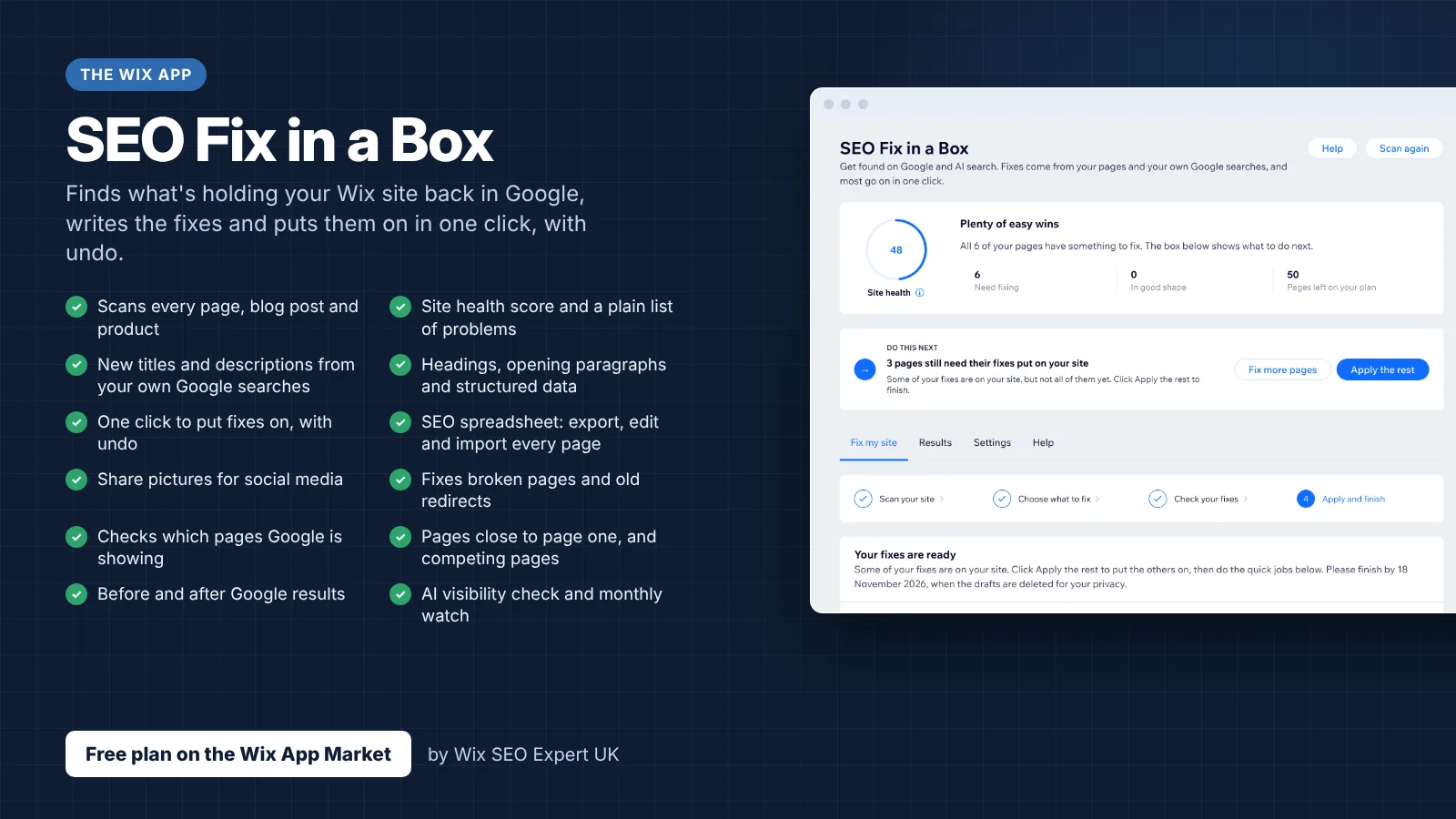
- SEO Fix in a Box: My Wix app. Free to install, it scans your site and shows what needs fixing, and paid plans write the fixes from your own Google searches
Was this lesson useful?
It takes 1 minute to tell me. The course is free and I want to keep it that way, and your feedback shows me what is working and helps other people find it.
This lesson on Google Search Console errors explained: every warning and how to fix it on Wix is part of Module 50: Wix SEO Troubleshooting, Diagnostics & Common Fixes in The Most Comprehensive Complete Wix SEO Course in the World (2026 Edition). Created by Michael Andrews, a Wix Marketplace Legend Partner with 14 years of hands-on experience, 800 completed Wix SEO projects and 456 verified five-star reviews.