Future-proofing your Wix SEO against algorithm updates
Module 26: AI, SGE & Future-Proof SEO | Lesson 314 of 683 | 20 min read
By Michael Andrews, Wix SEO Expert UK
Google made over 9 major confirmed algorithm updates in 2025 alone, plus thousands of smaller daily adjustments. Each major update reshuffles rankings across millions of queries. Sites built on tricks and shortcuts lost rankings with every update. Sites built on genuine quality and user value tended to be rewarded. Understanding this distinction, and building your Wix SEO strategy around principles that no algorithm update targets, is the key to sustainable organic growth that survives every change Google makes.
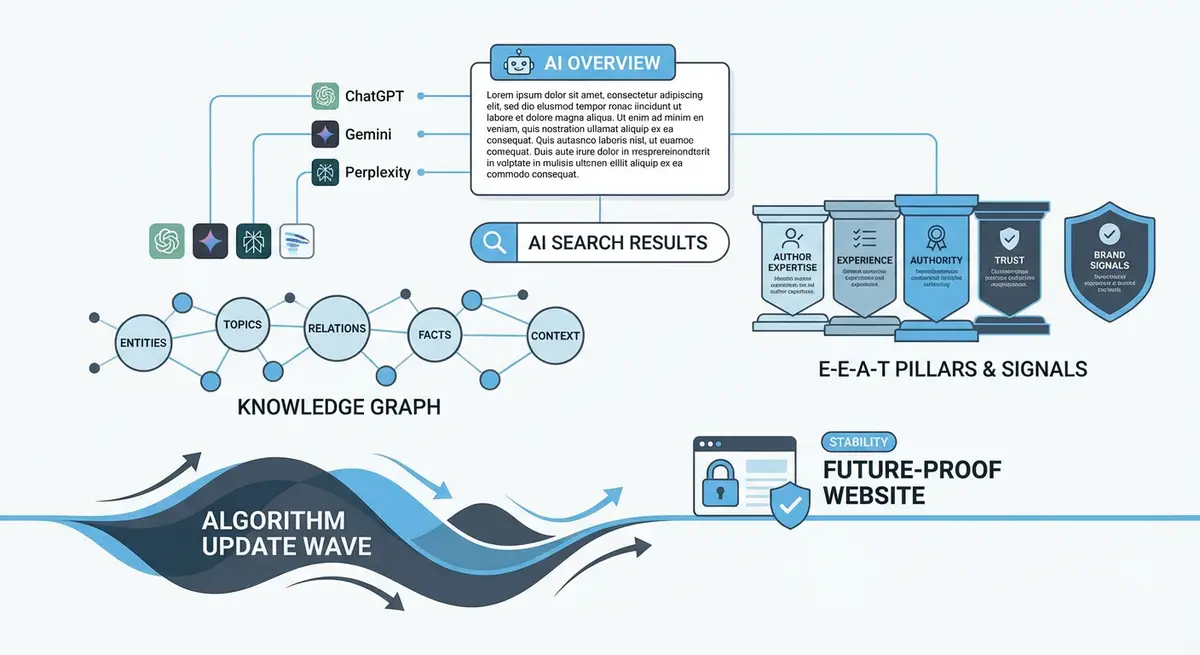
What Google Updates Actually Target
Every Google algorithm update targets specific quality problems. Understanding what each update type focuses on tells you exactly which vulnerabilities to eliminate from your Wix site and which strengths to build.
- Helpful Content updates: Target pages written primarily for search engines rather than humans. Content created to "rank" rather than to "help" is specifically penalised. Thin, AI-generated content without editorial review is also targeted.
- Core updates: Broad quality reassessments that re-evaluate the relative quality of sites across the web. Sites with thin, untrustworthy, or outdated content tend to lose. Sites with comprehensive, authoritative, current content tend to gain.
- Spam updates: Target overtly manipulative tactics including link spam, keyword stuffing, cloaking, hidden text, sneaky redirects, and AI-generated spam content.
- Product Review updates: Target shallow product reviews that lack genuine first-hand experience or analysis. Affect sites that review products without evidence of actual testing or use.
- Page Experience updates: Target slow, unstable, and intrusive pages. Core Web Vitals, mobile usability, HTTPS, and intrusive interstitials are all evaluated.
- Link Spam updates: Specifically target manipulative link building including purchased links, link exchanges, and PBN networks.
SEO Strategies That Have Survived Every Major Update
Certain SEO practices have not only survived every algorithm update since 2011 but have been actively rewarded as Google gets better at identifying quality. These are the foundation of an update-proof strategy.
- Publishing genuinely useful content written by someone with real expertise on the topic.
- Earning natural backlinks from relevant, authoritative sources because your content is worth referencing.
- Demonstrating first-hand experience and verifiable expertise through author credentials, case studies, and original data.
- Building a recognisable brand that people search for directly, generating branded search volume that signals trust.
- Maintaining technical health: fast loading, mobile-friendly, secure, well-structured, with clean code and proper schema.
- Keeping content accurate and up to date through regular reviews and substantive updates.
- Serving the user first. Every page should fully satisfy the intent behind the search query that brought the visitor there.
The Helpful Content Self-Assessment
Google has published a set of questions to help site owners evaluate whether their content meets the Helpful Content criteria. Running your Wix site content through these questions regularly identifies vulnerabilities before an algorithm update exposes them.
- Does the content provide substantial value when compared to other pages in search results?
- Is the content written by or reviewed by someone with genuine expertise or experience?
- Does the site have a primary purpose or focus, or does it create content on many different unrelated topics?
- After reading the content, will someone feel they have learned enough about a topic to achieve their goal?
- Will a reader feel the experience of reading this content was satisfying?
- Does the content demonstrate first-hand experience with the topic?
- Is the content substantially different from what other sites offer on the same topic?
How to Diagnose an Algorithm Update Impact
Diagnosing whether an algorithm update affected your Wix site
- Check Google confirmed update list at the Google Search Status Dashboard (status.search.google.com).
- Compare your organic traffic trend in GA4 against the update date. Align your traffic graph with the confirmed update timeline.
- In Google Search Console, identify which specific pages and keywords lost impressions and clicks after the update date.
- Review the specific focus of the update (Helpful Content, Core, Spam, Product Review) and evaluate the affected pages against those specific criteria.
- Compare your affected pages to the current top-ranking pages for the same queries. What do they do better?
- Check if the entire site was affected uniformly or if specific sections dropped. Uniform drops suggest site-wide quality issues. Section-specific drops suggest content-level problems.
- Make targeted quality improvements based on your analysis and wait for the next relevant update cycle to assess recovery.
Building an Algorithm-Resilient Content Strategy
The most effective defence against algorithm updates is a content strategy that would succeed even if Google did not exist. If your content is genuinely the best resource on a topic, if people would seek it out through word of mouth, if experts in your field would recommend it, then Google is aligned with your success rather than opposed to it.
- Focus on topics where you have genuine expertise and first-hand experience.
- Create content that goes deeper than any competing resource on the topic.
- Update your most important content at least quarterly with fresh data and examples.
- Remove or consolidate thin pages that add little value. A smaller site with all strong pages outperforms a large site diluted by weak pages.
- Invest in original research and proprietary data that no competitor can replicate.
- Build content that earns natural links and shares because people find it genuinely useful.
The Content Freshness Schedule
Stale content is increasingly penalised by Core updates. Pages that were comprehensive when published but have not been updated in two years become liabilities. Implement a systematic content freshness schedule for your Wix site.
Maintaining content freshness
- Create a spreadsheet listing every important page on your Wix site with columns for: URL, last updated date, next review date, and update priority.
- Set quarterly review dates for your top 10 pages by traffic.
- Set bi-annual review dates for all other published content.
- When reviewing, update statistics, refresh examples, add new information, replace outdated screenshots, and change the dateModified schema.
- If a page cannot be meaningfully updated because the topic is exhausted, consider whether it should be consolidated with a related page or whether it still serves a purpose.
Technical Resilience
Technical SEO problems compound during algorithm updates. A site with marginal Core Web Vitals scores may survive in normal conditions but lose rankings when a Page Experience update tightens the thresholds. Maintain technical excellence as a baseline so algorithm updates do not expose vulnerabilities.
- Monitor Core Web Vitals monthly in Google Search Console and address any failing metrics immediately.
- Ensure every page passes mobile usability checks.
- Verify HTTPS is functioning on all pages without mixed content warnings.
- Keep your XML sitemap up to date and verify it in Google Search Console after significant site changes.
- Check robots.txt regularly to ensure nothing important is accidentally blocked.
- Implement proper schema markup and validate it with the Rich Results Test after every site update.
Algorithm Monitoring Tools
- Google Search Status Dashboard: Official source for confirmed Google algorithm update announcements
- Moz Google Algorithm History: Comprehensive timeline of all Google algorithm updates with impact analysis
- Semrush Sensor: Real-time SERP volatility tracking that detects algorithm changes before official confirmation
- Google Search Console: Monitor your site performance and identify pages affected by algorithm changes
Complete How-To Guide: Future-Proofing Your Wix SEO Against Algorithm Updates
How to protect your Wix site from Google algorithm updates
- Step 1: Bookmark the Google Search Status Dashboard at status.search.google.com. Check it weekly. When a new update is confirmed, you will know immediately rather than discovering it weeks later through a traffic drop.
- Step 2: Set up a baseline traffic report in GA4. Create a custom report showing weekly organic sessions for your top 20 landing pages. This makes it easy to spot traffic changes that coincide with confirmed updates.
- Step 3: Audit your content against the Helpful Content criteria. For every key page, ask: "Would a real person with expertise in this topic be satisfied with this content?" If the answer is no, the page is vulnerable.
- Step 4: Remove or substantially improve any thin content. Pages with fewer than 300 words of substantive text, pages that merely rewrite competitor content, and pages created solely for search engines are all at risk.
- Step 5: Verify your E-E-A-T signals. Every piece of content should have: a named author with credentials, first-hand experience or expert analysis, accurate and current information, and clear sourcing for claims.
- Step 6: Check your backlink profile in Google Search Console or Ahrefs. Identify any suspicious or low-quality links. If you have participated in link schemes, disavow problematic links before a spam update targets them.
- Step 7: Run PageSpeed Insights on your top 5 landing pages. Ensure all pass Core Web Vitals on mobile. Page Experience updates penalise slow, unstable pages.
- Step 8: Implement a content freshness schedule. Update your top 10 pages at least quarterly with new data, examples, and screenshots. Stale content is increasingly disadvantaged by Core updates.
- Step 9: Build branded search volume. Create shareable content, speak at events, publish on social media, and build an email list. Branded searches are the strongest signal of a real, trusted business.
- Step 10: When a Google update rolls out, wait 2-3 weeks before making changes. Updates take time to complete and initial fluctuations often self-correct.
- Step 11: If traffic drops after a confirmed update, identify which pages and keywords were affected. Cross-reference the update type with the affected content. The update type tells you what to fix.
- Step 12: After making improvements, log the date and changes. Recovery typically takes 1-3 months. Monitor weekly against your baseline to track progress. Partial recovery often precedes full recovery.
Was this lesson useful?
It takes 1 minute to tell me. The course is free and I want to keep it that way, and your feedback shows me what is working and helps other people find it.
This lesson on Future-proofing your Wix SEO against algorithm updates is part of Module 26: AI, SGE & Future-Proof SEO in The Most Comprehensive Complete Wix SEO Course in the World (2026 Edition). Created by Michael Andrews, a Wix Marketplace Legend Partner with 14 years of hands-on experience, 800 completed Wix SEO projects and 456 verified five-star reviews.