Entity SEO: becoming a trusted entity in Google's Knowledge Graph
Module 26: AI, SGE & Future-Proof SEO | Lesson 312 of 683 | 28 min read
By Michael Andrews, Wix SEO Expert UK
Google's Knowledge Graph is a database of real-world entities, people, businesses, places, organisations, concepts, and the relationships between them. It contains billions of entries and is the foundation of how Google understands the world beyond keywords. Establishing your brand as a trusted entity in the Knowledge Graph is one of the most durable SEO strategies available, because entity recognition persists through algorithm updates and extends your visibility across Google Search, AI Overviews, Google Maps, and voice assistants simultaneously.
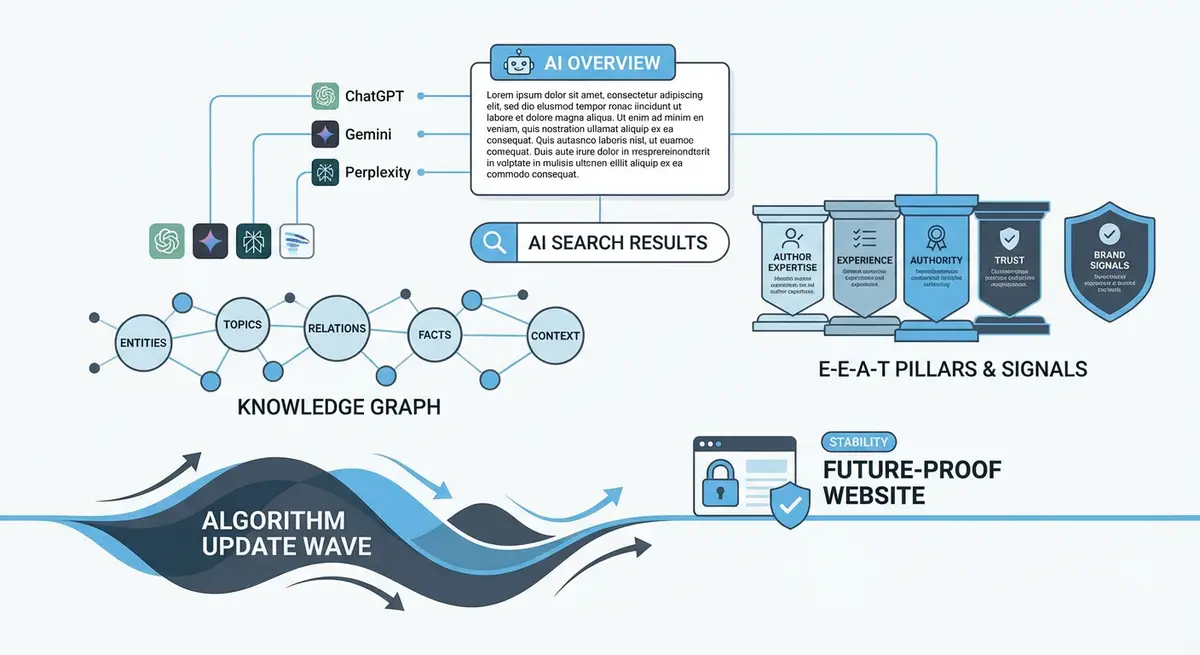
What the Knowledge Graph Is and Why It Matters
When you search for a well-known person or brand, you often see a Knowledge Panel on the right side of Google results: a box containing the entity key facts, images, and related information. This data comes from the Knowledge Graph. Having a Knowledge Panel means Google has verified your existence as a real entity with multiple corroborating sources. It is the ultimate trust signal in search.
Entity recognition goes beyond the visible Knowledge Panel. When Google recognises your brand as an entity, it associates your content with a verified real-world business rather than treating it as anonymous web pages. This entity association strengthens every piece of content you publish, making it more likely to rank in organic results, be cited in AI Overviews, and appear in relevant knowledge-based features.
How Google Builds Its Understanding of Entities
Google identifies entities through a process called entity reconciliation. It gathers information about your business from multiple sources, cross-references the data for consistency, and builds a confidence score about your entity. The more sources that provide consistent, corroborating information, the higher your entity confidence score and the more likely Google is to display a Knowledge Panel and associate your content with your verified entity.
- Google Business Profile provides the foundational business entity data: name, address, phone, category, and description.
- Wikidata entries feed directly into the Knowledge Graph and are one of the strongest entity signals available.
- Wikipedia articles, when available, provide the highest-authority entity validation.
- Structured data on your website (Organization and Person schema) explicitly defines your entity properties for Google.
- Third-party mentions on authoritative websites corroborate your entity from independent sources.
- Consistent NAP data across directories and citations reinforces entity accuracy.
- Social media profiles with verified ownership add additional entity signals.
Building Your Entity From Scratch
Most small and medium businesses do not have a Knowledge Panel because they have not built sufficient entity signals. The process is systematic: you create consistent entity data across multiple authoritative platforms, implement structured data that explicitly defines your entity, and earn third-party mentions that corroborate your existence. The process takes 3-6 months of consistent effort.
Building entity authority for your Wix business
- Start with your Google Business Profile. Complete every field: business name, primary category, secondary categories, business description (use the full 750 characters), services, products, hours, address, phone, website URL, and photos.
- Create a comprehensive About page on your Wix site. This becomes the canonical source of truth about your entity. Include your full business history, founder details with credentials, founding date, location, service areas, and team information.
- Add Organization schema to your Wix homepage. Include name, url, logo, description, foundingDate, founder (as Person type), areaServed, knowsAbout, and sameAs properties linking to every verified platform.
- Add Person schema for the business founder or primary expert on their author page. Include name, jobTitle, url, image, sameAs array, knowsAbout array, hasCredential objects, and alumniOf.
- Create a Wikidata entry for your business at wikidata.org. Add properties for: instance of (P31), official website (P856), founding date (P571), country (P17), social media links, and any notable awards or recognitions.
- Ensure your brand name appears in the identical format across all platforms. Even minor variations like "SEO Co" vs "SEO Company" can weaken entity reconciliation.
- Create or claim profiles on LinkedIn Company Page, Crunchbase, industry-specific directories, and any platforms where businesses in your sector are listed.
- Earn mentions on authoritative third-party websites through guest articles, press coverage, expert roundups, and industry directory features.
The sameAs Property: Connecting Your Entity
The sameAs property in your Organization schema is critically important for entity building. It explicitly tells Google that all these different web profiles, your LinkedIn, Facebook, Twitter, Wikidata, Crunchbase, all represent the same real-world entity. Without sameAs, Google has to infer these connections. With sameAs, you make them explicit.
{
  "@context": "https://schema.org",
  "@type": "Organization",
  "name": "Your Brand Name",
  "url": "https://www.yourdomain.com",
  "logo": "https://www.yourdomain.com/logo.png",
  "description": "Your business description",
  "foundingDate": "2019-01-01",
  "founder": {
    "@type": "Person",
    "name": "Founder Name",
    "jobTitle": "Founder & SEO Director"
  },
  "knowsAbout": ["Wix SEO", "Local SEO", "Technical SEO"],
  "areaServed": {
    "@type": "Country",
    "name": "United Kingdom"
  },
  "sameAs": [
    "https://www.linkedin.com/company/yourbrand",
    "https://www.facebook.com/yourbrand",
    "https://twitter.com/yourbrand",
    "https://www.youtube.com/c/yourbrand",
    "https://www.instagram.com/yourbrand",
    "https://www.crunchbase.com/organization/yourbrand",
    "https://www.wikidata.org/wiki/Q123456789"
  ]
}
Entity SEO for Personal Brands
For solopreneurs and personal brands, your person entity is as important as your business entity. Google evaluates author credibility separately from business credibility, and a strong personal entity can elevate the perceived trustworthiness of all content you create. This is especially important for AI search engines that evaluate author expertise when deciding which sources to cite.
- Create a dedicated author page on your Wix site with your full professional biography, credentials, and publications.
- Build a personal LinkedIn profile that matches the credentials on your Wix author page.
- Publish guest articles on industry publications with consistent author bylines linking to your Wix author page.
- Get quoted in press coverage to create third-party validation of your expertise.
- Add Person schema to your author page with knowsAbout, hasCredential, and sameAs properties.
- If eligible, create a personal Wikidata entry separate from your business entity.
NAP Consistency: The Entity Foundation
Name, Address, Phone (NAP) consistency is the foundation of entity accuracy. Google cross-references your NAP data across every source it can find. Inconsistencies, even minor ones, reduce your entity confidence score. Create a master NAP document with your exact business name, formatted address, and phone number. Use this document as the source of truth for every listing, directory, and profile you create.
Measuring Entity Recognition
Entity recognition can be measured through several observable indicators that tell you whether Google has accepted your brand as a verified entity.
- A Knowledge Panel appearing for your brand name search is the strongest indicator of entity recognition.
- Sitelinks appearing below your main result indicate Google understands your site structure and entity hierarchy.
- Google suggesting your brand name in autocomplete when users type partial queries.
- Your brand appearing in Google Trends data as a recognised topic rather than just a search term.
- AI systems like ChatGPT and Perplexity accurately describing your business when asked about your brand name.
- Rich results appearing in search with your brand logo and business information from structured data.
Entity SEO Tools
- Wikidata: Create and manage your business entity in the knowledge base Google draws from
- Google Business Profile: The foundational entity platform for local and business entities
- Schema.org Organization: Reference for Organization structured data properties
- Google Rich Results Test: Validate your structured data implementation for entity markup
- SEO Fix in a Box: My Wix app. Free to install, it scans your site and shows what needs fixing, and paid plans write the fixes from your own Google searches
Complete How-To Guide: Establishing Your Brand as an Entity in Google's Knowledge Graph
How to build entity authority for your Wix business
- Step 1: Search your brand name in Google. If a Knowledge Panel appears on the right, your entity is already recognised, skip to claiming and optimising it. If not, you need to build entity signals. Also search your name in ChatGPT and Perplexity to see what AI systems know about you.
- Step 2: Claim and fully complete your Google Business Profile. Fill in every available field: business name, primary and secondary categories, description (full 750 characters), services, products, opening hours, photos (minimum 10), and regular posts. This is the foundation of your entity presence.
- Step 3: Create or claim profiles on all major structured platforms: LinkedIn Company Page, Crunchbase, and relevant industry directories. Use your exact business name identically across every platform.
- Step 4: Build a comprehensive About page on your Wix site. Include your full business history, founder details with credentials, founding date, location, service areas, awards, and team information. This becomes the canonical source of truth about your entity.
- Step 5: Add Organization schema to your Wix homepage. Include name, url, logo, description, foundingDate, founder (as Person type), areaServed, knowsAbout, and sameAs properties linking to every verified platform profile.
- Step 6: Add Person schema for the business founder or primary expert on their author page. Include name, jobTitle, url, image, sameAs (linking to LinkedIn, Twitter, etc.), knowsAbout, and hasCredential properties.
- Step 7: Ensure NAP consistency across every listing. Audit every profile, directory, and social platform. Your business name, address, and phone number must be identical everywhere. Create a master NAP document as your single source of truth.
- Step 8: Earn mentions on authoritative third-party sites. Contribute guest articles to industry publications, get quoted in press coverage, participate in expert roundups, and speak at events. Each external mention is an entity corroboration signal.
- Step 9: Create a Wikidata entry for your business. Go to wikidata.org, create an item with your brand name, add instance of (P31), official website (P856), founding date (P571), country (P17), and social media links. This feeds directly into the Knowledge Graph.
- Step 10: Add your Wikidata Q-number to your Organization schema sameAs array. This creates a bidirectional link between your website structured data and the Knowledge Graph entity.
- Step 11: Verify entity recognition monthly. Search your brand name in Google, ChatGPT, and Perplexity. Check if the information returned is accurate. If incorrect details appear, trace the source and update the responsible platform.
- Step 12: Once a Knowledge Panel appears, claim it through Google. Scroll to the bottom of the panel and click "Claim this knowledge panel." Verify your identity through Search Console, YouTube, Twitter/X, or Facebook. Once claimed, you can suggest edits and add verified social links to your panel.
Was this lesson useful?
It takes 1 minute to tell me. The course is free and I want to keep it that way, and your feedback shows me what is working and helps other people find it.
This lesson on Entity SEO: becoming a trusted entity in Google's Knowledge Graph is part of Module 26: AI, SGE & Future-Proof SEO in The Most Comprehensive Complete Wix SEO Course in the World (2026 Edition). Created by Michael Andrews, a Wix Marketplace Legend Partner with 14 years of hands-on experience, 800 completed Wix SEO projects and 456 verified five-star reviews.