Core SEO concepts glossary: the foundation terms every Wix site owner must know
Module 55: Wix SEO Glossary: Complete A-Z Reference Library | Lesson 592 of 683 | 40 min read
By Michael Andrews, Wix SEO Expert UK
Every discipline has its own language, and SEO is no different. Before you can fully apply the strategies covered across this course, you need to be fluent in the terminology. This lesson covers the foundational SEO concepts that underpin every ranking decision Google makes, explained with specific context for Wix website owners. Each term includes a definition, usage context, how to apply it on your Wix site, common mistakes to avoid, and related terms to explore next. Bookmark this lesson and return to it whenever you encounter an unfamiliar term.
Algorithm
A complex set of rules and calculations used by search engines to determine the relevance, quality, and ranking position of web pages. Google's algorithm processes over 200 ranking signals simultaneously, including page quality, relevance, backlink authority, user experience signals, and content freshness.
Usage Context
You will encounter "algorithm" when discussing why rankings change, what a Google update affected, and why certain pages rank above others. Algorithm updates like core updates, spam updates, and the Helpful Content system directly affect Wix site rankings.
How to Apply on Wix
Optimising for Google's algorithm on Wix
- Focus on publishing content that genuinely serves your audience rather than trying to reverse-engineer individual signals.
- Monitor Google's official Search Central blog for announcements of algorithm updates.
- After any major update, compare your GSC Performance data (before and after) to assess impact on your Wix site.
- Address the signals you can directly control: content quality, internal linking, structured data, and Core Web Vitals.
- Avoid shortcuts and black hat tactics. Algorithm updates increasingly penalise manipulation.
Common Mistakes
- Chasing individual ranking signals in isolation. The algorithm evaluates signals holistically
- Panicking after algorithm updates without first verifying whether rankings actually changed in GSC
- Assuming algorithm updates are always negative. Many Wix sites gain visibility after updates
Related Terms
- Ranking Factor
- Core Web Vitals
- E-E-A-T
- Penalty
- White Hat SEO
E-E-A-T (Experience, Expertise, Authoritativeness, Trustworthiness)
Google's quality framework for evaluating content quality. Experience was added in December 2022, meaning Google now looks for first-hand experience with a subject alongside expertise, authority and trust. E-E-A-T is particularly important for YMYL (Your Money or Your Life) topics including health, finance, legal, and safety content.
Usage Context
E-E-A-T is assessed by Google's human Quality Raters using published guidelines, and these evaluations inform algorithm training. Sites that score poorly on E-E-A-T metrics tend to be suppressed in rankings. High E-E-A-T signals are especially critical if your Wix site publishes advice on health, finance, legal matters, or news.
How to Apply on Wix
Building E-E-A-T signals on your Wix site
- Create a detailed About page that showcases your credentials, qualifications, years of experience, and notable achievements.
- Add author bios to all blog posts using Wix Blog's author feature, linking to a full credentials page.
- Publish original case studies and first-hand accounts that demonstrate real experience with your subject matter.
- Add a credentials or certifications section to your homepage with trust badges and verifiable qualifications.
- Keep all factual content accurate and up to date. Incorrect information is an immediate trust signal failure.
- Implement Person schema markup in Wix custom code to formally declare author expertise to search engines.
- Earn backlinks from recognised industry publications and authoritative sources that corroborate your expertise.
Common Mistakes
- Publishing content without identified authors. Anonymous content scores poorly on E-E-A-T
- Claiming expertise without evidence. Credentials must be verifiable and specific
- Treating E-E-A-T as a checkbox rather than building genuine authority over time
- Ignoring trust signals like privacy policy, contact information, and secure checkout on eCommerce sites
Related Terms
- Authority
- Trustworthiness
- YMYL
- Schema Markup
- Content Quality
Search Intent
The underlying purpose or goal behind a user's search query. The four primary intent types are informational (seeking knowledge), navigational (seeking a specific site), commercial (researching before buying), and transactional (ready to purchase or take action). Matching your Wix page content to the correct search intent is the single most important on-page ranking factor in 2026.
Usage Context
Search intent determines what type of content Google ranks for a query. A query like "best Wix SEO plugins" has commercial investigation intent. Google ranks comparison and review content, not direct purchase pages. Understanding this distinction determines what format and content depth your Wix pages need.
How to Apply on Wix
Matching Wix page content to search intent
- Search your target keyword in Google in an incognito window and analyse the format of the top 5 results.
- Identify whether results are blog posts (informational), product pages (transactional), or comparison guides (commercial).
- Match your Wix page format to the dominant intent. If results are how-to guides, your page should be a how-to guide.
- Review the H2 headings and FAQ sections in competing results to understand what sub-topics users expect.
- Update the Wix page title tag and meta description to reflect the correct intent signals.
- Add a clear call-to-action aligned with intent: informational pages should offer a next step; transactional pages should make purchasing easy.
Common Mistakes
- Targeting transactional keywords with informational content (or vice versa)
- Failing to update page format when Google's intent assessment for a query changes after an algorithm update
- Trying to rank a single page for keywords with conflicting intents instead of creating separate pages
Related Terms
- Keyword
- SERP
- Landing Page
- Content Strategy
- Query
Long-Tail Keyword
A highly specific, longer keyword phrase (typically three or more words) that targets a narrow search intent. Long-tail keywords have lower search volumes but significantly higher conversion intent and lower competition. For Wix site owners competing against established businesses, long-tail keywords represent the fastest path to first-page rankings.
Usage Context
Long-tail keywords are particularly valuable in competitive niches. Rather than competing for "SEO consultant" (extremely competitive), targeting "Wix SEO consultant for eCommerce London" (very specific, lower competition) gives a new or medium-authority Wix site a realistic path to ranking.
How to Apply on Wix
Finding and targeting long-tail keywords on Wix
- Open Google Search Console and go to Performance. Look at queries where your site gets impressions but few clicks. These are long-tail ranking opportunities.
- Use Google Autocomplete by typing your main keyword and noting all suggested variations.
- Use the People Also Ask boxes in Google results to discover question-format long-tail variants.
- Create dedicated Wix blog posts or pages targeting specific long-tail phrases rather than stuffing multiple terms onto one page.
- Use the long-tail keyword as the H1 and include it naturally in the first paragraph.
- Build internal links from your core service pages to long-tail content pages to transfer authority.
Common Mistakes
- Creating near-identical pages targeting slight keyword variations. This causes cannibalization
- Ignoring long-tail opportunities in favour of only targeting high-volume head terms
- Keyword stuffing long-tail phrases unnaturally throughout content
Related Terms
- Keyword
- Search Intent
- Keyword Mapping
- Keyword Cannibalization
- Content Gap
Organic Traffic
Visitors who arrive at your Wix website by clicking on an unpaid search engine result. Organic traffic is widely considered the most valuable long-term traffic channel due to its sustainability, compounding returns, and high purchase intent compared to paid channels. Unlike paid search traffic that disappears when ad spend stops, organic rankings built correctly on your Wix site can persist and grow for months and years.
Usage Context
Organic traffic is your primary SEO performance metric. In GA4 it is reported under Traffic Acquisition as "Organic Search." In Google Search Console it appears as clicks from the Performance report. Month-over-month growth in organic traffic is the clearest indicator that your Wix SEO strategy is working.
How to Apply on Wix
Tracking and growing organic traffic from your Wix site
- Connect GA4 to your Wix site via Marketing & SEO > Marketing Integrations > Google Analytics.
- In GA4, navigate to Reports > Acquisition > Traffic Acquisition and filter by Organic Search.
- Connect Google Search Console to your Wix site via Marketing & SEO > Marketing Integrations.
- In GSC, review the Performance report to see which queries and pages drive the most organic traffic.
- Set up a monthly tracking spreadsheet: date, organic sessions from GA4, top pages, top queries from GSC.
- Identify your highest-traffic organic pages and prioritise them for conversion rate optimisation.
Common Mistakes
- Confusing all traffic with organic traffic. Direct and referral traffic are separate in GA4
- Not filtering GA4 data by organic source, making it impossible to assess SEO-specific performance
- Measuring only volume without also tracking conversion rate from organic traffic
Related Terms
- Conversion Rate
- Google Analytics 4
- Google Search Console
- Referral Traffic
- Landing Page
Ranking Factor
Any signal, attribute, or characteristic of a web page, website, or link that search engine algorithms consider when determining ranking positions. Google's algorithm reportedly uses over 200 ranking factors. Well-established factors include backlink quality, content relevance and depth, Core Web Vitals performance, E-E-A-T signals, search intent alignment, and structured data implementation. Wix handles several technical ranking factors automatically, including HTTPS and mobile responsiveness.
Usage Context
The ranking factor concept helps prioritise SEO effort. Not all factors carry equal weight. Confirmed high-impact factors include backlink quality, content relevance, and user experience. Lower-impact factors include keyword density and meta keywords. Focus your Wix SEO energy on high-impact confirmed factors.
How to Apply on Wix
Prioritising ranking factors for your Wix site
- Audit which confirmed high-impact factors your Wix site currently addresses: content depth, E-E-A-T, backlinks, Core Web Vitals.
- Use Google Search Console to identify technical factors hurting you: Core Web Vitals failures, mobile usability errors, structured data errors.
- Benchmark your backlink profile using Ahrefs or SEMrush. Backlinks remain one of the strongest ranking factors.
- Ensure your Wix title tags, H1 headings, and content clearly match the search intent of target queries.
- Focus on factors within your control before worrying about factors that require significant external effort like major publications linking to you.
Common Mistakes
- Over-investing in low-impact factors (meta keywords, keyword density percentages) while ignoring high-impact ones
- Treating rankings as controlled by a single factor rather than a holistic combination
- Chasing every newly theorised ranking factor discussed in SEO forums without evidence-based validation
Related Terms
- Algorithm
- Backlink
- Core Web Vitals
- E-E-A-T
- On-Page SEO
PageRank
The foundational algorithm developed by Google co-founders Larry Page and Sergey Brin, which evaluates the importance of web pages based on the quantity and quality of links pointing to them. While Google no longer publishes public PageRank scores, the internal PageRank system remains active and central to how link authority flows across the web and through your Wix site via internal links.
Usage Context
PageRank explains why internal linking matters: pages with many high-quality backlinks accumulate PageRank, which flows to other pages through internal links. Your Wix homepage typically has the most PageRank. Linking from the homepage to key service pages helps distribute that authority.
How to Apply on Wix
Using PageRank principles for Wix internal linking
- Identify your highest-authority pages using the Links report in Google Search Console (most external links received).
- Ensure those high-authority pages link to your most important target pages via contextual internal links.
- Avoid creating "orphan pages" on Wix. Pages with no internal links receive negligible PageRank.
- Use the Wix Editor to add relevant internal links within body content, not just in navigation.
- Flatten your site architecture so important pages are no more than 2-3 clicks from the homepage.
Common Mistakes
- Creating new Wix pages without any internal links pointing to them
- Wasting PageRank on utility pages (privacy policy, terms) by linking to them from every content page
- Expecting external PageRank (backlinks) to compensate for poor internal link architecture
Related Terms
- Backlink
- Link Equity
- Internal Link
- Authority
- Domain Authority
SERP (Search Engine Results Page)
The page displayed by a search engine in response to a query. Modern SERPs contain many features beyond the traditional ten blue links, including featured snippets, People Also Ask boxes, local packs, image carousels, AI Overviews, shopping results, and more. Your Wix SEO strategy should aim to appear in multiple SERP features for your target queries, not just standard organic results.
Usage Context
SERP analysis is the starting point for any keyword targeting decision. Before writing a piece of content for your Wix site, analyse the SERP for that query: what features appear, what format the top results take, what People Also Ask questions are common, and where sitelinks, images, or videos appear.
How to Apply on Wix
Conducting SERP analysis for Wix content planning
- Search your target keyword in an incognito browser window and screenshot the full SERP.
- Note which SERP features appear: featured snippet, local pack, image carousel, video results, AI Overview, People Also Ask.
- Analyse what content format dominates the organic results: list articles, guides, product pages, forum threads.
- Record the H2 headings visible in the featured snippet (if one exists). These indicate what sub-topics to cover.
- Identify schema markup opportunities based on what rich results appear (Product, Review snippets, Event, Video).
- Plan your Wix page format to match the dominant SERP result type for your target query.
Common Mistakes
- Targeting keywords without first analysing what type of content currently ranks
- Ignoring SERP features by only optimising for the 10 blue links
- Not checking the mobile SERP, which often differs from the desktop version
Related Terms
- Featured Snippet
- Local Pack
- Rich Results
- AI Overview
- Zero-Click Search
Index
The vast database of web pages that Google has discovered, crawled, and stored for inclusion in search results. When a Wix page is "indexed," it is eligible to appear in search results. Monitoring your site's index status through Google Search Console's Coverage report is an essential ongoing technical SEO activity for every Wix site owner.
Usage Context
A page cannot rank unless it is indexed. Pages may fail to be indexed due to noindex directives, thin content, crawl errors, redirect issues, or being blocked by robots.txt. Understanding the difference between "crawled, not indexed" and "excluded by noindex" is essential for diagnosing indexing issues on Wix.
How to Apply on Wix
Managing your Wix site index status
- Connect your Wix site to Google Search Console and navigate to Indexing > Pages.
- Review the total number of indexed pages versus excluded pages and monitor for unexpected changes.
- Click into each exclusion reason to identify specific pages that are not being indexed and why.
- Use the URL Inspection tool to check specific important Wix pages for their indexing status.
- For pages that should be indexed but are not, fix the identified issue and use Request Indexing in the URL Inspection tool.
- Set noindex on pages that genuinely should not be indexed: thank-you pages, internal search results, duplicate variants.
- Check that important pages do not have noindex set accidentally. This is a common Wix SEO mistake.
Common Mistakes
- Accidentally setting noindex on important Wix pages via the SEO settings panel
- Assuming that publishing a page automatically means Google has indexed it
- Not monitoring index status regularly. Pages can lose their index status without warning
Related Terms
- Noindex
- Crawl Budget
- Sitemap
- Robots.txt
- URL Inspection Tool
Authority
A measure of a website's trustworthiness and ranking potential, accumulated primarily through the quality and quantity of inbound links from reputable sites. Authority operates at both domain level and individual page level. High-authority Wix sites rank more easily for competitive terms and benefit from Google placing more trust in their content quality assessments.
Usage Context
Authority is a relative concept. A Wix site with 50 high-quality referring domains will typically outrank a similar Wix site with 200 low-quality links. Third-party metrics like Domain Rating (Ahrefs) and Domain Authority (Moz) estimate authority, though they are not Google's actual metrics.
Related Terms
- Backlink
- Domain Authority
- E-E-A-T
- Link Equity
- PageRank
Query
The word or phrase that a user types, speaks, or submits to a search engine. Queries are categorised by intent: informational, navigational, commercial, and transactional. Understanding which query types drive traffic to your Wix site through Google Search Console allows you to create targeted content that satisfies exactly what your potential visitors are looking for.
Usage Context
In Google Search Console, queries are the specific search terms that triggered impressions or clicks to your Wix site. Different from keywords (which you target in planning), queries are actual user inputs. Some queries you receive may surprise you. They reveal how real users describe what you offer.
Related Terms
- Search Intent
- Keyword
- Long-Tail Keyword
- Impressions
- Click-Through Rate
Penalty
A reduction in search rankings resulting from violations of search engine guidelines, either applied algorithmically or manually by a human Google reviewer. Major Google penalties include the Helpful Content system (targeting thin or unhelpful content), the link spam update (targeting manipulative link building), and manual actions for clear guideline violations.
Usage Context
Penalties are rare for Wix sites that follow white hat best practices. Manual actions appear as notifications in Google Search Console under Security & Manual Actions. Algorithmic penalties manifest as sudden, significant ranking drops coinciding with confirmed algorithm updates.
How to Apply on Wix
Avoiding and recovering from penalties on Wix
- Check Google Search Console > Security & Manual Actions regularly for any notifications.
- Never purchase links, use link farms, or engage in manipulative link schemes for your Wix site.
- Maintain content quality standards. Every Wix page should serve genuine user needs.
- If you receive a manual action, address every issue in the notification and submit a Reconsideration Request in GSC.
- If you suspect an algorithmic penalty, compare your ranking drop date against Google update timelines at moz.com/google-algorithm-change-history.
Common Mistakes
- Ignoring GSC manual action notifications until rankings collapse significantly
- Attempting to recover by creating new pages rather than fixing underlying quality issues
- Using the disavow tool without professional advice. Disavowing good links can worsen rankings
Related Terms
- White Hat SEO
- Black Hat SEO
- Manual Action
- Disavow
- Link Spam
White Hat vs Black Hat vs Grey Hat SEO
White hat SEO refers to optimisation practices that comply fully with search engine guidelines and focus on creating genuine value for users. Black hat SEO refers to prohibited tactics that attempt to manipulate rankings through deception. Grey hat SEO occupies ambiguous territory with moderate risk. All recommendations in this course are white hat: sustainable, Google-compliant strategies that build lasting organic visibility for your Wix site.
Usage Context
Understanding this distinction helps you evaluate advice you encounter elsewhere. Many SEO articles and communities promote grey hat or even black hat tactics. If an approach sounds like a shortcut that Google would not approve of, treat it with extreme caution for your Wix site.
Related Terms
- Penalty
- Link Farm
- Private Blog Network
- Cloaking
- Keyword Stuffing
Apply This Knowledge
- Google Search Console: Check which keywords drive traffic to your Wix site and monitor index status.
- WixSEO.co.uk: Professional Wix SEO services if you need expert help applying these concepts.
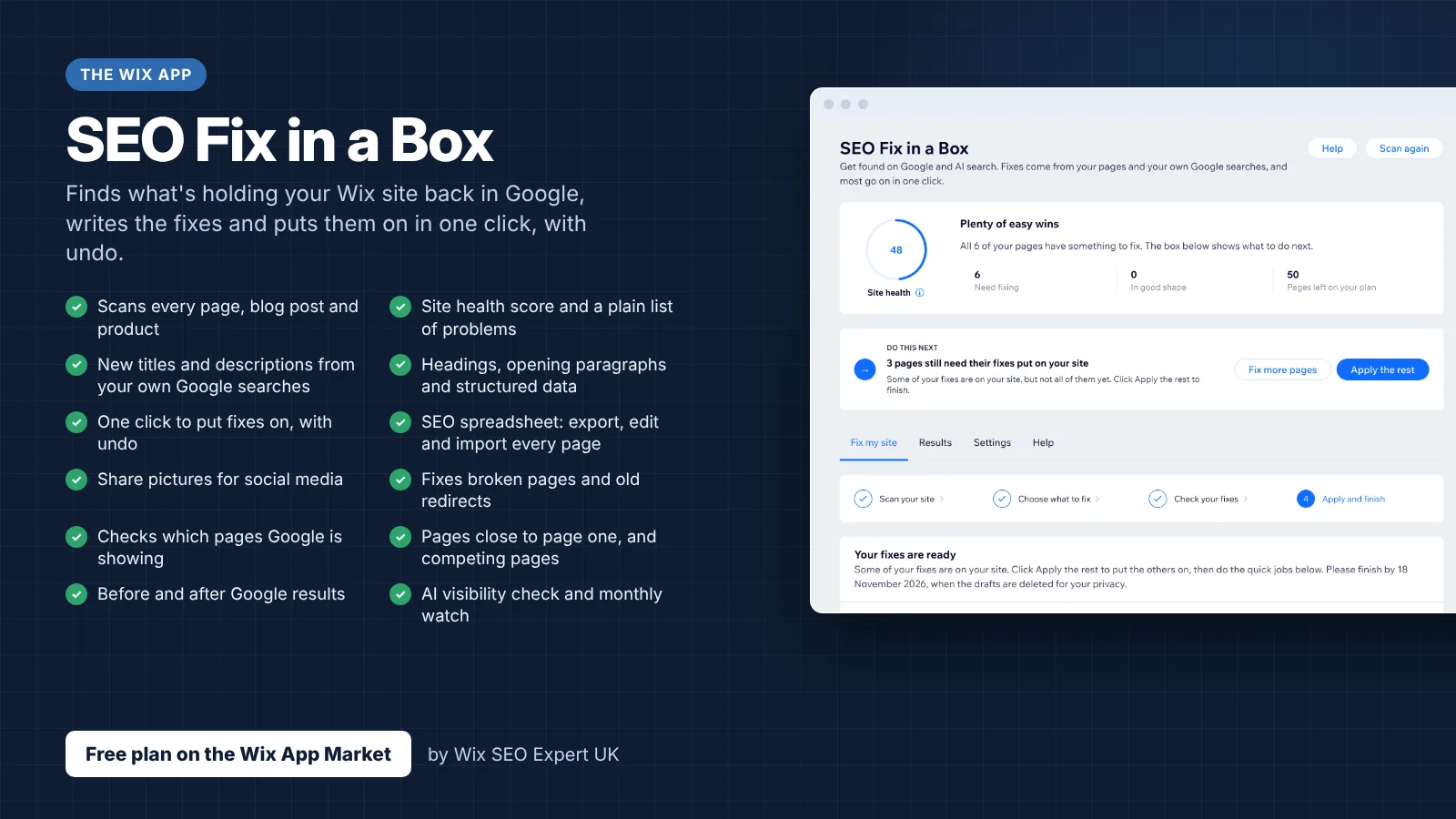
- SEO Fix in a Box: My Wix app. Free to install, it scans your site and shows what needs fixing, and paid plans write the fixes from your own Google searches
Was this lesson useful?
It takes 1 minute to tell me. The course is free and I want to keep it that way, and your feedback shows me what is working and helps other people find it.
This lesson on Core SEO concepts glossary: the foundation terms every Wix site owner must know is part of Module 55: Wix SEO Glossary: Complete A-Z Reference Library in The Most Comprehensive Complete Wix SEO Course in the World (2026 Edition). Created by Michael Andrews, a Wix Marketplace Legend Partner with 14 years of hands-on experience, 800 completed Wix SEO projects and 456 verified five-star reviews.