Content and strategy glossary: Wix SEO content marketing terminology
Module 55: Wix SEO Glossary: Complete A-Z Reference Library | Lesson 598 of 683 | 40 min read
By Michael Andrews, Wix SEO Expert UK
Content is the foundation of SEO. Without strong content, no amount of technical optimisation or link building will produce sustainable rankings. This lesson covers the key content strategy and content marketing terminology that defines how effective Wix SEO content is planned, created, and measured. Each term includes a clear definition, Wix-specific application steps, common mistakes, and related terms.
Content Strategy
The planning, creation, distribution, and governance of content to achieve specific business and SEO goals. An effective content strategy for your Wix site begins with keyword research to identify target queries, followed by content gap analysis, a publication calendar, content format decisions, and a measurement framework. Strategy ensures every piece of content you create serves a specific purpose in your SEO funnel rather than being published at random.
Usage Context
Without a strategy, content creation on Wix becomes reactive, publishing when inspiration strikes rather than when there is a clear audience need and keyword opportunity. A documented content strategy aligned with your Wix site's SEO goals ensures every hour spent creating content contributes to measurable ranking improvements.
How to Apply on Wix
Building a content strategy for your Wix site
- Define your target audience and their primary questions, needs, and search behaviours.
- Conduct keyword research identifying 50-100 target keywords across all intent stages.
- Create a keyword map assigning specific keywords to specific existing or planned Wix pages.
- Identify content gaps: valuable keywords where you have no content yet.
- Prioritise content creation by combining search volume, competition, and business relevance.
- Build a quarterly content calendar in a spreadsheet: topic, target keyword, page type, publication date, target author.
- Review and update your strategy quarterly. Add new keywords, retire underperforming topics, refocus based on ranking data.
Common Mistakes
- Creating content without keyword research. Publishing on topics with no search demand
- No documented strategy. Content decisions made ad hoc without alignment to SEO goals
- Strategy without measurement. Content that is never audited for performance cannot be improved
Related Terms
- Keyword Mapping
- Topical Authority
- Pillar Page
- Content Gap
- Content Audit
Topical Authority
The degree to which a website is recognised by search engines as a comprehensive, authoritative source on a specific subject area. Topical authority is built by thoroughly covering a topic from many angles: foundational guides, specific how-to content, FAQs, comparisons, case studies, and glossary entries. For your Wix site, becoming the definitive resource on your specific niche is more achievable and more rewarding than competing broadly.
Usage Context
Topical authority explains why a newer Wix site with 50 deeply comprehensive posts can sometimes outrank an older site with 500 shallow posts. Depth of coverage on a specific topic matters more than breadth of coverage across many unrelated topics.
How to Apply on Wix
Building topical authority on your Wix site
- Choose 2-3 core topic areas that align with your business and expertise.
- Create a comprehensive pillar page for each core topic (1,500-3,000 words covering the topic broadly).
- Build out cluster content: individual posts covering specific subtopics in depth.
- Link all cluster posts back to the pillar page and link the pillar page to relevant cluster posts.
- Cover the topic from multiple formats: guides, case studies, FAQs, tool comparisons, how-tos.
- Publish consistently within your chosen topic areas rather than jumping to unrelated topics.
- Audit your topic coverage quarterly and identify gaps, such as subtopics or questions you haven't covered yet.
Common Mistakes
- Trying to cover too many topics as a new Wix site. Focus beats breadth in early stages
- Creating pillar pages without supporting cluster content. Pillars alone do not build topical authority
- Not interlinking pillar and cluster content. Internal linking is essential to signal topical relationships
Related Terms
- Pillar Page
- Content Cluster
- Internal Link
- E-E-A-T
- Content Strategy
Pillar Page and Topic Cluster
A pillar page is a comprehensive resource covering a broad topic in depth, serving as the hub of a topic cluster. Cluster content pages cover specific subtopics in detail and link back to the pillar page. This interconnected architecture signals deep topical authority to search engines. On Wix, implement topic clusters by creating a comprehensive guide page for each major service or topic area, then creating supporting blog posts that link back to it.
Usage Context
The pillar and cluster model replaced the older silo architecture approach. The key difference is that all cluster pages link back to the pillar page (and the pillar links out to clusters), creating a web of interconnected topical content rather than a strict hierarchy.
How to Apply on Wix
Creating pillar and cluster pages in Wix
- Identify your main service or topic and create a comprehensive Wix page targeting the broad keyword (e.g., /wix-seo-guide).
- Write 2,000-4,000 words covering every major aspect of the topic at an overview level.
- Create supporting blog posts each targeting a specific subtopic: /wix-title-tag-optimisation, /wix-image-seo, /wix-internal-linking.
- From each cluster post, add a contextual link back to the pillar page using descriptive anchor text.
- From the pillar page, link out to each cluster post in the relevant section.
- Over time, expand the cluster with more specific content. Each new cluster post strengthens the pillar's authority.
- Use the Wix Blog categories to organise cluster posts under the relevant pillar topic.
Common Mistakes
- Pillar pages that are actually thin. True pillar content should be the most comprehensive resource on that topic
- Cluster posts that do not link back to the pillar page
- Creating clusters that are too broad. Each cluster post should target a very specific subtopic
Related Terms
- Topical Authority
- Internal Link
- Content Strategy
- Keyword Mapping
- Content Gap
Content Gap and Content Audit
A content gap is a topic, keyword, or question that your competitors rank for but your Wix site lacks content to address. A content audit is a systematic evaluation of all content on your Wix site to assess quality, performance, relevance, and alignment with current SEO goals. Together, gap analysis and auditing define your content backlog: what to create next and what to improve first.
Usage Context
Content gap analysis is opportunity-focused: finding where competitors have visibility that you do not. Content auditing is quality-focused: identifying your existing content that underperforms and needs improvement. Both inform your content strategy and ensure you are spending content creation time on the highest-impact work.
How to Apply on Wix
Conducting content gap analysis and content audit for Wix
- Content Gap Analysis: Enter your domain and 2-3 competitor domains into Ahrefs or SEMrush's Content Gap tool.
- Review the list of keywords competitors rank for that your Wix site does not. These are content creation priorities.
- Filter the gap list by search volume and relevance. Focus on gaps with meaningful volume and commercial relevance.
- Content Audit: Export all indexed Wix pages from Google Search Console's Pages report.
- For each page, check organic sessions (GA4), keyword rankings (GSC), and backlinks (Ahrefs/SEMrush).
- Categorise pages: Keep and optimise (high traffic, high potential), Update and refresh (outdated but still ranking), Consolidate (thin, low-traffic duplicates), Remove and redirect (zero value, never indexed).
- Execute the audit action plan systematically, starting with the highest-traffic pages.
Common Mistakes
- Deleting thin content pages without first redirecting them. Broken links and lost equity result
- Consolidating pages without redirecting the merged page to the surviving one
- Conducting content audits without a clear action plan for each page category
Related Terms
- Content Strategy
- Topical Authority
- Thin Content
- Redirect (301)
- Keyword Mapping
Search Intent and Evergreen Content
Search intent is the underlying purpose behind a user's query (informational, navigational, commercial, transactional). Evergreen content remains relevant and valuable over an extended period without significant updates, unlike time-sensitive news or trend content. Matching evergreen content to the right search intent produces the best long-term SEO ROI on your Wix site: content that ranks for a sustained period without requiring constant rework.
Usage Context
Evergreen informational content (comprehensive guides, glossaries, how-tos) builds long-term organic traffic that compounds over time. Time-sensitive content (news, event announcements, seasonal posts) drives spikes that fade. A healthy Wix content strategy includes primarily evergreen content supplemented by timely content for current relevance signals.
How to Apply on Wix
Creating evergreen SEO content for Wix
- Identify informational and commercial investigation queries in your niche with stable year-round search volume.
- Create comprehensive Wix blog posts or guide pages that address these queries thoroughly.
- Avoid date-specific references that age poorly. Instead of "in 2026," write "currently" or update it each year.
- Schedule an annual review of your evergreen posts to update statistics, examples, and any outdated information.
- Build internal links to evergreen posts consistently as new content is published. They should accumulate links over time.
- Track evergreen post performance in GSC and GA4. Stable or growing traffic signals the content remains relevant.
Common Mistakes
- Publishing only time-sensitive content that loses value quickly
- Never updating evergreen content. Outdated information eventually causes rankings to decline
- Writing evergreen content that does not match the dominant search intent for its target keyword
Related Terms
- Search Intent
- Content Strategy
- Topical Authority
- Content Audit
- Keyword Mapping
E-E-A-T in Content
Demonstrating Experience, Expertise, Authoritativeness, and Trustworthiness through your Wix site's content. In practice, this means attributing content to named expert authors with bios, citing credible sources, including original data and first-hand experience, presenting credentials prominently, keeping content accurate and up-to-date, and building an overall site reputation for reliable information in your niche.
Related Terms
- E-E-A-T
- Thin Content
- Content Strategy
- Schema Markup
- Topical Authority
Thin Content and Keyword Cannibalization
Thin content provides little or no value to users: very low word count, lack of depth, or content generated without genuine expertise. Keyword cannibalization occurs when multiple pages on the same Wix site compete for the same keyword, causing Google to be uncertain about which page to rank. Both issues reduce your Wix site's ability to rank and can be identified through content audits and keyword mapping reviews.
How to Apply on Wix
Diagnosing and fixing thin content and keyword cannibalization on Wix
- Thin Content: Use Screaming Frog to crawl your Wix site and filter pages by word count under 300 words.
- For each thin page, assess its organic value in GSC. Thin pages with no traffic or rankings can be combined with a stronger page or redirected.
- Keyword Cannibalization: Export all your Wix pages and their target keywords from your keyword map.
- Search GSC Performance and filter by your target keyword to see which pages appear for the same query.
- If multiple pages compete for the same keyword, choose the strongest as the canonical target and either redirect or update the weaker pages to target different keywords.
- Add canonical tags where you cannot redirect, pointing to the preferred page.
- Update internal links to consistently point to the preferred page for each keyword.
Common Mistakes
- Creating multiple very similar service pages for slight keyword variations (e.g., "Wix SEO expert" and "Wix SEO specialist") without differentiated content
- Not maintaining a keyword map, making it impossible to spot cannibalization until it is already harming rankings
- Assuming thin content that once ranked will continue to rank as Google's quality standards improve
Related Terms
- Keyword Mapping
- Content Audit
- Canonical Tag
- Redirect (301)
- E-E-A-T
Essential Tools for This Lesson
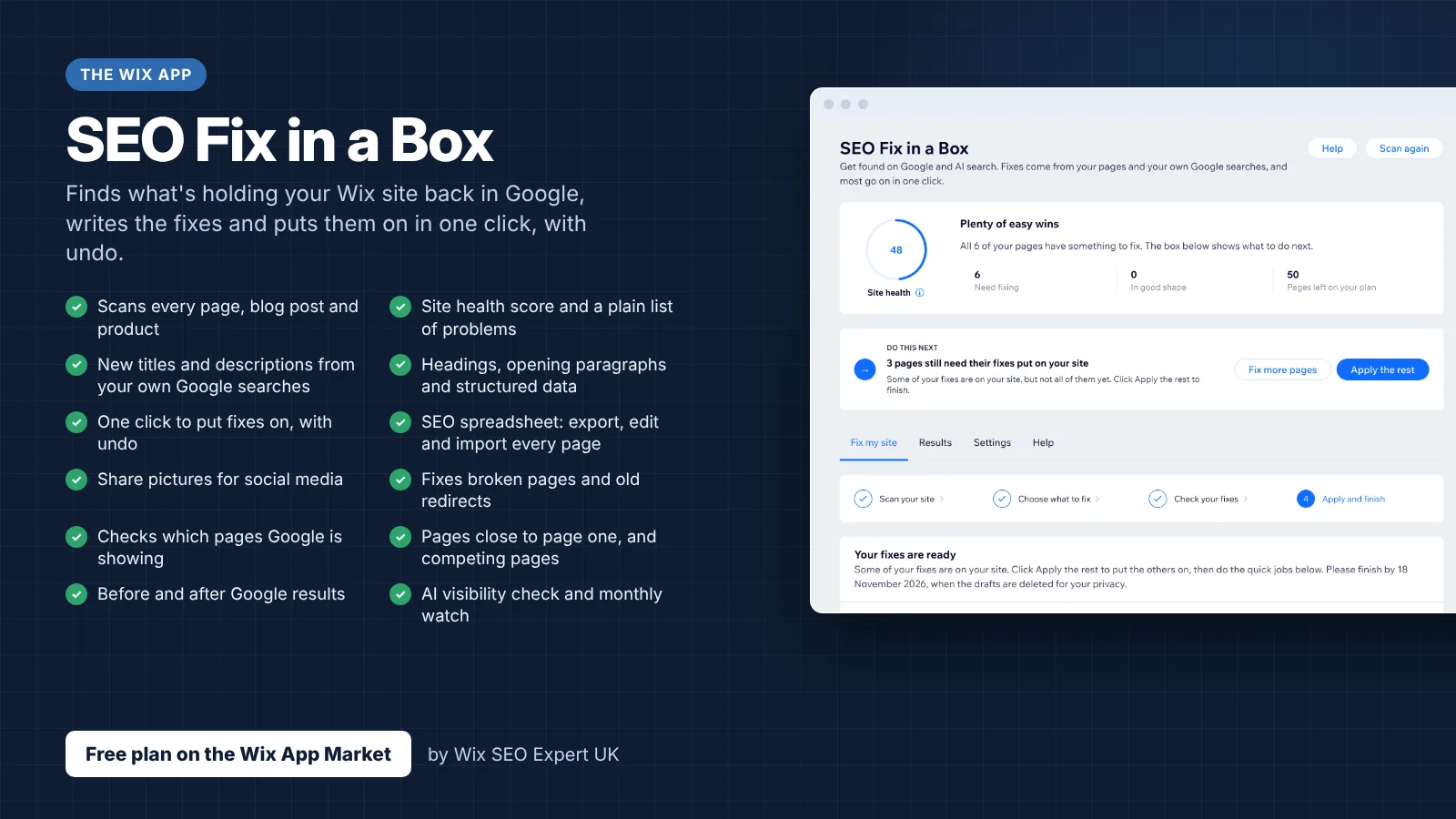
- SEO Fix in a Box: My Wix app. Free to install, it scans your site and shows what needs fixing, and paid plans write the fixes from your own Google searches
Was this lesson useful?
It takes 1 minute to tell me. The course is free and I want to keep it that way, and your feedback shows me what is working and helps other people find it.
This lesson on Content and strategy glossary: Wix SEO content marketing terminology is part of Module 55: Wix SEO Glossary: Complete A-Z Reference Library in The Most Comprehensive Complete Wix SEO Course in the World (2026 Edition). Created by Michael Andrews, a Wix Marketplace Legend Partner with 14 years of hands-on experience, 800 completed Wix SEO projects and 456 verified five-star reviews.