Social media foundations for Wix SEO: why every platform matters
Module 30: Social Media Setup for Wix SEO | Lesson 351 of 683 | 55 min read
By Michael Andrews, Wix SEO Expert UK
Social media profiles are not just marketing channels. They are powerful SEO assets that influence how search engines perceive your brand authority, drive referral traffic to your Wix site, and create the entity signals that Google uses to validate your business. This lesson establishes the strategic foundation for setting up every major platform correctly from the start and gives you the data-backed evidence for why each platform matters.
Why Social Media Profiles Are Critical SEO Infrastructure
Google's Knowledge Graph relies on consistent entity signals across the web to understand who you are, what you do, and whether you are trustworthy. Each verified social media profile acts as a corroborating data point that strengthens your brand entity. When Google sees your business name, address, phone number, website URL and description consistently represented across Facebook, Instagram, LinkedIn, YouTube, TikTok, X, Pinterest and Google Business Profile, it increases confidence in your entity and improves your chances of earning Knowledge Panels, rich results and higher organic rankings.
Platform-by-Platform SEO Impact: The Data
Not all social platforms deliver the same SEO value. The following data breaks down what each platform contributes to your search visibility, referral traffic potential, and entity authority in 2026. Use this as your strategic guide for prioritising setup and ongoing investment.
Infographic: Social Media Platform Comparison for SEO (2026 Data)
The 5 SEO Mechanisms: How Social Profiles Drive Rankings
Understanding exactly how social media impacts SEO allows you to optimise each platform strategically rather than posting blindly. There are five distinct mechanisms through which social profiles influence your search rankings.
Mechanism 1: Brand Entity Signals
Google builds entity profiles from data points scattered across the web. Each social media profile that displays your consistent business name, description, category and website URL adds a data point to your entity profile. When Google has 8+ corroborating sources confirming your business identity, it dramatically increases confidence in your entity. This confidence translates into Knowledge Panels, sitelinks, and higher organic rankings for branded and related searches.
Mechanism 2: Referral Traffic and Engagement Signals
When visitors arrive at your Wix site from social media, they generate engagement signals that Google observes: pages per session, time on site, bounce rate and conversion actions. High-quality referral traffic that engages deeply with your content signals to Google that your site provides value. This is particularly powerful because social referral visitors often explore multiple pages, boosting your overall engagement metrics.
Mechanism 3: Content Distribution and Link Acquisition
Social media amplifies your content to audiences who may link to it from their own websites, blogs and resources. A piece of content that gets widely shared on LinkedIn or X has a higher probability of earning editorial backlinks from industry publications, bloggers and journalists who discover it through social channels. This indirect link-building effect is one of the most undervalued SEO benefits of social media.
Mechanism 4: Social Proof and E-E-A-T Authority
Google evaluates Experience, Expertise, Authoritativeness and Trustworthiness (E-E-A-T) as core quality signals. Active social media profiles with engaged followers, consistent posting, industry-relevant content, and customer interactions demonstrate all four pillars of E-E-A-T. A business with 500 Google Reviews, 2,000 Facebook followers, 50 YouTube tutorials and regular LinkedIn articles presents dramatically stronger E-E-A-T signals than one with no social presence.
Mechanism 5: Citation Consistency for Local SEO
For local businesses, social media profiles function as citations: online mentions of your business name, address and phone number. Consistent NAP data across Google Business Profile, Facebook, Instagram, LinkedIn, Yelp and other platforms is one of the top 5 local SEO ranking factors. Each social profile with matching NAP data strengthens your local search positioning.
Complete How-To: Preparing Your Brand for Multi-Platform Social Media Setup
Before creating a single social media profile, you must prepare a comprehensive brand package that ensures consistency across every platform. Rushing into account creation without this preparation is the number one reason businesses end up with inconsistent profiles that dilute their SEO value. Follow every step below in order.
Complete brand preparation process (do this before touching any social platform)
- Define your exact business name as it should appear everywhere. Check your Companies House registration, Google Business Profile and Wix site. Remove any variations. Write it down in a document titled "Brand Master Record". Example: "Frontline Web Ltd" not "FrontlineWeb" or "Frontline Web Limited" or "frontline web".
- Gather your brand colour hex codes. Open your Wix site editor, go to Site Design, and note your exact primary colour, secondary colour and accent colour hex values. Add these to your Brand Master Record. You will need these for consistent graphics across all platforms.
- Prepare your logo files in four formats: (1) Square 1080x1080px PNG with transparent background (profile photos), (2) Horizontal logo 2560x1440px PNG (YouTube banner, LinkedIn cover), (3) Square 320x320px PNG (smaller profile displays), (4) Original SVG if available. Add all files to a dedicated "Brand Assets" folder.
- Create cover/banner images for each platform using Canva or Photoshop. Required sizes: Facebook 820x312px, X/Twitter 1500x500px, LinkedIn 1128x191px, YouTube 2560x1440px (safe area 1546x423px), Pinterest 800x450px. Maintain consistent branding, colours and messaging across all banners.
- Write your master bio document with four versions: (1) Long bio: 300 words covering who you are, what you do, who you serve, your credentials and your location, (2) Medium bio: 160 characters for X and Pinterest, (3) Short bio: 150 characters for Instagram, (4) Ultra-short: 80 characters for TikTok. Each version must include your primary keyword and location.
- Confirm your primary website URL including the protocol: https://www.yourdomain.com. Test that this URL resolves correctly without redirect chains. This exact URL will be used on every platform.
- Prepare your NAP (Name, Address, Phone) exactly as it appears on your Wix site footer, contact page and Google Business Profile. Write the complete address including postcode and country. Write the phone number in international format (+44 for UK). Add to your Brand Master Record.
- Create a dedicated brand email address for social accounts: social@yourbusiness.com or marketing@yourbusiness.com. Using a personal Gmail for business social accounts looks unprofessional and creates security risks.
- Research your competitors' social profiles. Visit the social profiles of your top 5 competitors and note: which platforms they use, their follower counts, posting frequency, content types that get the most engagement, and any gaps you can exploit.
- Set up a password manager (Bitwarden, 1Password or LastPass) and create a shared vault for social media credentials. Every social account will have unique, strong passwords stored securely.
- Choose your social media scheduling tool. For most small businesses, Buffer (free tier: 3 channels, 10 scheduled posts) or Meta Business Suite (free: Facebook and Instagram scheduling) is sufficient. For larger operations, consider Hootsuite or Sprout Social.
- Create a content calendar template with posting schedules for each platform. A starting cadence I suggest: Facebook 3x/week, Instagram 4x/week (including Stories), X 5x/week, LinkedIn 2x/week, TikTok 3x/week, Pinterest 5 Pins/week, YouTube 1 video/week. Adjust it to what you can keep up.
- Define your 3-5 content pillars: the core topics you will consistently discuss across all platforms. These should align with your Wix site's service pages and blog categories. Example for an SEO agency: (1) SEO tips, (2) Client results/case studies, (3) Industry news, (4) Behind-the-scenes, (5) Educational tutorials.
- Create a hashtag strategy document. Research and list: 10 broad industry hashtags (500K+ posts), 15 medium hashtags (10K-500K posts), 10 niche/local hashtags (under 10K posts), and 3-5 branded hashtags unique to your business.
- Set up Google Alerts for your business name, personal name (if sole trader/personal brand), and key product/service terms. This helps you monitor when your brand is mentioned online and respond quickly.
- Prepare 10-15 pieces of content in advance before creating any profiles. This ensures you can immediately start posting once profiles are live. An empty social profile is worse than no profile. Prepare: 5 educational posts, 3 behind-the-scenes posts, 2 testimonial/review highlights, 2 service showcase posts, and 3 industry insight posts.
Infographic: The Social Media SEO Setup Timeline
Setting up all platforms properly takes structured effort. Here is the recommended sequence and what to tackle at each stage.
How to Connect Your Social Media Profiles to Your Wix Site
Once your social media profiles are set up, connecting them to your Wix site through structured data and native integrations strengthens your brand entity signals in Google.
How to link social platforms to your Wix site for SEO entity building
- Step 1: Log in to your Wix Dashboard and navigate to Marketing & SEO > SEO Tools > SEO Setup Checklist. Complete all steps related to business information to establish the foundation for your social entity signals.
- Step 2: Navigate to your Wix site homepage in the Wix Editor. Open the page SEO settings (three dots > SEO) and scroll to the Advanced SEO section. Locate the Structured Data (JSON-LD) field.
- Step 3: Add or update your Organization or LocalBusiness schema to include a sameAs array. List the full profile URLs for every social media platform where your business has an active profile.
- Step 4: In the Wix Editor, go to your site footer. Add social media icon links for each platform you have set up. These clickable icons should link to your exact profile URLs. Ensure each link opens in a new tab.
- Step 5: Navigate to Settings > Business Info in your Wix Dashboard. Fill in your social media profile URLs in the dedicated social fields. This information is used by Wix to populate schema markup automatically.
- Step 6: Log in to each social media platform and verify your bio link points to your Wix website homepage URL. For platforms that allow multiple links (like Linktree alternatives), include links to your key service or product pages.
- Step 7: Create UTM tracking parameters for all bio links. Use the format utm_source=platform&utm_medium=social&utm_campaign=profile-bio. Update each social profile bio link with the platform-specific UTM URL.
- Step 8: In Google Analytics 4, navigate to Reports > Acquisition > Traffic Acquisition. Filter by medium = social to see which platforms are driving traffic to your Wix site. Verify UTM-tagged visits are appearing correctly.
- Step 9: Check NAP consistency across all connected platforms. Your business name, address, and phone number must be identical on your Wix site, Google Business Profile, and every social media profile. Even minor differences (Street vs St) reduce entity confidence.
- Step 10: In your Wix Dashboard, navigate to Marketing & SEO > Social Share and set your default Open Graph image, title format, and description. This controls how your Wix pages appear when shared on social media.
- Step 11: Test your Wix site social sharing on each platform using their debugging tools. Use the Facebook Sharing Debugger, LinkedIn Post Inspector, and Twitter Card Validator to verify previews are correct.
- Step 12: Set a monthly reminder to check all social profile bio links are working. Platform updates can break links or change URL formats. A broken bio link loses referral traffic and weakens your entity signals.
Module Roadmap: What You Will Build
Over the next 11 lessons, you will set up, optimise and connect every major social media platform to your Wix website. By the end of this module, you will have a fully integrated social media ecosystem that strengthens your SEO, drives qualified referral traffic, and presents a consistent, professional brand presence across every platform your customers use.
Tools You Will Need
- Canva: Create professional social media graphics, banners and brand assets for free
- Linktree: Create a single link hub for platforms with one-link-in-bio limitations
- Google Business Profile Manager: Set up and manage your Google Business Profile
- Meta Business Suite: Manage Facebook and Instagram business accounts from one dashboard
- Buffer: Schedule and publish content across multiple social platforms
- Google Alerts: Monitor mentions of your brand name across the web
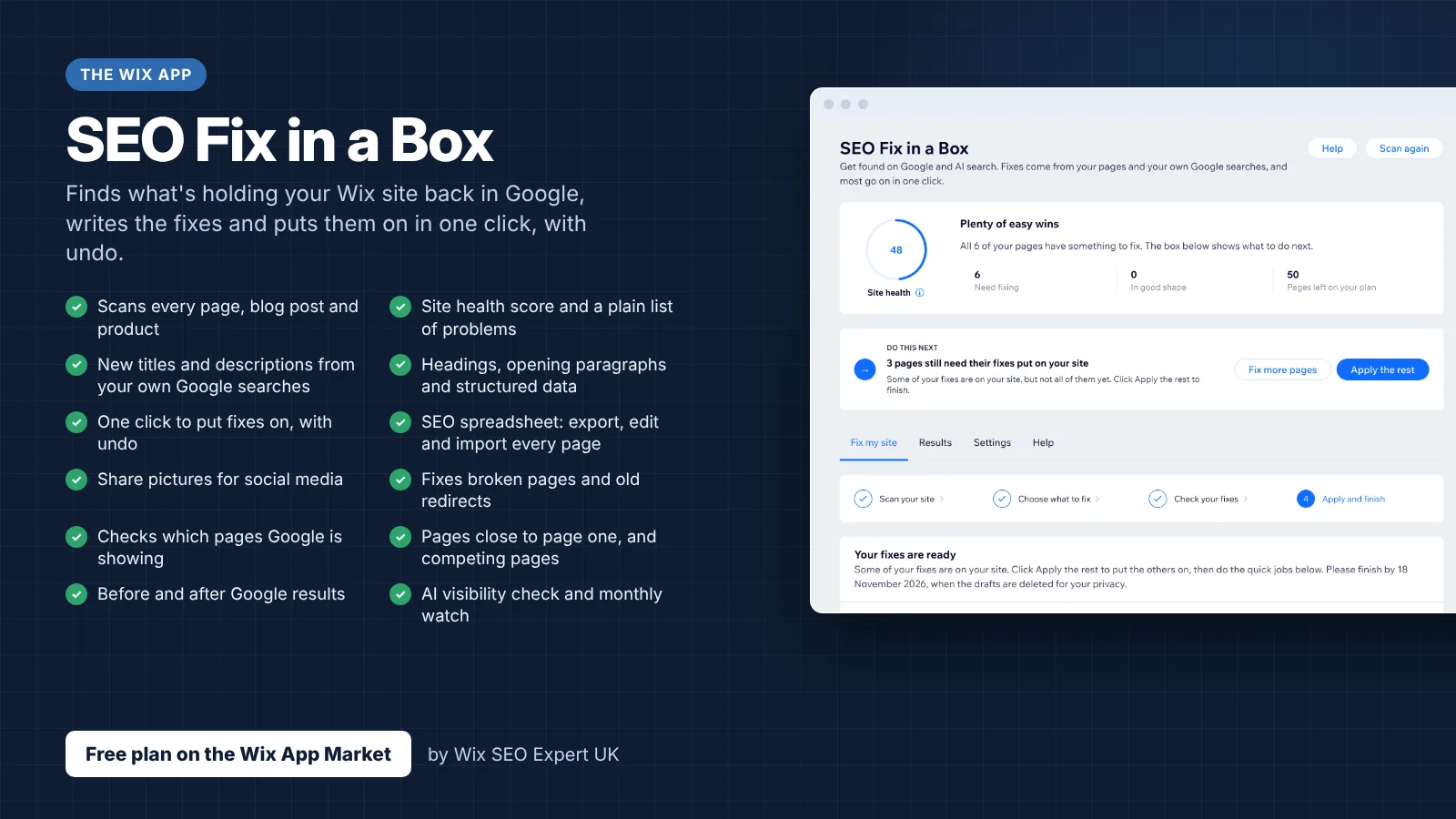
- SEO Fix in a Box: My Wix app. Free to install, it scans your site and shows what needs fixing, and paid plans write the fixes from your own Google searches
Was this lesson useful?
It takes 1 minute to tell me. The course is free and I want to keep it that way, and your feedback shows me what is working and helps other people find it.
This lesson on Social media foundations for Wix SEO: why every platform matters is part of Module 30: Social Media Setup for Wix SEO in The Most Comprehensive Complete Wix SEO Course in the World (2026 Edition). Created by Michael Andrews, a Wix Marketplace Legend Partner with 14 years of hands-on experience, 800 completed Wix SEO projects and 456 verified five-star reviews.