SaaS SEO fundamentals for digital service businesses on Wix
Module 38: SEO for SaaS & Digital Services on Wix | Lesson 433 of 683 | 48 min read
By Michael Andrews, Wix SEO Expert UK
SaaS and digital service businesses face unique SEO challenges that traditional eCommerce or local business strategies do not address. Your product is intangible, your buyer journey is longer, and your competition often includes venture-backed companies with dedicated SEO teams. This lesson lays the strategic foundation for ranking a SaaS or digital services website built on Wix, covering the keyword landscape, buyer intent mapping and the content architecture that drives both organic traffic and product signups.
Why SaaS SEO Differs from Traditional SEO
SaaS SEO is distinct because the product is delivered digitally, which means there are no physical location signals, no product shipping pages, and no tangible items for Google Shopping. Instead, SaaS SEO revolves around educating potential users, demonstrating value through content, and capturing demand at every stage of a longer consideration cycle. A typical SaaS buyer visits a website 6-8 times before converting, so your organic presence must cover informational, navigational, and transactional intent comprehensively.

On Wix, you have the advantage of a platform that handles technical SEO fundamentals automatically: server-side rendering, automatic sitemaps, SSL certificates and mobile responsiveness. This frees you to focus on the strategic and content layers that matter most for SaaS visibility.
The SaaS Keyword Landscape
SaaS keywords fall into distinct categories that map to different stages of the buyer journey. Understanding these categories is essential for building a content strategy that captures traffic at every stage and guides prospects toward conversion.
- Problem-aware keywords: "how to manage team tasks remotely" or "why is my email deliverability low" - searchers know they have a problem but have not identified a solution category yet
- Solution-aware keywords: "project management software" or "email marketing platform" - searchers know the solution category and are exploring options
- Product-aware keywords: "Asana vs Monday" or "Mailchimp alternatives" - searchers are comparing specific products and evaluating features
- Brand keywords: your product name, product name + pricing, product name + reviews - searchers already know about your product and want specific information
- Feature keywords: "gantt chart tool" or "email automation builder" - searchers are looking for a specific capability your product offers
- Integration keywords: "CRM that integrates with Slack" or "accounting software for Shopify" - searchers need compatibility with tools they already use
- Use-case keywords: "best software for freelancer invoicing" or "team collaboration tool for agencies" - searchers describe their specific scenario
Mapping Keywords to the SaaS Funnel
Building your SaaS keyword map on Wix
- Start with your core product category keyword (e.g. "project management software") and list every variation including long-tail phrases
- Identify 10-15 problems your product solves and research the exact phrases people use to describe those problems in Google, Reddit and Quora
- List every direct competitor by name and create a spreadsheet of "[competitor] alternative", "[competitor] vs [your product]", "[competitor] pricing" and "[competitor] review" keywords
- Map each feature of your product to its own keyword cluster, for example "time tracking", "resource allocation", "team calendar"
- Categorise every keyword by intent: informational (blog posts), navigational (product pages), commercial investigation (comparison pages), or transactional (pricing, signup)
- Assign each keyword cluster to a specific page type on your Wix site: landing page, blog post, comparison page, feature page, or documentation page
- Prioritise keywords by a combination of search volume, conversion potential and competitive difficulty, focusing first on commercial intent keywords where you can realistically rank
SaaS Content Architecture on Wix
Your Wix site architecture for SaaS should follow a hub-and-spoke model where your homepage and main product pages act as hubs, supported by spokes of blog content, comparison pages, feature pages and use-case pages. Each spoke targets a specific keyword cluster and links back to the relevant hub page, passing authority and guiding visitors toward conversion.
- Homepage: targets your primary brand and category keyword, establishes what you do and for whom
- Product/features page: targets solution-aware keywords with detailed feature descriptions
- Pricing page: targets "[product] pricing" and comparison-related pricing queries
- Comparison pages: target "[competitor] vs [your product]" and "[competitor] alternative" queries
- Use-case pages: target scenario-specific queries like "project management for marketing teams"
- Integration pages: target integration-specific queries like "[your product] + Slack integration"
- Blog: targets problem-aware and informational queries that attract top-of-funnel traffic
- Knowledge base: targets feature-specific how-to queries and reduces support burden
- Free tools: target high-volume informational queries and generate leads through gated results
Technical SEO Priorities for SaaS on Wix
- Core Web Vitals: SaaS landing pages must load fast because bounce rates directly impact trial signups. Optimise images, minimise third-party scripts and use Wix native features wherever possible
- Crawlability: ensure all important pages are linked from your main navigation or footer, and that your Wix sitemap includes every page you want indexed
- Schema markup: implement Organization, SoftwareApplication, FAQPage and BreadcrumbList schemas to enhance search result appearance
- Canonical tags: if you have similar pages targeting different use cases, set proper canonical URLs to avoid duplicate content issues
- Hreflang tags: if you serve multiple countries, implement hreflang through Wix multilingual features to avoid competing with your own pages
- Internal linking: every blog post should link to at least one product page, and every product page should link to relevant blog posts and comparison pages
How to Set Up Your Wix SaaS Site for Maximum SEO Visibility
Follow these steps to configure your Wix site architecture, keyword mapping and technical SEO foundations so that search engines can discover, understand and rank your SaaS product for the right buyer intent keywords.
Building a search-optimised SaaS site structure on Wix
- Step 1: Navigate to Wix Dashboard > Marketing & SEO > SEO Tools. Run the SEO Setup Checklist and complete all outstanding items. Pay special attention to the homepage title tag, which should follow the format: [Product Name] | [Category Keyword] for [Audience].
- Step 2: Create your keyword map in a spreadsheet. List columns for: Keyword, Search Volume, Intent (Informational/Commercial/Transactional), Assigned Page Type and Target URL. Start with your core product category keyword and expand to comparisons, features and problem-based terms.
- Step 3: Create a dedicated page for each major product feature in Wix. Set each page URL to /features/[feature-name] and write a title tag that targets the feature keyword directly, for example "Email Automation Software | [Brand]".
- Step 4: Create a Pricing page at /pricing and a dedicated Comparison hub at /compare. These are the highest-converting page types in SaaS SEO. Configure their title tags and meta descriptions to target commercial intent keywords explicitly.
- Step 5: Navigate to Wix Dashboard > Blog and create your first content cluster. Write a pillar post targeting your main product category keyword at 2,000 or more words, then create five supporting posts targeting related long-tail informational queries.
- Step 6: Add SoftwareApplication or WebApplication schema to your homepage and main product pages. Navigate to Wix Editor > Settings > Advanced SEO > Structured Data Markup and paste your JSON-LD schema.
- Step 7: Connect Wix to Google Analytics 4 via Wix Dashboard > Marketing & SEO > Marketing Integrations. Configure conversion events for: free trial signups, demo requests and pricing page visits to track organic traffic quality.
- Step 8: Submit your sitemap to Google Search Console at search.google.com/search-console. Verify the sitemap includes all product pages, feature pages, comparison pages and blog posts.
- Step 9: Set up internal linking rules. Every blog post must link to at least one product or feature page. Every comparison page must link to the pricing page. Every feature page must link to the free trial signup.
- Step 10: After 30 days, review Google Search Console Performance to see which keywords are generating impressions. Identify the top 10 keywords with high impressions but below-average CTR and optimise those pages title tags and meta descriptions to improve click-through rates.
Measuring SaaS SEO Success
SaaS SEO metrics go beyond traffic. You need to track the full journey from organic impression to paid conversion. Set up Google Analytics 4 on your Wix site and create events for key actions: free trial signups, demo requests, pricing page visits and feature page engagement. Use UTM parameters on internal links from blog posts to product pages to understand which content drives the most qualified traffic.
- Organic traffic by page type: are your comparison pages or blog posts driving more qualified visitors?
- Keyword rankings by funnel stage: are you improving visibility for commercial intent keywords specifically?
- Organic traffic to signup rate: what percentage of organic visitors start a free trial or request a demo?
- Content-assisted conversions: which blog posts appear in the conversion path even if they are not the last touch?
- Page-level engagement: time on page and scroll depth for key landing pages as indicators of content quality
Essential Tools for This Lesson
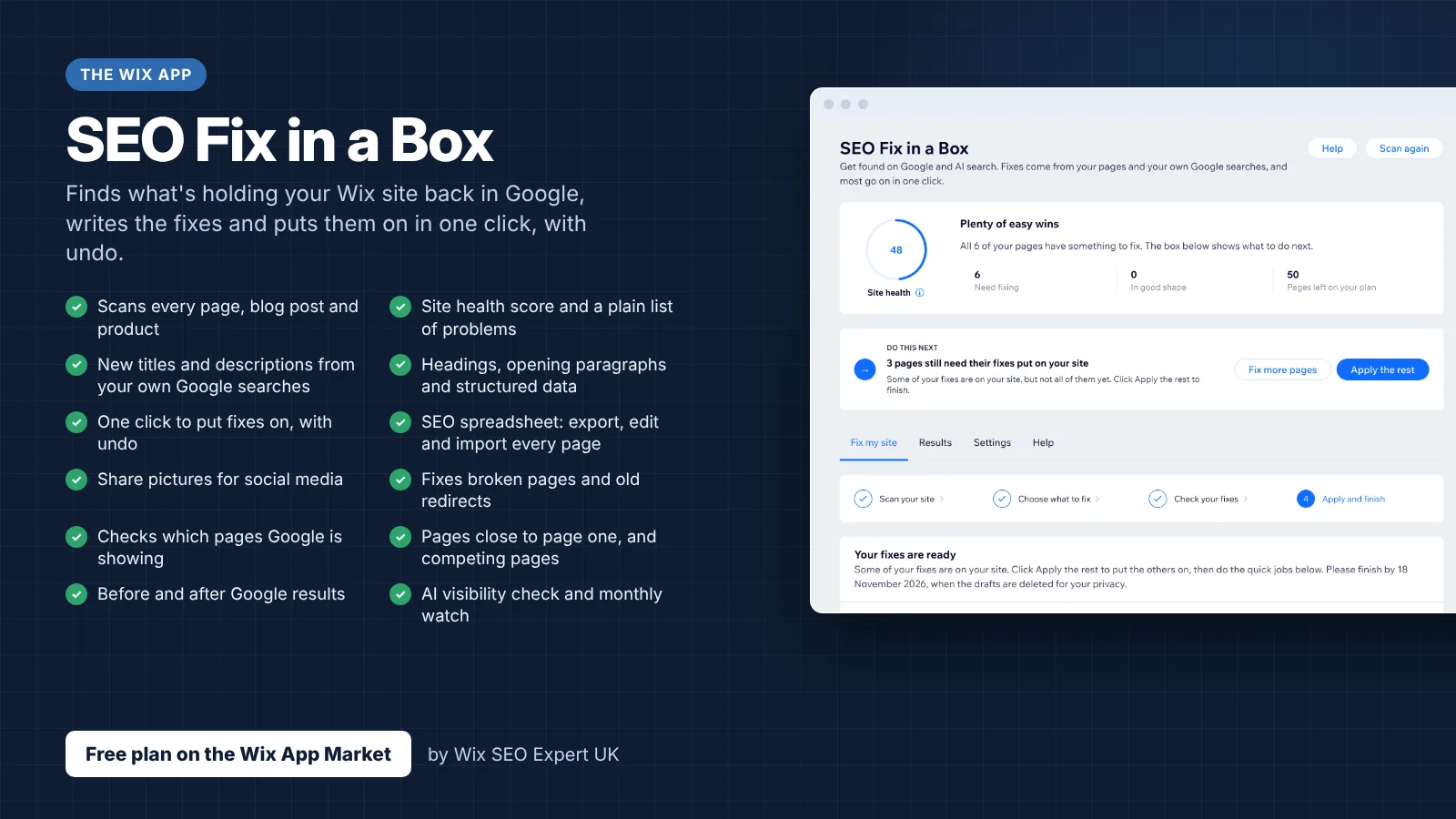
- SEO Fix in a Box: My Wix app. Free to install, it scans your site and shows what needs fixing, and paid plans write the fixes from your own Google searches
Was this lesson useful?
It takes 1 minute to tell me. The course is free and I want to keep it that way, and your feedback shows me what is working and helps other people find it.
This lesson on SaaS SEO fundamentals for digital service businesses on Wix is part of Module 38: SEO for SaaS & Digital Services on Wix in The Most Comprehensive Complete Wix SEO Course in the World (2026 Edition). Created by Michael Andrews, a Wix Marketplace Legend Partner with 14 years of hands-on experience, 800 completed Wix SEO projects and 456 verified five-star reviews.