The master reference: 150+ SEO terms quick-reference guide for Wix practitioners
Module 55: Wix SEO Glossary: Complete A-Z Reference Library | Lesson 601 of 683 | 45 min read
By Michael Andrews, Wix SEO Expert UK
This final lesson is your complete quick-reference master glossary: over 150 SEO terms in alphabetical order, each with a concise Wix-relevant definition. Bookmark this lesson and use it as your first port of call whenever you encounter an unfamiliar SEO term in research, client communications, agency reports, or tool interfaces. For any term you want to explore in depth, refer back to the dedicated glossary lessons earlier in this module where the most important concepts have full application guides, common mistakes, and related terms.
A-B Terms
- Above the Fold: The portion of a webpage visible without scrolling; prioritise key content and CTAs here for maximum engagement.
- Algorithm: Google's complex set of rules for ranking web pages; updated hundreds of times per year.
- Alt Text: Descriptive image attribute for accessibility and image SEO; add to every image in Wix image settings.
- Anchor Text: Visible hyperlink text; use descriptive, keyword-informed anchors in Wix internal links.
- Answer Engine: Search tool prioritising direct answers over links; optimise with FAQ schema and clear Q&A formatting.
- Authority: A site's ranking credibility built through quality backlinks and consistent E-E-A-T signals.
- Backlink: Inbound link from another domain; a primary ranking factor; build ethically through content and digital PR.
- Black Hat SEO: Prohibited tactics violating search engine guidelines; never use on your Wix site.
- Bounce Rate: Single-page session percentage; replaced by engagement rate in GA4.
- Brand SERP: Search results appearing for your brand name; manage actively with GBP, social profiles, and review sites.
- Breadcrumbs: Navigation showing page hierarchy; helps UX and search engine understanding of site structure.
- Broken Link: A link returning a 404 error; monitor and fix in GSC and with regular Wix site audits.
- Bot / Crawler: Automated program that browses the web to index content; Googlebot is Google's primary crawler.
C-D Terms
- Canonical Tag: HTML element specifying the preferred URL version; Wix sets these automatically but verify manually.
- Citation: NAP mention of your business on external sites; critical for Wix local SEO.
- Click-Through Rate (CTR): Clicks divided by impressions; improve by writing compelling title tags and meta descriptions.
- Cloaking: Showing different content to crawlers vs users; a serious black hat violation; never do this.
- Content Audit: Systematic evaluation of all site content quality and performance.
- Content Gap: Topics competitors rank for that you do not; identify with Ahrefs or SEMrush.
- Content Marketing: Creating content to attract and convert audiences; the engine of Wix SEO traffic growth.
- Conversion Rate: Percentage of visitors completing desired actions; optimise landing pages to maximise it.
- Core Web Vitals: LCP, INP, and CLS; Google's user experience ranking signals.
- Crawl Budget: The number of pages Google crawls per site in a given period; manage carefully on large Wix sites.
- Crawl Depth: Clicks from homepage to a page; keep important Wix pages within three clicks.
- Crawl Error: Issue preventing a crawler from accessing a page; monitor and resolve in Google Search Console.
- CSS: Styling language; render-blocking CSS harms Core Web Vitals; minimise and inline critical CSS.
- Dead Link: A hyperlink pointing to a non-existent page; fix immediately to preserve link equity.
- Deduplicate: Process of consolidating duplicate URLs; use canonical tags or 301 redirects.
- Deep Link: A link pointing to a specific internal page rather than the homepage.
- Disavow: Requesting Google ignore specific backlinks; use only for genuinely toxic link profiles.
- Domain Authority: Moz's 0-100 domain strength metric; useful for competitor comparison.
- Domain Rating: Ahrefs' 0-100 domain backlink strength metric.
- Doorway Page: Page created solely to rank for specific queries; explicitly prohibited by Google.
- Duplicate Content: Identical content across multiple URLs; resolve with canonicals or 301 redirects.
- Dwell Time: Time on page before returning to SERP; improve with comprehensive, well-formatted content.
E-G Terms
- E-E-A-T: Experience, Expertise, Authoritativeness, Trustworthiness; Google's content quality framework.
- Entity: A distinct real-world thing recognised by Google's Knowledge Graph.
- Evergreen Content: Content that remains relevant long-term; prioritise for sustainable Wix SEO traffic.
- Exact Match Domain (EMD): Domain matching a target keyword exactly; ranking advantage has diminished since 2012.
- External Link: Outbound link from your Wix site to another domain; link to authoritative sources.
- Featured Snippet: Position zero SERP result; win by giving a clear, direct answer under a question heading.
- Follow Link: A hyperlink that passes link equity; the default state of all links.
- Footer Link: Link in the website footer; use for navigation not keyword manipulation.
- Fresh Content: Recently published or updated content; Google rewards freshness for time-sensitive queries.
- GEO (Generative Engine Optimisation): Optimising for AI-generated search results and citations.
- Google Analytics 4 (GA4): Current Google analytics platform; install via Wix Marketing Integrations.
- Google Business Profile (GBP): Free business listing; most important Wix local SEO factor.
- Google Search Console (GSC): Free Google tool for monitoring Wix site search performance.
- Googlebot: Google's web crawler; respects robots.txt and meta robots directives.
- Grey Hat SEO: Ambiguous practices with moderate guideline risk; avoid for sustainable Wix SEO.
H-K Terms
- Heading Tags (H1-H6): HTML heading hierarchy; H1 is primary keyword signal; use logically in Wix editor.
- Heatmap: Visual analytics tool showing user interaction patterns; use Hotjar or Clarity on Wix.
- Hidden Text: Text visible to crawlers but not users; a black hat violation; never use.
- Hreflang: Attribute specifying language and regional targeting; Wix Multilingual handles automatically.
- HTTP Status Codes: Server response codes (200 OK, 301 redirect, 404 not found, 500 server error).
- HTTPS: Secure HTTP with SSL encryption; confirmed ranking signal; Wix provides automatically.
- Hyperlink: Clickable link connecting web pages; fundamental to SEO architecture.
- Image SEO: Optimising images for visibility; use descriptive file names and alt text in Wix.
- Impression: Counted each time your Wix URL appears in search results.
- Index: Google's database of crawled web pages eligible to appear in search results.
- Internal Link: Link between pages on the same Wix site; distribute link equity strategically.
- IP Address: Unique network device identifier; shared hosting IP reputation can affect sites.
- JavaScript SEO: Ensuring JS-rendered content is crawlable; Wix uses JS heavily; verify in GSC.
- JSON-LD: Google's recommended format for structured data markup; implement via Wix custom code.
- Keyword: Search term users enter into Google; the foundation of Wix SEO strategy.
- Keyword Cannibalization: Multiple pages competing for the same keyword; resolve via consolidation.
- Keyword Density: Keyword occurrence frequency; avoid stuffing; write naturally.
- Keyword Gap: Keywords competitors rank for that you do not.
- Keyword Mapping: Assigning target keywords to specific Wix pages.
- Keyword Research: Process of finding valuable target search terms for your Wix site.
- Keyword Stuffing: Excessive keyword repetition; penalised by Google; never use.
L-P Terms
- Landing Page: Page designed to convert specific traffic from a keyword or campaign.
- LCP (Largest Contentful Paint): Core Web Vital measuring loading speed; target under 2.5 seconds.
- Lighthouse: Google's open-source performance and SEO auditing tool.
- Link Building: Process of acquiring backlinks to improve authority and rankings.
- Link Equity (Link Juice): Authority that flows through hyperlinks.
- Link Farm: Network of sites created purely for backlinks; a penalisable black hat tactic.
- Link Reclamation: Recovering lost or broken backlinks; high ROI link building activity.
- LLM (Large Language Model): AI system powering tools like ChatGPT, Gemini, and Perplexity.
- Local Pack: Google SERP feature displaying three local business listings.
- Local SEO: Optimising for geographically targeted search results.
- Long-Tail Keyword: Specific multi-word phrase with lower volume but higher conversion intent.
- Manual Action: Google penalty applied by a human reviewer for guideline violations.
- Meta Description: HTML attribute summarising page content; shown in SERP snippets.
- Meta Robots: Tag directing crawler behaviour (index/noindex, follow/nofollow).
- Meta Tags: HTML elements in page head providing metadata to crawlers and browsers.
- Meta Title: HTML title tag; clickable headline in search results; primary keyword signal.
- Mobile-First Indexing: Google using mobile page version as primary ranking basis.
- Multi-Location SEO: Strategy for businesses serving multiple geographic locations.
- NAP (Name, Address, Phone): Business contact info requiring consistency across all citations.
- Natural Language Processing (NLP): AI technology enabling search engines to understand language context.
- Negative SEO: Deliberate attempts to harm competitor rankings; rare but monitor your backlink profile.
- Nofollow: Link attribute preventing link equity transfer; used for sponsored and UGC links.
- Noindex: Directive excluding a page from Google's index; set via Wix page SEO settings.
- Off-Page SEO: Activities outside your Wix site affecting rankings (links, citations, mentions).
- On-Page SEO: Optimising elements directly on your Wix pages.
- Organic Traffic: Visitors arriving via unpaid search results.
- Page Authority: Moz's per-page ranking strength metric.
- Page Experience: Google's UX ranking signals including Core Web Vitals and HTTPS.
- Page Speed: Page load time; a confirmed ranking factor; optimise through Wix technical settings.
- PageRank: Google's original link authority algorithm; still active internally.
- Paid Search: Pay-per-click advertising on search engines; Google Ads.
- Penalty: Ranking reduction for guideline violations; avoid through white hat Wix SEO.
- Pillar Page: Comprehensive content covering a broad topic; central to topic cluster strategy.
- Private Blog Network (PBN): Prohibited link network; never use for Wix link building.
- Programmatic SEO: Using databases and templates to create many pages at scale.
Q-Z Terms
- Quality Rater Guidelines: Google's manual for human evaluators; reflects algorithm principles.
- Query: The search term a user enters into Google.
- Ranking Factor: Signal used by Google's algorithm to determine ranking positions.
- Redirect: Server instruction forwarding one URL to another; use 301 for permanent moves in Wix.
- Referral Traffic: Visitors arriving via links on other websites.
- Rich Results: Enhanced SERP formats (star ratings, product details, breadcrumbs, video) powered by structured data.
- Rich Snippets: Visual enhancements to search results from Schema markup.
- Robots.txt: File directing search crawler behaviour; auto-generated by Wix.
- RSS Feed: Syndication format for content distribution; Wix Blog generates automatically.
- Schema Markup: Structured data code helping Google understand page content.
- Search Console: See Google Search Console.
- Search Intent: The underlying purpose behind a search query.
- SERP: Search Engine Results Page; the page Google displays for a query.
- Sitemap: XML file listing all crawlable URLs; Wix generates and submits automatically.
- Thin Content: Low-value content with little depth or originality; penalised by Helpful Content system.
- Title Tag: See Meta Title.
- Topical Authority: Being recognised as a comprehensive expert on a specific subject.
- URL: Web address of a page; keep short, descriptive, and keyword-relevant in Wix.
- URL Structure: Format and composition of page web addresses.
- Velo by Wix: Wix's JavaScript development platform for advanced SEO customisation.
- Voice Search: Spoken queries processed by Google; optimise with conversational content and FAQ schema.
- White Hat SEO: Legitimate, guideline-compliant optimisation; the only approach recommended in this course.
- Wix CMS: Database-driven content management for creating dynamic pages at scale.
- Wix Multilingual: Wix's built-in multilingual and hreflang management feature.
- Wix SEO Patterns: Dynamic meta tag templates for Wix blog, store, and CMS pages.
- Wix Studio: Advanced Wix design and development platform for professionals.
- XML Sitemap: See Sitemap.
- Zero-Click Search: SERP result where the query is answered without a click to any website.
How to Use This Glossary to Diagnose Real Wix SEO Problems
Follow these steps to apply the terminology in this glossary practically, using the terms as diagnostic anchors when investigating SEO issues on your Wix site or a client site.
Using the SEO glossary as a diagnostic framework for Wix issues
- Step 1: When organic traffic drops suddenly, start with Crawl Errors and Manual Actions. Open Google Search Console at search.google.com/search-console > Security and Manual Actions. Then go to Indexing > Pages and filter for "Not indexed" to check whether a Noindex tag has been accidentally applied to important pages.
- Step 2: When a page is not appearing in Google search despite being live, diagnose Crawl Budget, Robots.txt, and Canonical Tag. Test the URL in the GSC URL Inspection tool to see whether Googlebot has recently crawled it and what canonical is being reported.
- Step 3: When your page ranks but click-through rate is low, focus on Meta Title and Meta Description. Open GSC > Performance and filter by the specific page. Compare your current title and description against the top 3 SERP competitors for your target keyword and identify where yours is weaker.
- Step 4: When page speed is a concern, diagnose LCP, INP, and CLS using the Core Web Vitals definitions. Run the page through PageSpeed Insights at pagespeed.web.dev. The tool identifies the specific element causing each metric failure (e.g., "Largest Contentful Paint element: IMG" tells you it is your hero image).
- Step 5: When rich results are not appearing for a page that should qualify, diagnose Schema Markup and JSON-LD. Open the Google Rich Results Test and enter the page URL. Review the Detected Items section to see which schema types are found and which have errors preventing rich result eligibility.
- Step 6: When a local business is not appearing in the Local Pack, diagnose NAP consistency, Citation quality, and Google Business Profile completeness. Search the business name across Google, Bing Places, Yelp, and the top 5 industry directories. Note every instance where the name, address, or phone differs from the GBP.
- Step 7: When content is not ranking despite targeting the right keyword, diagnose E-E-A-T, Search Intent alignment, and Thin Content. Compare your page word count, heading structure, and expertise signals against the top 3 ranking pages for your target keyword. Identify specific gaps in depth, credentials, or intent match.
- Step 8: When a site has many pages but low organic traffic per page, diagnose Keyword Cannibalization, Crawl Depth, and Internal Link distribution. Use GSC Performance to identify multiple pages ranking for overlapping queries. Consolidate cannibalised pages and improve internal linking to boost priority page authority.
- Step 9: When a Wix site migration has caused ranking drops, diagnose 301 Redirects, URL Structure changes, and Crawl Errors. Use Screaming Frog to crawl all old URLs and confirm each one redirects to the correct new equivalent page with a single-hop 301. Check GSC Coverage for new 404 errors post-migration.
- Step 10: When a client asks "why is my competitor ranking higher than me?", frame your answer using Backlink Authority, Domain Rating, Topical Authority, and E-E-A-T. Use Ahrefs to compare referring domain counts and domain ratings. Identify content gaps using the Keyword Gap tool. This terminology-grounded analysis demonstrates expertise and provides a clear improvement roadmap.
How to Build Your SEO Vocabulary Into Daily Practice
Follow these steps to embed the glossary terminology into your daily workflow, accelerating how quickly you read industry content, communicate with clients and developers, and spot new SEO opportunities.
Integrating SEO terminology into your professional daily practice
- Step 1: Subscribe to three SEO industry publications: Google Search Central Blog (for official updates), Search Engine Journal, and Search Engine Land. Read the headline and first paragraph of each new article daily. After one month, you will recognise 95% of the technical terms without needing to reference the glossary.
- Step 2: When writing a client report or proposal, reference the relevant glossary terms explicitly: "Your site has several Crawl Errors caused by broken Redirect chains, which are consuming Crawl Budget on 301 loops rather than allowing Googlebot to index your product pages." This demonstrates specialist expertise immediately.
- Step 3: When briefing a web developer on Wix, use precise terminology: specify that you need a Canonical Tag set to a specific URL, a Noindex directive removed from a page, or a JSON-LD Schema block added to the page head. Vague instructions cause implementation errors. Precise terminology prevents them.
- Step 4: Join Twitter/X, LinkedIn, or Reddit SEO communities (r/SEO, r/bigseo) and follow 5 credible SEO professionals. Read their posts daily. When they use a term from this glossary, note how it is being used in context. Real-world usage cements understanding faster than definitions alone.
- Step 5: Create a personal "SEO term of the week" practice: each Monday, pick one term from this glossary that you have not fully mastered. Spend 15 minutes applying it: check whether your Wix site has it configured correctly, research one tool that measures it, and write one sentence explaining it to a non-technical client.
- Step 6: When auditing a Wix site, use the glossary terms to structure your audit report headers: Technical SEO (Crawlability, Indexing, Core Web Vitals), On-Page SEO (Meta Tags, Heading Tags, Internal Links), Off-Page SEO (Backlinks, Domain Authority, Citations), and Content Quality (E-E-A-T, Search Intent, Thin Content). This framework is universally understood by SEO professionals.
- Step 7: Practice explaining technical SEO concepts using plain language translations: "Crawl budget means Google limits how many of your pages it visits each day, so wasting visits on junk pages reduces how often it checks your important product pages." Being able to translate between technical terminology and plain English is a core professional skill.
- Step 8: When you encounter a new SEO tool, check its feature list against the glossary. Tools that address the most glossary terms in your current SEO workflow deliver the highest ROI. Tools that use proprietary terminology for standard concepts often provide the same data as free tools at a premium price.
- Step 9: After any significant Google algorithm update (check the Google Search Central Blog for announcements), revisit the relevant glossary terms affected by the update. For example, a Helpful Content update would prompt you to review the Thin Content, E-E-A-T, and Topical Authority definitions and check your site against the updated guidance.
- Step 10: Revisit this full glossary every six months. SEO terminology evolves: terms like GEO (Generative Engine Optimisation), INP (replacing FID), and AI Overviews entered common usage in the past two years. New terms will emerge in the next two. Staying current with terminology keeps your skills current with the industry.
Further Reading and Reference
- WixSEO.co.uk Blog: Expert Wix SEO articles expanding on every concept in this glossary.
- WixSEO.co.uk SEO Glossary Page: The full interactive SEO glossary with search and category filtering.
- Google Search Console: Apply your analytics knowledge by monitoring your Wix site performance daily.
- Google Quality Rater Guidelines: The authoritative source for understanding what Google values in content.
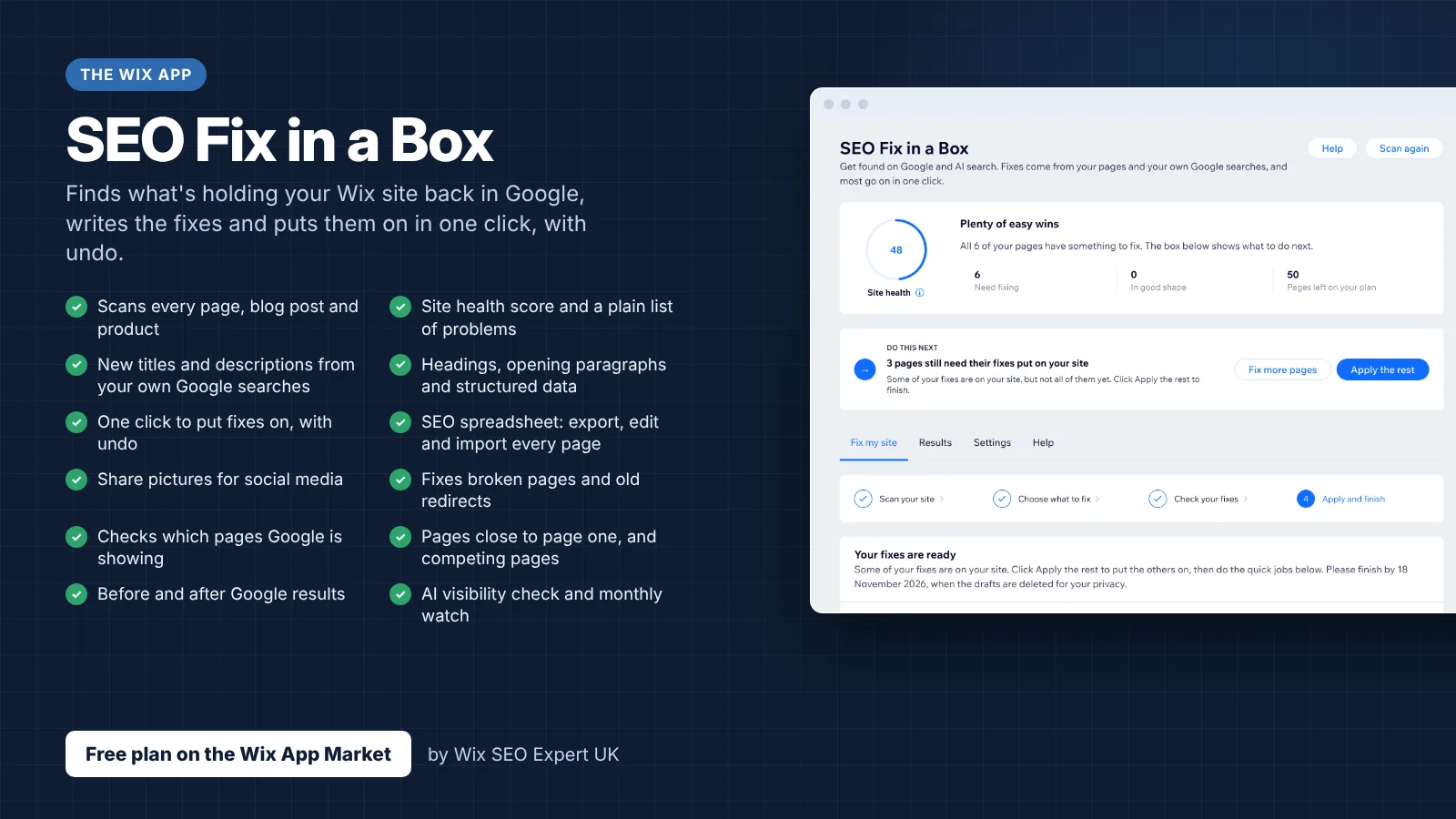
- SEO Fix in a Box: My Wix app. Free to install, it scans your site and shows what needs fixing, and paid plans write the fixes from your own Google searches
Was this lesson useful?
It takes 1 minute to tell me. The course is free and I want to keep it that way, and your feedback shows me what is working and helps other people find it.
This lesson on The master reference: 150+ SEO terms quick-reference guide for Wix practitioners is part of Module 55: Wix SEO Glossary: Complete A-Z Reference Library in The Most Comprehensive Complete Wix SEO Course in the World (2026 Edition). Created by Michael Andrews, a Wix Marketplace Legend Partner with 14 years of hands-on experience, 800 completed Wix SEO projects and 456 verified five-star reviews.