Enterprise SEO reporting and ROI measurement
Module 42: Enterprise SEO Strategy on Wix | Lesson 478 of 683 | 35 min read
By Michael Andrews, Wix SEO Expert UK
Enterprise SEO reporting serves a fundamentally different audience than small business reporting. You are presenting to C-suite executives, board members, marketing directors and cross-functional teams who need to understand SEO performance in business terms. This lesson covers how to build enterprise-grade SEO reporting that demonstrates ROI, justifies investment and drives strategic decisions.
Enterprise SEO KPIs That Matter
Enterprise SEO metrics must tie directly to business outcomes. While rankings and traffic are important operational metrics, your executive reports should lead with revenue impact, market share and competitive position. Build a metrics hierarchy that connects tactical SEO metrics to strategic business objectives.
- Organic revenue attribution: total revenue from organic search visitors tracked through GA4 e-commerce or goal values
- Organic market share: your share of clicks for your core keyword set compared to competitors, measured through rank tracking tools
- Cost per organic acquisition: total SEO investment divided by organic conversions, compared to paid channel CPAs
- Organic contribution to pipeline: for B2B, the percentage of qualified leads originating from organic search
- Content ROI: revenue generated per content piece compared to production cost
- Technical health score: composite score from crawl errors, page speed, indexing rate and Core Web Vitals
- Keyword visibility index: aggregate ranking score across your full target keyword set showing directional trend
Building Executive SEO Dashboards
How to build a Looker Studio executive dashboard
- Connect Google Analytics 4 as a data source and create a revenue by channel chart highlighting organic search.
- Connect Google Search Console and display total clicks, impressions and average position trending over time.
- Add a competitor comparison section using data from your rank tracking tool showing share of voice trends.
- Create a content performance section showing top pages by organic revenue with month-over-month changes.
- Add a technical health section with key metrics: pages indexed, crawl errors, Core Web Vitals scores.
- Include a forward-looking section with projected organic traffic and revenue based on current trends.
- Design the dashboard for a non-technical audience: use clear charts, minimal jargon and executive summary sections.
Calculating and Presenting SEO ROI
SEO ROI at enterprise level requires accounting for all costs: team salaries, tool subscriptions, content production, agency fees and opportunity cost. Compare total organic revenue minus total SEO investment to calculate true ROI. Present this alongside paid search ROI to demonstrate organic efficiency. Most enterprise SEO programmes deliver 5x to 15x ROI when measured correctly, far exceeding paid channels.
Reporting Cadence and Audience
- Weekly flash reports: one-page summary of key metrics for the SEO team and marketing director. Traffic, rankings, technical issues and content published.
- Monthly performance reports: detailed analysis for marketing leadership covering all KPIs, content performance, technical health and competitive landscape.
- Quarterly business reviews: executive-level presentation for C-suite focusing on revenue impact, ROI, market share and strategic recommendations.
- Annual strategic reviews: comprehensive assessment of the SEO programme including year-over-year comparisons, competitive analysis, investment case for next year and strategic roadmap.
Complete How-To Guide: Enterprise SEO Reporting Infrastructure
Build your enterprise reporting infrastructure
- Step 1: Define your KPI hierarchy. Map each business objective (revenue growth, lead generation, market share) to specific SEO metrics that demonstrate progress.
- Step 2: Set up GA4 with proper conversion tracking. Configure e-commerce tracking or goal values for every conversion action so organic revenue attribution is accurate.
- Step 3: Build your Looker Studio dashboard. Create separate pages for executive summary, traffic analysis, content performance, technical health and competitive landscape.
- Step 4: Set up automated data pipelines. Use Supermetrics or Google Sheets connectors to pull data from GSC, GA4, Ahrefs/Semrush and your CRM into a central data warehouse.
- Step 5: Create your ROI calculation model. Build a spreadsheet tracking all SEO costs monthly (team, tools, content, agency) and all organic revenue monthly. Calculate rolling 12-month ROI.
- Step 6: Establish your reporting cadence. Create templates for weekly, monthly and quarterly reports. Automate weekly reports to send via email every Monday morning.
- Step 7: Prepare your first quarterly business review presentation. Include executive summary, performance against targets, competitive landscape, key wins, challenges and strategic recommendations.
- Step 8: Implement attribution modelling. Configure GA4 data-driven attribution to understand organic search contribution across the full customer journey, not just last-click attribution.
Essential Tools for This Lesson
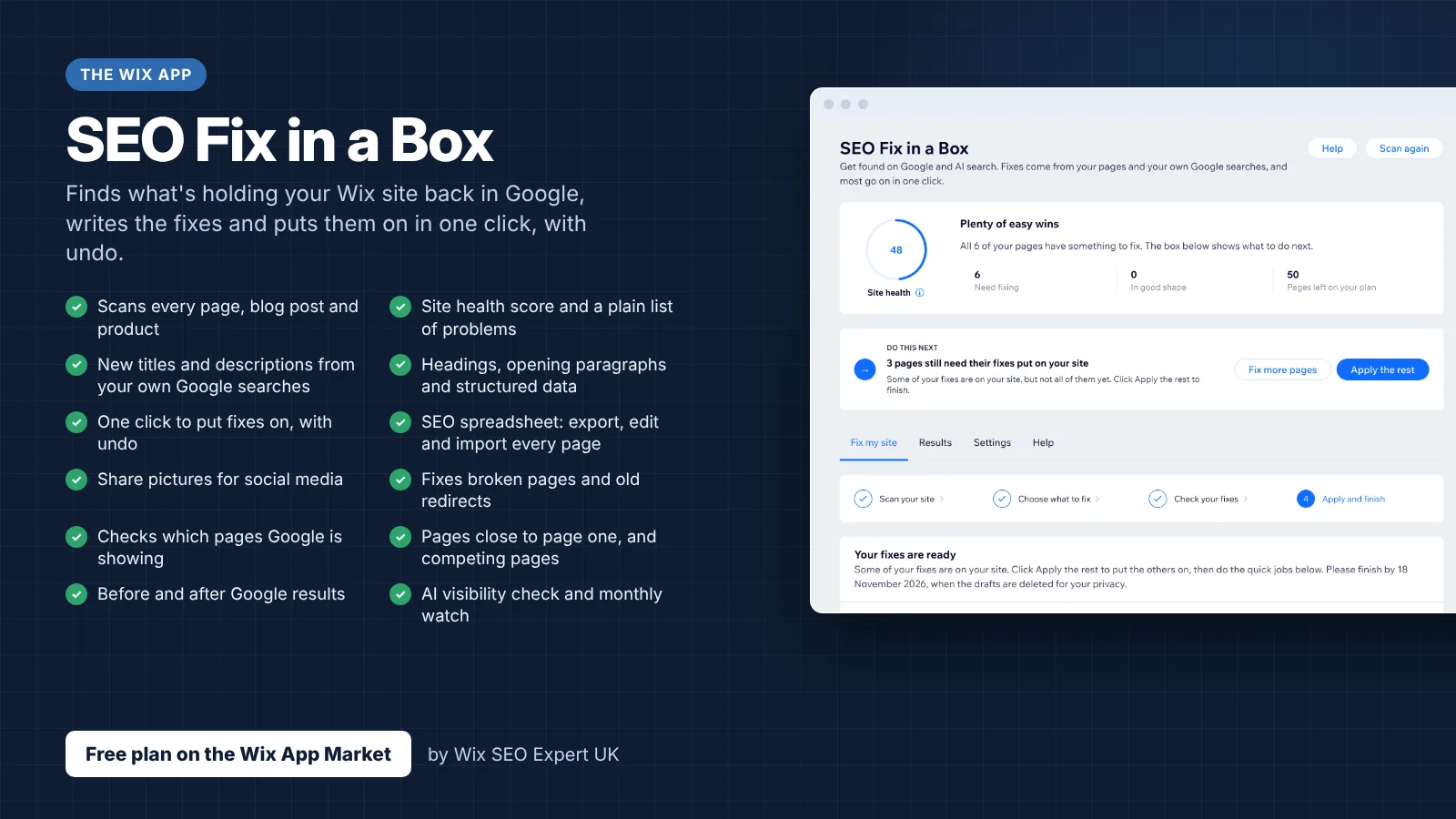
- SEO Fix in a Box: My Wix app. Free to install, it scans your site and shows what needs fixing, and paid plans write the fixes from your own Google searches
Was this lesson useful?
It takes 1 minute to tell me. The course is free and I want to keep it that way, and your feedback shows me what is working and helps other people find it.
This lesson on Enterprise SEO reporting and ROI measurement is part of Module 42: Enterprise SEO Strategy on Wix in The Most Comprehensive Complete Wix SEO Course in the World (2026 Edition). Created by Michael Andrews, a Wix Marketplace Legend Partner with 14 years of hands-on experience, 800 completed Wix SEO projects and 456 verified five-star reviews.