Crisis reputation management: rapid SEO response for Wix businesses
Module 32: Reputation Management & Online Review SEO on Wix | Lesson 381 of 683 | 48 min read
By Michael Andrews, Wix SEO Expert UK
A reputation crisis can strike any business: a viral negative review, an unfair news article, a social media pile-on, or a disgruntled former employee post. When negative content suddenly dominates your brand SERP, you need a rapid response strategy that works across both the content and technical SEO dimensions. The businesses that recover fastest are those with a crisis playbook prepared before any crisis occurs. This lesson covers the crisis management playbook: what to do in the first 24 hours, the first week, and the first month when your business faces a reputation emergency on Wix.
Types of Reputation Crises
- Viral negative review: a single customer complaint goes viral on social media or Reddit
- Negative press article: a news outlet publishes critical coverage of your business
- Competitor attack: a competitor creates negative content targeting your brand name
- Disgruntled employee/partner: someone with inside knowledge publishes damaging content
- Fake reviews campaign: multiple fake negative reviews appear simultaneously
- Legal action publicity: a lawsuit or regulatory action becomes public
The First 24 Hours: Rapid Response Protocol
Immediate actions when a reputation crisis hits
- Step 1: Assess the severity. Is the negative content on page 1 for your brand name? How many people have seen it? Is it gaining traction?
- Step 2: Screenshot and document everything. Save the negative content, any comments, shares, and metrics. This evidence may be needed later.
- Step 3: Do NOT respond publicly in anger or defensively. Draft a response but have someone else review it before posting.
- Step 4: If the content is factually inaccurate, contact the publisher privately with specific corrections and evidence.
- Step 5: If the content violates platform guidelines (fake review, harassment, defamation), report it immediately through the platform official channels.
- Step 6: Publish a statement on your Wix website if the crisis is significant enough. Be transparent, factual, and empathetic.
- Step 7: Increase monitoring: set up real-time Google Alerts and check social media every few hours.
- Step 8: Brief your team: ensure everyone knows not to engage publicly without approval.
The First Week: Active Content Suppression
Begin the content suppression strategy immediately. Publish positive content on high-authority platforms: a LinkedIn article addressing the issue transparently, a YouTube video, updated Google Business Profile posts, and new content on your Wix blog. Each piece of positive content is a potential SERP replacement for the negative content. Speed matters enormously in the first week: negative content ranks highest while it is newest and gaining engagement, and your counter-content needs to begin accumulating signals immediately. Publish 3-5 pieces of content within the first week across different platforms to maximise the number of owned assets competing for page 1 positions.
The First Month: Sustained Recovery
Continue publishing positive content on a weekly cadence. Request reviews from satisfied customers to build a fresh wave of positive testimonials across Google, Trustpilot, and industry platforms. Engage with industry publications for positive coverage stories. Monitor the brand SERP daily and track the position of the negative content across both desktop and mobile results, as these can differ. Most crises resolve within 30-60 days with consistent execution. Some crises with high-authority negative content (major news outlets, established review sites) may take 3-6 months of sustained effort.
Legal Options and SERP Removal Tactics
In severe cases, legal options may support or accelerate SERP recovery. Defamatory content can be targeted with DMCA takedown requests if it includes copyrighted material, or directly through platform legal removal processes. Google provides a legal removal request tool for content that violates specific laws (e.g., non-consensual intimate images, court-ordered removals). However, legal action often draws additional media attention to the crisis, so weigh this carefully. For fake reviews on Google, report through GBP with as much supporting evidence as possible: screenshots of the reviewer profile with no prior review history, evidence of no business relationship, and metadata if available.
Post-Crisis Brand SERP Hardening
After recovering from a crisis, use the experience to build a more resilient brand SERP. The crisis has revealed exactly which SERP positions were vulnerable. Now permanently claim those positions with high-quality owned or earned content. If a negative Trustpilot page ranked on page 1, build your own Trustpilot review count to make the overall rating more favourable. If a news article ranked, establish relationships with that publication for positive future coverage. If a Reddit thread ranked, participate genuinely in relevant Reddit communities to build positive visibility there. The goal is to have every page 1 result for your brand name be either owned by you or positive by association.
Complete How-To Guide: Crisis Reputation Management Playbook
Full crisis management process from detection to recovery
- Step 1 (Hour 1): Document the crisis. Screenshot all negative content. Note URLs, platforms, authors, and timestamps.
- Step 2 (Hour 2): Assess severity using these criteria: (a) Is it on page 1 for brand name? (b) Is it going viral? (c) Is the source high-authority? (d) Is the content factually accurate?
- Step 3 (Hour 3): If factually inaccurate: send a private, professional correction request to the author/publisher with evidence.
- Step 4 (Hour 4): If it violates platform guidelines: submit formal removal requests to each platform.
- Step 5 (Day 1): Draft and publish a transparent statement on your Wix site if the crisis is public-facing.
- Step 6 (Day 1-3): Publish positive content on 3 high-authority platforms: LinkedIn article, YouTube video, and industry blog guest post.
- Step 7 (Week 1): Launch a review generation push. Contact 20+ satisfied customers and ask for reviews on Google and Trustpilot.
- Step 8 (Week 2): Publish 2 more positive content pieces. Update your Wix About page and services pages with fresh content.
- Step 9 (Week 3-4): Continue content creation cadence. Monitor brand SERP daily. Track negative content position.
- Step 10 (Month 2): Evaluate progress. If negative content has moved to page 2, maintain the current strategy. If still on page 1, intensify content creation and link building to owned assets.
- Step 11 (Month 3): Conduct a full brand SERP audit. Calculate your new Brand SERP Score. Document the recovery for future reference.
- Step 12 (Ongoing): Implement the proactive reputation management strategies from this module to prevent future crises.
Essential Tools for This Lesson
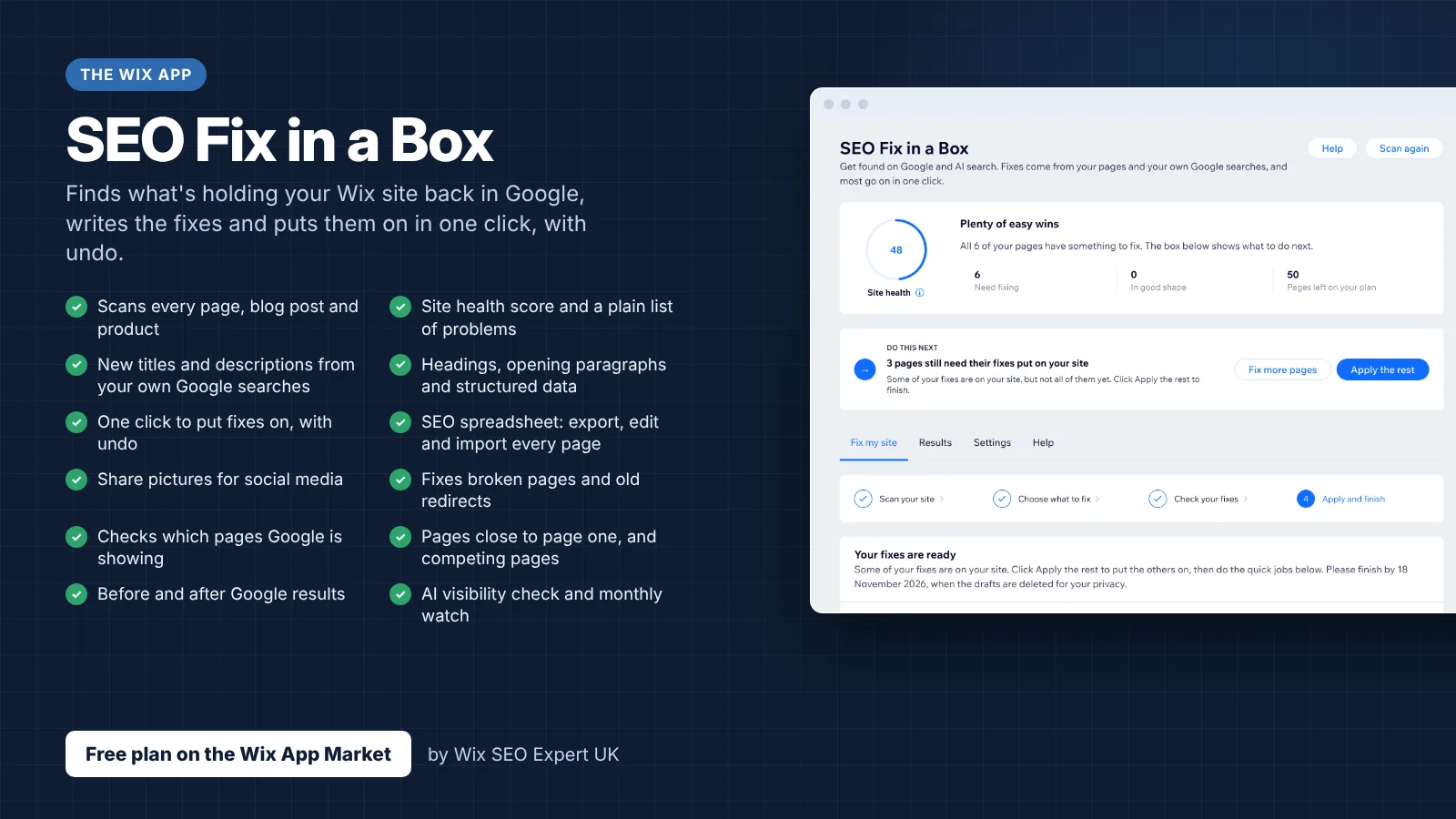
- SEO Fix in a Box: My Wix app. Free to install, it scans your site and shows what needs fixing, and paid plans write the fixes from your own Google searches
Was this lesson useful?
It takes 1 minute to tell me. The course is free and I want to keep it that way, and your feedback shows me what is working and helps other people find it.
This lesson on Crisis reputation management: rapid SEO response for Wix businesses is part of Module 32: Reputation Management & Online Review SEO on Wix in The Most Comprehensive Complete Wix SEO Course in the World (2026 Edition). Created by Michael Andrews, a Wix Marketplace Legend Partner with 14 years of hands-on experience, 800 completed Wix SEO projects and 456 verified five-star reviews.